A national standard describes two classes for first-aid kits—Class A and Class B—with each class containing the supplies needed to treat injuries typical for certain facilities.
Updates to the standard have increased the amounts of some supplies that the kits should contain and also introduced new supplies to the list.
The standard includes four type levels for kits, with the requirements for each type varying based on the work environment it was designed for.
Employers are asked to assess the level of risk in their workplace so they can have the right supplies on hand should an injury occur.
A good first-aid kit is more than a collection of adhesive bandages. In low-risk facilities, kits should have the equipment needed to deal with common workplace injuries, such as sprains, minor cuts and scrapes. But if more high-risk tasks are being completed in your facility, you may need a more comprehensive first-aid kit.
The American National Standards Institute (ANSI) and the International Safety Equipment Association (ISEA) publish the voluntary consensus standard ANSI/ISEA Z308.1. The standard, which has been updated periodically since 1978, provides a framework for selecting workplace first-aid kits based on the complexity and hazards of the work environment.
The standard distinguishes between Class A and Class B first-aid kits and establishes minimum quantities and sizes for the supplies in each class. It also classifies first-aid kit containers as Type I through Type IV based on their intended environment and durability.
What Is a Class A First-Aid Kit?
Class A kits are designed to have contents for the most common types of workplace injuries, such as cuts and abrasions, minor burns and eye injuries.
The minimum fill of products in Class A kits generally is appropriate as a starting point for workplaces where the hazards don’t indicate a need for the broader supplies and quantities in a Class B kit.
Class A First-Aid Kit Contents Checklist
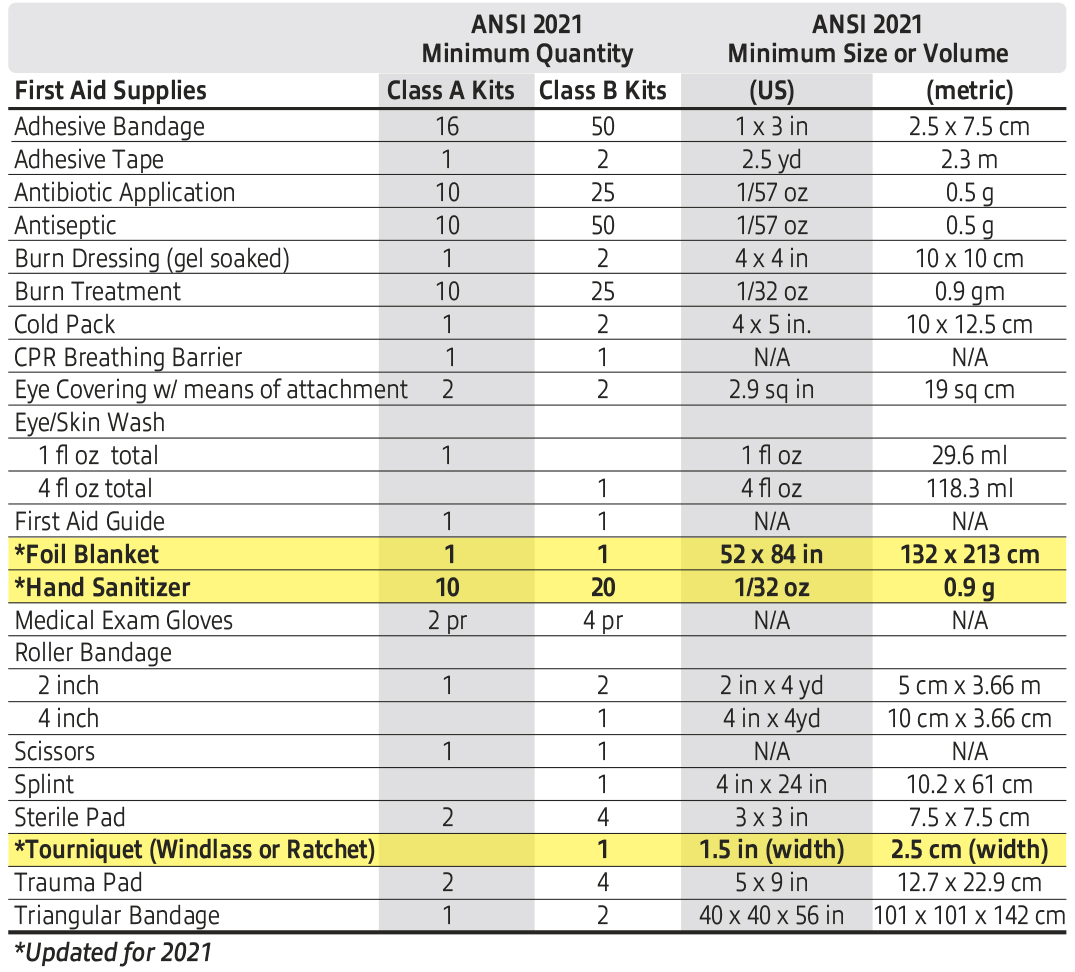
As of the 2021 standard update, Class A first-aid kits should include a minimum quantity of 74 items: adhesive bandages, adhesive tape, antibiotic applications, antiseptic, burn dressing (gel soaked), burn treatment, cold pack, CPR breathing barrier, eye covering, eye and skin wash, first-aid guide, foil blanket, hand sanitizer, medical exam gloves, roller bandage, scissors, sterile pads, trauma pads and triangular bandage.
In 2021, the foil blanket was added and hand sanitizer quantities were increased.
Class B kits are designed to have contents for more complex injuries or for use in high-risk environments. Class B kits contain the Class A supplies in larger quantities and additional supplies intended to address more serious injuries.
Class B First-Aid Kit Contents Checklist
As of the 2021 standard update, Class B first-aid kits should include a minimum quantity of 202 items: adhesive bandages, adhesive tape, antibiotic applications, antiseptic, burn dressings (gel soaked), burn treatment, cold packs, CPR breathing barrier, eye covering, eye and skin wash, first-aid guide, foil blanket, hand sanitizer, medical exam gloves, roller bandages, scissors, splint, sterile pads, tourniquet, trauma pads and triangular bandages.
Class B kits include a splint and a tourniquet that Class A kits do not. In 2021, the foil blanket was added and hand sanitizer quantities were increased.
Class A and Class B first-aid kit contents, courtesy of PRO-SAFE.
Class A vs. Class B First-Aid Kits: Key Differences
Class A and Class B kits are not simply small versus large. The key differences center around the types of injuries and hazards that the supplies are designed to address.
Class B kits contain all the supplies that Class A kits do, generally in greater quantities. Class B kits also include a 4-inch roller bandage, a splint and a tourniquet that are not part of the Class A minimum fill.
Which Workplaces Need Class A vs. Class B Kits?
There is no rule that says a particular industry must use a particular class of kit.
According to ISEA’s first-aid webpage, “employers should conduct a workplace hazard assessment to first decide if a Class A or Class B minimum fill best fits the type of hazards at the facility.”
How Many First-Aid Kits Does Your Workplace Need?
A workplace hazard assessment can also be used to determine whether additional kits and additional quantities or types of supplies are necessary.
According to PRO-SAFE: “Response time is imperative, and the number of first-aid cabinets should be based on how quickly an injury can be treated rather than the number of employees. OSHA generally advises that near proximity of a first-aid kit should result in an emergency being treated within 3-4 minutes.”
How to Conduct a Workplace Risk Assessment for First-Aid Kits
ANSI not only lays out the requirements for first-aid kit contents, but it also sets requirements for employers to assess the risks in their workplace. The 2021 standard update includes robust guidance for conducting a workplace hazard assessment.
“Risk assessments can be conducted in a variety of ways, from reviewing BLS (Bureau of Labor Statistics) and OSHA (Occupational Safety and Health Administration) injury data to employing a medical professional to evaluate a facility and make recommendations; the best approach is an informed approach and may involve a combination of inputs,” writes Erica Osley in OH&S. “This mandated assessment of possible injuries and appropriate first response protocols is key to tailoring first-aid kits based on each workplace’s unique risk factors.”
Type I, II, III and IV First-Aid Kit Containers
In addition to first-aid kit classes, the ANSI/ISEA standard designates different types of kit containers for different work environments. According to ANSI, uses break down as such:
Type I Kits
Type I kits are designed for indoor use and are generally not portable; they’re permanently mounted to a wall or other structure. They are for general indoor use, office use or use in a general manufacturing facility.
Type II Kits
Type II kits are designed for indoor use with minimal risk of damage to kit supplies. They come with handles and are portable. As with Type I kits, they’re for general indoor use, office use or manufacturing environments.
Type III Kits
Type III kits are portable and for use in either indoor or outdoor environments, but not where there is a high potential for damage due to environmental factors or rough handling. The kits can be mounted and have a water-resistant seal. They are for mobile, indoor and outdoor use.
Type IV Kits
Type IV kits, which must meet performance guidelines for corrosion, moisture and impact resistance, are suitable for outdoor use and places where they may be subject to rough handling. They are designed for use in the transportation, utility and construction industries.
ANSI/ISEA Z308.1 First-Aid Kit Requirements
ANSI/ISEA Z308.1-2021 is a voluntary consensus standard, not an OSHA regulation. It establishes minimum performance requirements for workplace first-aid kits and supplies, including the assortment and quantity of supplies in Class A and Class B kits. The standard also establishes requirements for first-aid kit containers.
The standard’s minimum fill should be viewed as a starting point. ANSI/ISEA recognizes that workplaces have different hazards and that employers may need to add supplies or increase quantities based on those hazards.
OSHA’s regulation for first aid, 29 CFR 1910.151(b), states: “In the absence of an infirmary, clinic or hospital in near proximity to the workplace which is used for the treatment of all injured employees, a person or persons shall be adequately trained to render first aid. Adequate first aid supplies shall be readily available.”
Writing for OH&S, Osley explains, “in the matter of kit specifications and minimum content requirements, OSHA refers to the American National Standards Institute (ANSI).”
Kit requirements can also vary by state. If you are in a state-plan state that may have different requirements from federal OSHA, you must adhere to those requirements.
To request a quote, please login to your existing account or register a new one. This helps us provide you with a personalized experience and keep track of your requests.