Walk onto many manufacturing floors and you’ll find the same scene: a bin of earplugs sitting beneath a sign by the door that reads “hearing protection required beyond this point,” and workers grabbing a pair on their way in without much thought. Nobody is checking whether the earplugs fit, or if they’re being worn at all. Nobody is asking if the earplugs are providing sufficient protection.
That casualness has a cost. According to the National Institute for Occupational Safety and Health (NIOSH), occupational hearing loss is one of the most common work-related illnesses in the U.S., and in manufacturing, 1 in 5 workers who are exposed to noise have hearing impairment that interferes with their daily life.
NIOSH also says that occupational hearing loss is almost always preventable. Yet across plant floors, a persistent gap separates issuing hearing protection from actually protecting hearing.
What Is Hearing Protection PPE?
Personal protective equipment (PPE) for hearing—primarily earmuffs, earplugs and electronic communication devices—is designed to reduce a worker’s exposure to hazardous noise when worn properly, though the right choice depends heavily on the environment and the individual.
It’s a distinction that trips up nearly every employer who’s running a hearing conservation program, says Liam Russell, regional business manager in 3M’s personal safety division. The failure point isn’t necessarily a lack of equipment, although more than a quarter of noise-exposed manufacturing workers report not wearing hearing protection, NIOSH says. Often, the failure is improper use: the wrong style for the job, not wearing the protector at all, insufficient or too much protection for the noise level, or a one-size-fits-all mentality.
“Wearing hearing protection is not the same as being protected,” Russell says.
What OSHA Says About Hearing PPE
The Occupational Safety and Health Administration’s (OSHA’s) noise exposure standard, 29 CFR 1910.95, sets an 8-hour time-weighted average sound level of 85 decibels—the “action level”—that triggers a required hearing conservation program to include noise monitoring, audiometric testing, worker training and hearing protectors made available at no cost. At 90 decibels of exposure, employers must implement engineering or administrative controls to bring noise down—and if those controls aren’t sufficient, PPE must be provided to reduce sound levels.
The standard goes further than monitoring exposure levels. It also requires employers to evaluate whether the specific protector they’ve selected provides enough attenuation (reduction) for that specific noise environment. It’s one thing to know that a work area reads 95 decibels and note it on a form; it’s another to ensure that the earplug issued at the door is being worn correctly 100 percent of the time within the exposure area and is bringing a worker’s exposure under the limit.
That second step is where programs tend to fall short, Russell says.
“Being compliant is checking all the boxes but not really going deeper,” he says. “If they’re just worrying about making sure the paperwork is complete, they’re probably not running an effective safety program.”
Read more: 7 Key Factors for Complying with OSHA's Hearing Conservation Standard
Types of Industrial Hearing Protection
Most industrial settings rely on some combination of three protection categories, each for different noise levels, exposure durations and work environments.
Over-Ear Hearing Protection (Earmuffs)
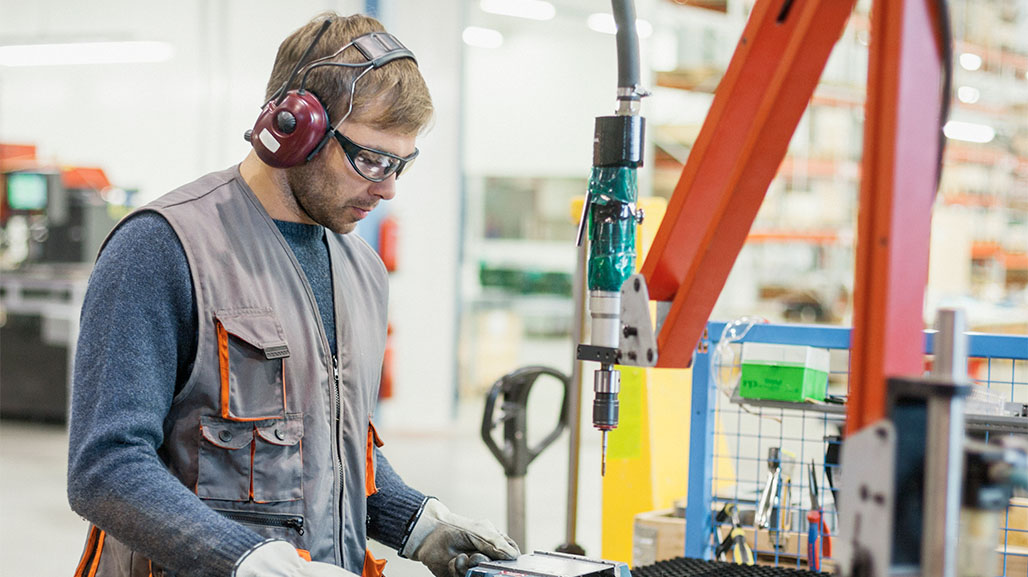
Earmuffs use a rigid cup and cushioned seal to block sound at the outer ear. Because they don’t require insertion, they offer consistent, easy-to-verify protection—a supervisor can confirm at a glance whether a worker has them on. They’re also reusable, hold up well and fit a wide range of workers. They are a particularly good fit for short-duration visitors, Russell says.
But there are trade-offs. In hot environments, earmuffs can be ineffective because “the wearer is looking for any opportunity to take them off,” he says. When worn for long stretches, some users report discomfort from pressure. Because earmuffs must seal around the entire ear, they may lose some noise reduction if they are worn together with other types of PPE or headgear.
Shop for earmuffs from MSC Direct
Earplugs
Earplugs insert directly into the ear canal and include disposable foam and premolded reusable designs, hybrid or “push-to-fit” styles, and custom options molded to an individual’s ear. They’re compact, generally compatible with other PPE and have comparable attenuation to earmuffs—but that performance depends entirely on correct insertion and wear time, which is where most real-world failures happen.
Banded or semi-insert styles—sometimes called canal caps—rest at the ear canal opening rather than sealing inside it and tend to offer lower noise reduction than fully inserted plugs.
Shop for earplugs from MSC Direct
Electronic and Communication Hearing Protectors
Electronic hearing protectors—available in both earmuff and earplug forms—integrate noise attenuation with communication or ambient-sound features designed so workers can hear speech or alarms in loud environments without removing protection.
The communication feature matters more than it might seem. “People are removing their hearing protection in order to communicate, and in many cases that dramatically increases the risk associated with the hazard,” Russell says.
Shop for hearing protection headsets and headphones from MSC Direct
How to Choose the Right Hearing Protection
Choosing the right hearing protection means starting by monitoring noise levels, then matching a device to them. Underprotection is the obvious risk, but overprotection also can be problematic: Workers cut off from ambient sound often solve that isolation by removing their hearing protection, which erases the protection. The goal isn’t maximum noise reduction; it’s enough reduction to bring exposure under the limit but still allow workers to hear job-critical sounds.
Understanding Noise Reduction Rating (NRR)
Every hearing protector sold in the U.S. must display a noise reduction rating (NRR) on its packaging to comply with 40 CFR Part 211, Subpart B—a single number, in decibels, estimating how much noise the device blocks. Protectors are tested under controlled lab conditions, however, so the number on the package tends to overstate performance in the field.
OSHA specifically uses the NRR as a starting point to determine whether a particular rating is adequate for the noise exposure before a hearing protector is offered to a worker.
The current recommendation by OSHA and NIOSH is to verify that the worker can achieve appropriate noise reduction by conducting a fit test on the hearing protector that is fitted by the worker. Fit testing can produce a personal attenuation rating, or PAR. This PAR can be subtracted from the A-weighted noise exposure—a filter used when measuring a worker’s noise exposure—to identify cases of underprotection or overprotection.
“Knowing the PAR allows for training and selecting devices that the employee will be able to fit and use correctly,” Russell says.
Read more: A Guide to Industrial Noise, Hearing Loss, NRR and Ear Protection
Matching Protection to Your Work Environment
Once the noise level is known through area monitoring or dosimetry (personal monitoring), matching protection to it comes down to the environment as much as the decibel reading—and heat, shift duration and compatibility with other PPE are factors. In especially loud environments, Russell notes, combining earplugs and earmuffs for layered protection is a standard escalation when a single device doesn’t provide enough attenuation on its own.
Industrial Hearing Protection Best Practices
Identifying the right device is only half the equation. How it’s worn, maintained and reinforced day to day determines whether it works.
Proper Fit and Wear
If there is one fix with outsized impact, it’s “full, proper insertion of the earplug,” Russell says.
The “pinna pull”—reaching up and back to straighten the ear canal before inserting—is taught in nearly every hearing conservation training session, he says, but “rarely is it actually executed on the floor.”
Another challenge to proper fit is conflict with other PPE. When eyewear temples run directly under earmuff cushions, for example, sound can leak in around the edges. This is largely solvable with the right product: Low-profile safety eyewear with thin, flat temples is designed to sit under earmuff cushions with less disruption, and some earmuff models use deeper, contoured cushions to accommodate eyewear without losing their seal. In this case, pairing compatible eyewear and earmuffs, rather than choosing each in isolation, helps prevent conflict more so than troubleshooting after the fact.
Inspection, Maintenance and Replacement
Hearing protectors work best if they fit, and they stay clean and intact. A torn cushion, grooved or compressed foam, or a plug handled with dirty gloves won’t attenuate the way its rating promises.
Disposable foam plugs are typically swapped daily—not because they wear out, but for hygiene. Reusable earplugs, by contrast, can be cleaned and worn repeatedly as long as they are inspected and the manufacturer’s recommendations are followed: “‘Dirty and damaged’ becomes user-defined criteria” for replacement, Russell explains. Earmuffs require more deliberate upkeep, as the cushions that seal against the skin lose flexibility and shape over time; in many models, the cushions can be replaced periodically.
Building a Hearing Conservation Program
A hearing conservation program built to last starts with the hierarchy of controls: Reduce noise at the source before relying on PPE. Also, audiometric testing, while required, should be more than a compliance checkbox.
“What is missing is we can’t assume that the products we’re giving them are actually performing the way they were designed, due to the way they are used by workers,” Russell says. “If you focus on noise abatement first and then you also focus on training and fit validation,” the rest of the program should become easier to sustain.
Successful programs take into account individual differences and preferences. “Give workers an ownership in the type of PPE that they wear,” Russell says. He acknowledges that this approach may cost money and time, but where worker safety is concerned, it’s worth the investment in the long run. As with many issues surrounding PPE compliance, the solution starts with leadership endorsement.
“A hearing conservation program—any safety program, really—is effective when it’s part of a culture,” Russell says. “And that culture needs to be driven from the top down.”
Read more: How to Develop an Effective Hearing Conservation Program