Workers in the metal stamping industry are exposed to sharp corners and jagged edges, which means their arms and hands need to be protected. They also come into contact with solvents and flying particles. All of these scenarios require workers to be protected with quality safety gear.
Let's face it, many times working professionals get thrown to the wolves when it comes to the work performed in business, whether that’s the safety professionals keeping others safe or the physical workers making things. That’s why, at MCR Safety, they believe in keeping you informed about how their products fit into various industries, such as metal stamping.
Workers in this industry are exposed to sharp corners and jagged edges, which means their arms and hands need to be protected. They also come into contact with solvents and flying particles. All of these scenarios require workers to be protected with quality safety gear.
This article will explore the world of metal stamping, focused primarily within the automotive industry, the hazards involved, and the personal protective equipment workers should consider wearing to stay protected.
What is Metal Stamping?
Metal stamping is the process by which metal is cut and formed into a desired shape or profile by a stamping die, whose cutting and forming parts are made of particular types of steel. Within the automotive industry, metal stamping is the fastest method available for producing the vast numbers of parts to create automotive vehicles.
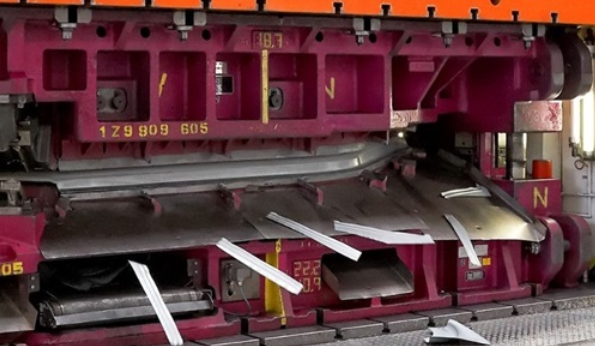
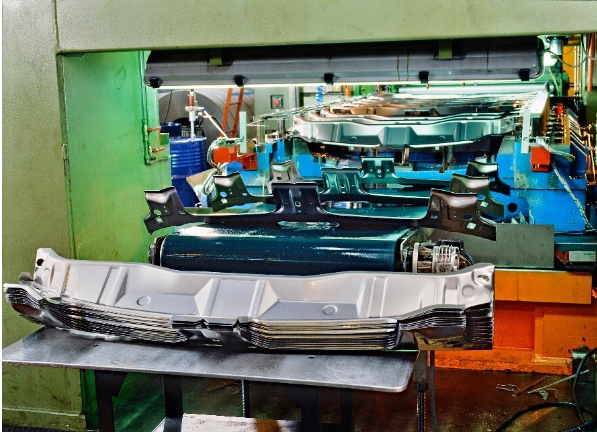
This image shows metal after stamping occurs. Sharp metal is everywhere, meaning cut protection is essential.
Stamping Processes
Stamping is a “cold-form” operation. Heat is not used during the process; however, friction generates heat as the metal is cut and formed, so metal often becomes very hot when it exits the die.
There are different stamping processes, depending on what final product is desired:
Blanking: Cutting shapes from large pieces of metal.
Coining: Letters, numbers, or images are imprinted on the metal’s surface. (This is how coins are made, thus the name.)
Drawing: Metal is forced against a die and is stretched into a three-dimensional object, usually a complex shape. It is the most common method for making auto body parts.
Piercing: Indentations are made on the surface of the metal; the metal is not cut all the way through. Instead, a cavity is left on the metal's surface.
Punching: The cut shape is discarded, and the surrounding metal is used. Both blanking and punching can be done at once.
Automotive Stamping
Metal stamping is one of the first steps in the automobile production process. Stamping is essential to the fabrication of automobiles because of the large number of different-sized steel parts that are assembled into finished vehicles and the ability to stamp and replicate a high volume of identical parts. A car body may contain more than 1,500 stampings, in addition to large parts, including the doors, floor, chassis, and roof.
As mentioned above, many automotive parts are made by a process known as drawing. In drawing, a flat piece of sheet metal is placed on the forming die. It is held in place via a compressive force exerted by a blank holder, which controls the sliding of the metal sheet during the drawing process.
A punching tool then moves down to the piece, causing it to deform. The metal flows into the die cavity to create the final shape, typically hollow and open on one side. The term “deep drawing” refers to the shapes produced by this method, as they often have depths that exceed their diameter.
Stamping Process
Since many of you are visual learners, here is a look at metal stamping’s role in vehicle manufacturing plants:
Tool-die makers get to work. Workers prep the press, and stamping begins.
Press machine stamps out metal components. Workers have to handle stamped parts and feed the blanks into the machines to make different components. Examples include rear frames, panels, bumpers, and floor and side panels.
Stamped metal is detached. Workers move the stamped metal parts to production, loading them onto welding robots.
Cut-resistant gloves are essential PPE needing to be worn throughout all stages of working around the metal. However, its importance can't be understated when workers must handle rough-edged stamped metal and move to other work stations where sharp metal is present.
Continue reading this blog in its entirety here to learn more about the metal stamping process and PPE designed to protect workers.
This article was previously featured on MCR Safety's blog.
MCR Safety has over forty years of experience as a leader in the field of personal protective equipment (PPE).Our assortment of offerings includes gloves, glasses, and garments which are made from the highest quality materials available to ensure maximum safety, comfort, and style. Products formally promoted under our legacy brands, such as, Memphis Gloves, Crews Glasses, and River City Garments; are being transitioned to our full line branding of MCR Safety.
To request a quote, please login to your existing account or register a new one. This helps us provide you with a personalized experience and keep track of your requests.