



Tech Essentials Cut And Puncture Resistant Gloves
Cut and Puncture-Resistant Gloves are designed to protect hands from cuts, scratches, punctures, and sharp objects. These gloves are effective workplace hand protection, which requires two key factors: matching the glove’s cut resistance to the level of hazards and ensuring workers consistently wear the gloves. This is where protection meets comfort—both are essential for performance and safety compliance. Cut and puncture-resistant gloves should be worn any time a task involves handling items that pose cutting and puncture hazards, such as sharp metal edges, glass, blades, or other sharp objects. Cut-resistant gloves are most important in two common situations: when directly handling sharp-edged materials, and when operating cutting tools or machinery where blade or edge contact is possible.
Cut resistance and puncture resistance are two different glove properties. Cut resistance measures how well a glove resists slicing from a blade edge, while puncture resistance measures how well a glove resists a sharp point pushing through the material. A glove that is highly cut resistant is not automatically puncture resistant unless it has also been tested and rated for puncture resistance. For tasks that involve handling sharp metals, a glove rated for both high cut resistance and puncture resistance offers better overall protection than a glove rated for cut resistance alone.
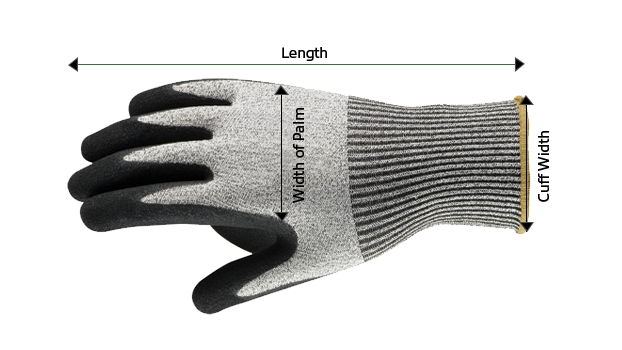
Diagram of a Cut-Resistant Glove
Did You Know?
According to the U.S. Bureau of Labor Statistics, over 1 million workers visit the ER each year for hand injuries—70% weren’t wearing gloves, and 30% wore gloves that were damaged, inadequate, or incorrect for the task.
Color-Coded Gloves:
Some manufacturers use a color band at the bottom of the glove to indicate size. Each manufacturer has its own color-code system.
Cut Resistance Level
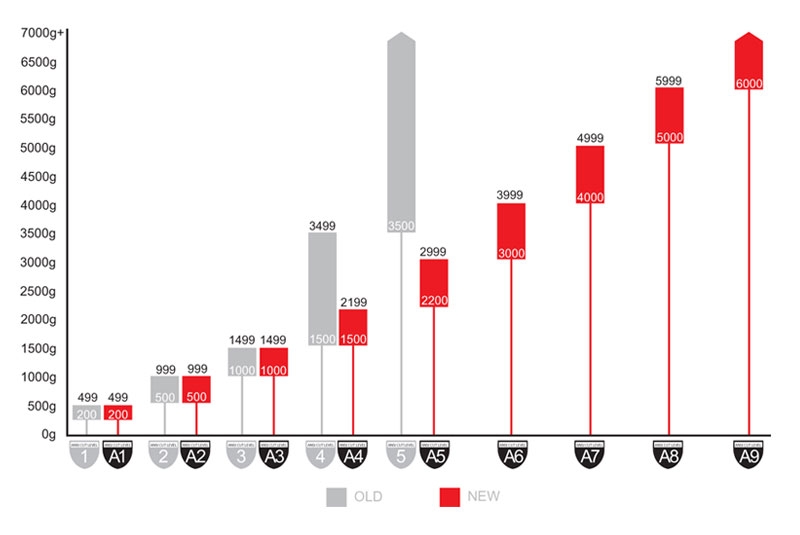
Cut resistance levels indicate how well a glove protects against cuts, measured by the grams of force needed to cut through it with a standard blade over a 25mm stroke. Higher levels offer greater protection.
ANSI has updated the ANSI/ISEA 105 standard with new classification levels, a revised cut score scale, and an improved glove testing method. ANSI/ISEA 105 is the American National Standards Institute standard that defines how cut-resistant gloves are classified. The current scale runs from A1 (lowest cut resistance) to A9 (highest cut resistance). The older version of the standard used a numeric scale from Level 0 (no meaningful cut resistance, sometimes referred to as class 0 gloves) up to Level 5 (highest cut resistance). A glove labeled cut level 1 under the older scale is roughly comparable to an A2 rating under the current A1 through A9 scale, so it's important to check which version of the standard a glove is rated under before comparing cut levels.
Please consult your safety professional to determine the right glove for your application. Always ensure your selected glove complies with the mandated safety standard recommended for your application.
TDM-100 Cut Level Test:
All manufacturers use the same standard for cut-resistance levels set by ASTM International with the Tomodynamometer Machine (TDM-100).
A glove sample is placed on a conductive material inside the TDM-100.
An ASTM-validated cutting blade is attached to the device.
A load weight applies force through a platen.
The blade moves across the material until it cuts through and contacts the conductive layer. The cut length is then measured in millimeters.
The blade is replaced, and the test is repeated five times at three different load weights, producing cut-through distances of 5–20, 20–33, and 33–50.8 millimeters. Results are recorded and used to calculate the force required to cut through at a reference distance of 20 millimeters.
The final results determine the grams required to cut through the material and assign a cut level from A1 to A9.
Put simply, TDM-100 cut resistance means the grams of force a blade needs to cut through a glove material on the Tomodynamometer test, which is how cut-proof gloves are rated and compared across manufacturers.
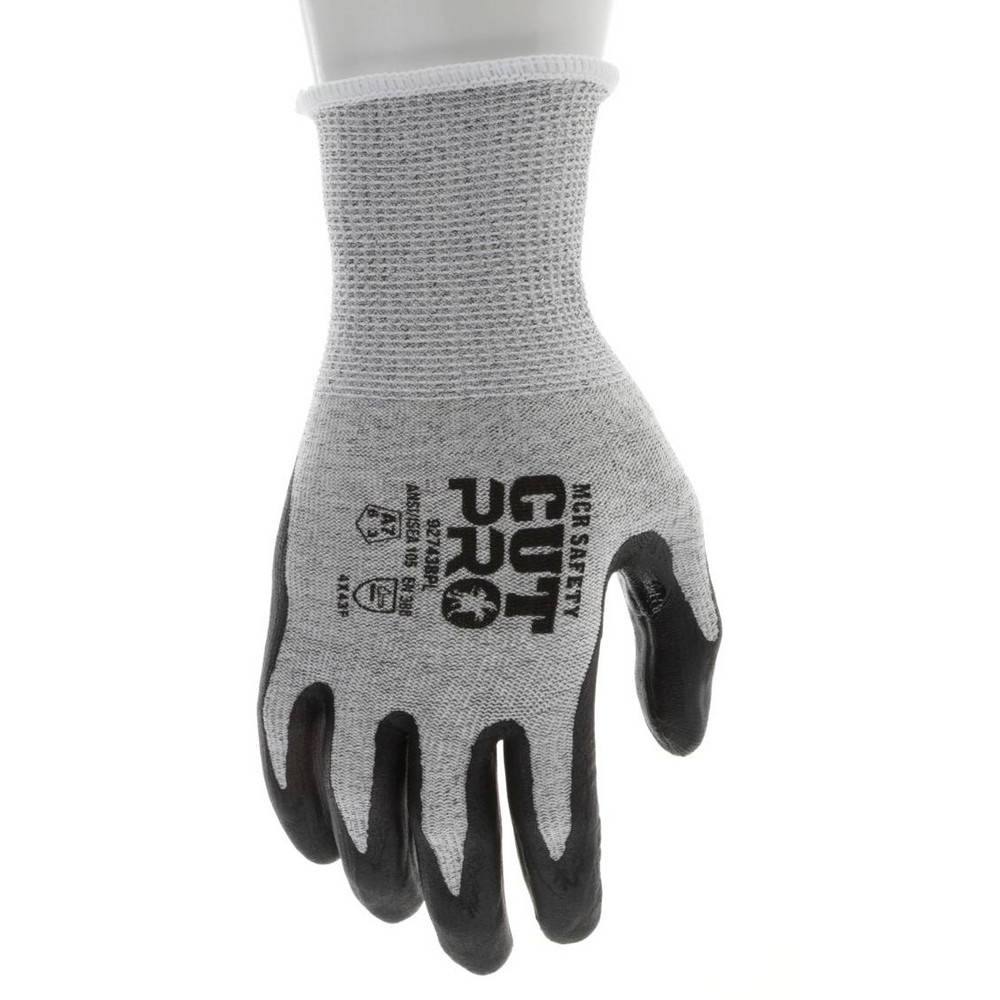
Cut Level Defined
A1 cut resistance protects against cuts ranging from 200 to 499 grams. These gloves are ideal for light to medium cut hazards in tasks like assembly, maintenance, material handling, and shipping/receiving.
A2 cut resistance protects against cuts ranging from 500 to 999 grams. These gloves are suitable for light to medium cut hazards in construction, material handling, sharp-edged and small parts assembly, as well as general-purpose use.
A3 cut resistance offers protection from cuts between 1000 and 1499 grams. These gloves protect from light to medium cut hazards and are ideal for construction, material handling, small parts assembly with sharp edges, and general-purpose applications.
A4 cut resistance protects against cuts ranging from 1,500 to 2,199 grams. These gloves are ideal for medium cut hazards in industries such as aerospace, metal fabrication and handling, HVAC, electrical work, packaging, warehousing, and food preparation and processing.
A5 cut resistance protects against cuts between 2,200 and 2,999 grams. These gloves are suited for medium to heavy cut hazards in applications such as appliance manufacturing, glass and can handling, drywalling, electrical work, carpet installation, HVAC, pulp and paper, automotive assembly, metal fabrication and handling, packaging, warehousing, aerospace, and food processing.
A6 cut resistance protects against cuts ranging from 3,000 to 3,999 grams. These gloves are ideal for high-cut hazard tasks in manufacturing, automotive, construction, glass handling, machining, metal handling, metal stamping, and paper production.
A7 cut resistance protects against cuts between 4,000 and 4,999 grams. These gloves are ideal for high-cut hazard applications such as metal fabrication, stamping, recycling, glass and window handling, manufacturing, HVAC, food preparation and processing, and aerospace.
A8 cut resistance protects against cuts from 5,000 to 5,999 grams. These gloves are designed for high-cut hazard tasks in metal fabrication, stamping, recycling, glass and window handling, manufacturing, HVAC, food preparation, and aerospace.
A9 cut resistance protects against cuts exceeding 6,000 grams. These gloves are ideal for high-cut hazard applications such as metal fabrication, stamping, recycling, glass and window handling, manufacturing, HVAC, food preparation, and aerospace.
Cut levels A6 through A9 are generally considered industrial cut resistant gloves, since they're built for high-cut hazard environments like metal fabrication, stamping, and glass handling. The material and coating a glove uses, covered below, is what ultimately determines which A-level it achieves.
Standard Materials
A glove’s cut resistance primarily depends on its materials and thickness or weight per square inch. Thicker, high-performance materials enhance protection, while lighter gloves offer greater flexibility and reduce hand fatigue. Additional features like coatings can improve grip, but may not be suitable for applications like food processing.
Canvas is a breathable, flexible material that provides protection for general-purpose tasks and can also serve as a liner for coated gloves.
Cotton and cotton blends are durable, abrasion-resistant, and moisture-absorbing. They help protect hands from irritation and cold temperatures.
Dyneema® is a lightweight, ultra-strong polyethylene fiber—stronger than steel and para-aramids. It resists chemicals, moisture, and UV rays. Dyneema® is one of the materials commonly recommended when a task needs both high cut resistance and dexterity, such as metal fabrication.
Para-aramids are lightweight synthetic fibers known for their resistance to cuts, punctures, and heat. Five times stronger than steel, they are commonly used in manufacturing applications. Alternative para-aramid materials are also available, offering comparable protection. Like Dyneema®, para-aramid fibers are a common choice for metal fabrication tasks that require cut resistance without sacrificing dexterity.
Leather is a breathable, durable natural material that offers good grip in both wet and dry conditions. It is abrasion-resistant and commonly used for general-purpose tasks. Synthetic leather mimics the look and feel of genuine leather, offering a more economical and flexible option with a solid grip, though it is less durable than cotton.
Metal and metal blends are materials that include stand-alone metal mesh or fabrics infused with metals like copper or steel. They offer excellent abrasion and cut resistance, making them ideal for cleanrooms, electronics, and food industry applications.
Nylon blends are synthetic fibers that are combined with other synthetic or natural materials to create a breathable, strong, and flexible fabric. Ideal for both wet and dry environments, nylon blends offer low moisture absorption, excellent tactile sensitivity, dexterity, and abrasion resistance.
Nylon and spandex blends offer a balance of breathability and durability, protecting against oils and scratches. They are suitable for a wide range of production applications.
Polyester blends are made by combining synthetic fibers with other materials. Polyester blends are durable, abrasion-resistant, and offer added resistance to sunlight—similar to nylon blends.
Polyethylene (HPPE) blends are ultra-fine fibers designed to be stronger than steel. They are breathable, durable, and resistant to oils.
Synthetic blends typically combine materials like nylon, polypropylene, and polystyrene; these blends are stronger on surfaces than natural fibers and offer greater resistance to solvents. They are versatile and suitable for a wide range of applications.
Para-aramid and Dyneema® are the two materials most often recommended for metal fabrication tasks that require both high cut resistance and dexterity.
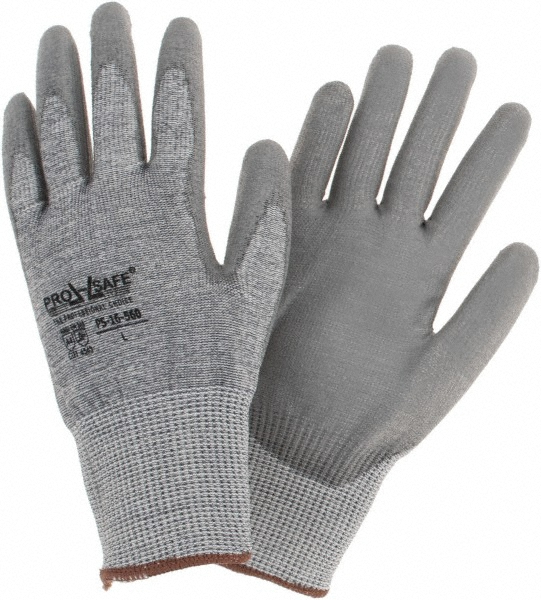
Standard Coatings
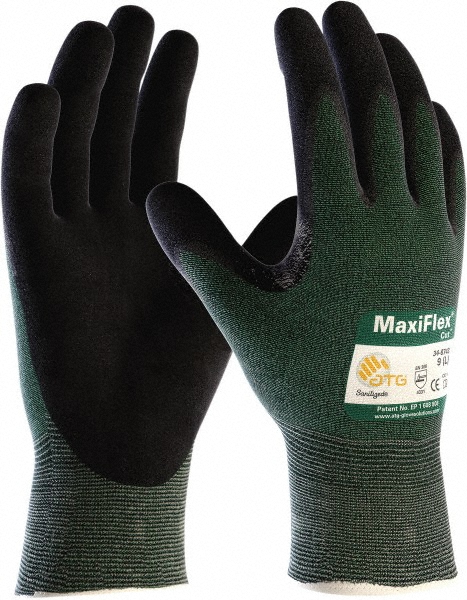
Foam nitrile is a flexible coating resistant to snags and abrasions. It provides a nonslip grip on slick, light, oily surfaces.
Latex is a durable natural rubber commonly used in general-purpose applications, offering resistance to solvents.
Micro-foam nitrile is ideal for use with light oils and provides excellent abrasion resistance. The micro dots are raised for increased durability and offer cushioning in repetitive applications.
Natural rubber latex is durable and economical. It is resistant to alcohols, bases, ketones, and water-based solutions. It has poor resistance to greases and oils.
Nitrile is a synthetic rubber that is resistant to chemicals, oils, solvents, greases, and petroleum-based fluids. It is resistant to abrasions, cuts, punctures, slashes, and snags.
Nitrile and polyurethane coatings are water-based and designed with high cut protection. They offer enhanced breathability, dexterity, and comfort. Ideal for resisting cuts and burrs.
Polyurethane (PU) is a strong, durable, and flexible manufactured material. It is abrasion and cut-resistant.
Polyvinyl chloride (PVC) is a thermoplastic polymer used against acids, chemicals, greases, and oils. It is economical and abrasion-resistant. It is not as puncture or cut-resistant as other gloves.
Rubber provides resistance to most acids, alcohols, and liquids. It is highly flexible, resistant to cuts, and used for general-purpose applications.
Silicone rubber is an elastomer that is durable and extremely heat-resistant.
Silicone-free nitrile is a synthetic rubber that does not have silicone properties that can transfer contaminants to metal and cause adhesive failure in machinery. Ideal for resistance to chemicals, oils, solvents, greases, and petroleum-based fluids. Silicone-free nitrile is resistant to abrasions, cuts, punctures, slashes, and snags.
Uncoated gloves lack additional coatings and provide minimal protection, making them suitable only for low-risk tasks.
Other Gloves from MSC
Arc Flash and Flame-Resistant Gloves: Designed to protect against burns, electrical shock, sparks, and flames. While both types offer fire resistance, arc flash gloves typically provide higher protection levels, depending on their rating.
Chemical-Resistant Gloves: Designed for handling acids, caustics, solvents, fuels, oils, and greases. Many also resist corrosion and protect against snags, punctures, abrasions, and cuts.
Disposable/Single-Use Gloves: Protect acids, chemicals, dirt, grease, and other light-duty contaminants. Suitable for industrial, medical, cleanroom, and food handling applications.
Lineman’s Gloves (Electrical Protection Gloves): Made from high-dielectric, insulated rubber to guard against electrical hazards. These gloves must always be worn with leather protectors, which provide additional protection against cuts, abrasions, and punctures. Caution: Leather protectors alone do not provide protection against electric shock and should never be used without rubber insulating gloves.
Work and General-Purpose Gloves: Provide protection against dirt, debris, mechanical hazards, sharp objects, and low-level chemicals.
Welders’ and Heat-Resistant Gloves: Protect against flames, heat, sparks, and other thermal hazards.
For tasks that require both cut resistance and electrical protection, such as work performed by an electrician near sharp metal components, look for a cut-resistant glove rated for the job's cut hazard along with a separate Arc Flash and Flame-Resistant or Lineman's glove rated for the electrical hazard. Cut-resistant gloves alone do not provide electrical protection.
Shop Cut And Puncture Resistant Gloves
To request a quote, please login to your existing account or register a new one. This helps us provide you with a personalized experience and keep track of your requests.