Cold hands are more than uncomfortable. In manufacturing environments, it can have consequences that affect operations and safety. When hand dexterity diminishes in the cold, workers aren’t able to move as surely and can drop parts, slowing down production. With decreased grip strength, they might lose their hold on tools or machinery, increasing the risk of injury. Exposure to extremely low temperatures can cause frostbite.
Historically, employers solved the problem of cold hands with bulk—either thick glove materials or layered gloves, or both. For applications where dexterity, grip and tactile sensitivity are needed, however, thick hand protection is not good enough to do the job. Workers may be forced to take off their gloves to perform certain tasks, which is a safety risk.
“It’s very important for you to keep that thermal protection and not have to remove your gloves to do your application.”
D’Lynn Chambers,
Product Marketing Specialist,
Ansell
“You need a glove that gives you both dexterity and thermal protection,” says D’Lynn Chambers, a product marketing specialist in the mechanical portfolio at Ansell. “It’s very important for you to keep that thermal protection and not have to remove your gloves to do your application. You need dexterity to be able to handle whatever you’re working with.”
Today, manufacturing technologies and materials are delivering the best of both worlds in cold-weather work gloves: hand warmth and dexterity.
Knitting Technologies for Work Gloves
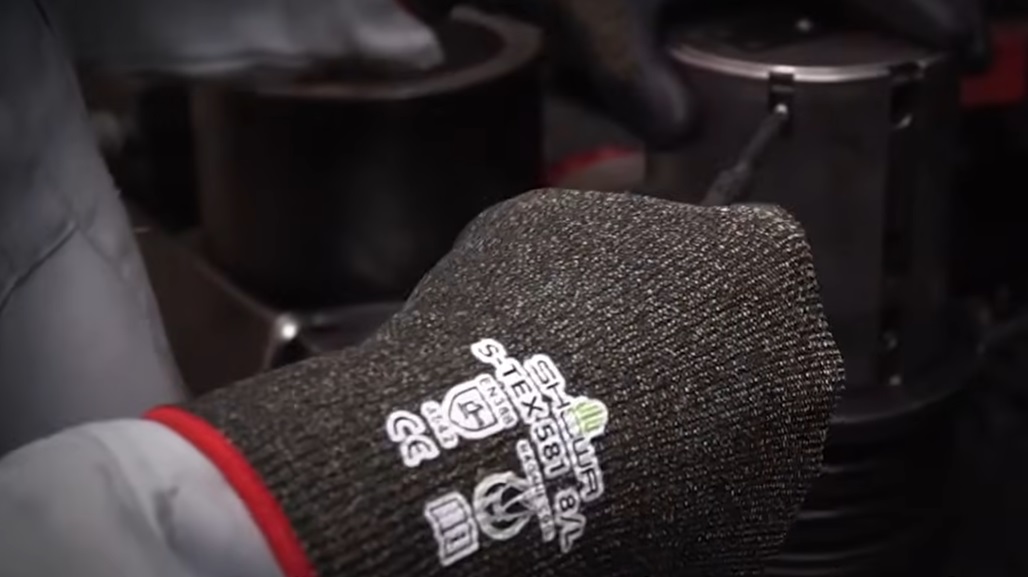
Moving beyond traditional cut-and-sew technologies, advanced knitting machines allow glove manufacturers to control stitching density to improve dexterity while maintaining warmth.
Finer glove gauges—with stitch counts up to 21 per inch of knitted material—are thinner and more comfortable to wear.
Read more: Cold-Weather Safety Tips: Keep Workers Warm with New Innovations
“You’re looking at cotton, polyesters and acrylics,” Chambers says. “Ansell blends different types of fibers and yarns to offer the hand protection you need in your applications.” This includes proprietary technologies that add protective attributes such as cut and abrasion resistance, she adds.
Gloves made of polyester and other synthetic fibers are well-suited to keep hands warm and breathable in cold, damp conditions. Worn as a liner under an outer glove, Ansell’s ActivArmr 78-150 and ActivArmr 78-101 can be used in food processing and refrigerated environments, plus assembly or inspection tasks. ActivArmr 80-400 gloves are fleece-lined to guard against subzero temperatures with extended contact.
Uniform stitch counts also create uniform pockets that trap air for better insulation.
Work-Glove Coatings and Warmth
The primary purpose of glove coating is to improve grip and abrasion resistance of knitted liners, although in cold environments, it also provides a barrier that keeps out wetness and reduces evaporative cooling to preserve warmth.
When warm liner materials are used, a palm coating may be all that’s needed for workers in cold areas. ActivArmr 97-631 gloves, for example, feature a PVC palm coating for maintaining grip in package handling and cold storage applications.
Read more: Hand Warmers: How They Work (and Everything Else You Need to Know)
Gloves with three-quarter or full coatings provide more protection, and in some cases, warmth and dryness. ActivArmr 97-011 gloves with three-quarter coating are tested to -4 F.
“Depending on the application or the thermal temperatures that we’re targeting, we may do a double dip,” Chambers says.
Keeping Hands Dry
When hands are wet, moisture evaporates and cools, which is something you don’t want in cold conditions. Dry hands are key to maintaining warmth.
“In cold applications, you want to keep the wet away to where your hand is comfortable and you can wear that glove longer,” Chambers explains. “If your hand gets wet, then you’re likely going to have to change your gloves multiple times.”
When workers can wear their gloves comfortably and safely from one end of the application to the other, that’s the goal, Chambers says. Glove technologies such as knitting techniques, yarn materials and coatings are making this possible, even in cold conditions.
Read more: 5 Less-Obvious Winter Safety Tips for Your Shop Floor