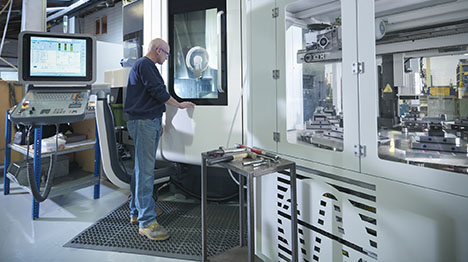
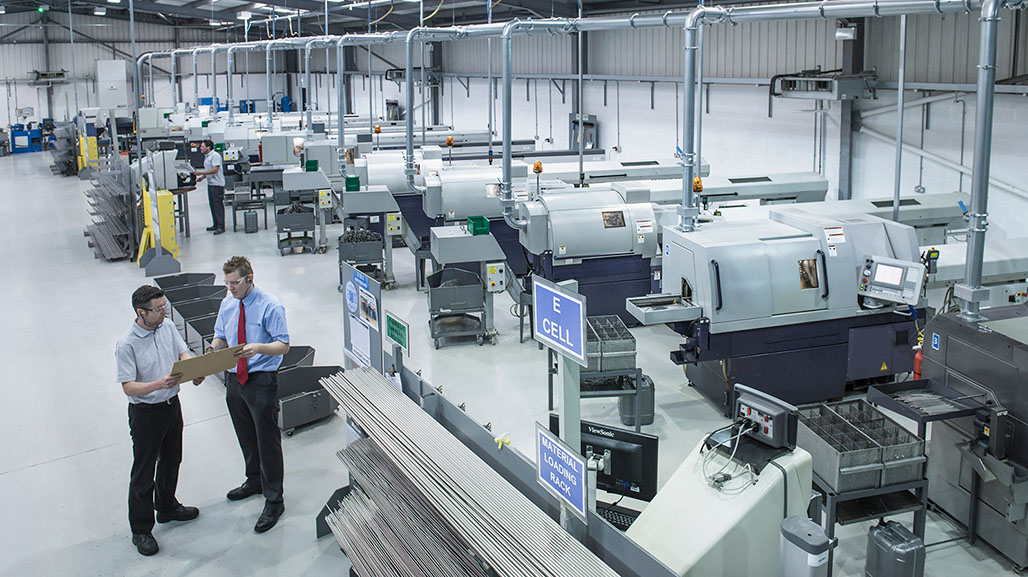
Manufacturing workers depend on visibility—to see their work, navigate around machines and moving parts, and safely move around the facility. That doesn’t change when the power goes out.
If normal lighting suddenly disappears, emergency lighting switches on to help workers avoid hazards and reach safety.
Here’s a guide to emergency lighting standards and best practices.
Core Standards for Emergency Lighting
The foundation for emergency lighting is a firm understanding of the standards. Requirements come from a variety of organizations that determine where lighting is placed, how much lighting is needed and for how long.
NFPA 101, Life Safety Code
The National Fire Protection Association’s NFPA 101, Life Safety Code specifies how long an emergency lighting system should stay on after an outage, and how often the system should be tested.
Emergency lighting must turn on automatically and stay on for a minimum of 90 minutes after normal lighting stops. Stoppage could happen because of a power failure, a circuit breaker trip or a manual switch-off.
“Engineers laying out lighting should be strategic in specifying fixture mounting heights to ensure the proper illumination levels are achieved.”
Matt Zega,
Electrical Engineer
Lighting must provide an average of 1 foot-candle (10.8 lux) of initial illumination, and at any point, not less than 0.1 foot-candle (1.1 lux) along the egress path, measured at the floor. The code also dictates the minimum decline of illumination (0.6 foot-candle, or 6.5 lux, on average) and the maximum-to-minimum ratio of illumination (40-to-1). For more on foot-candles, read this article in Knowledge Center.
Systems must be tested monthly for 30 seconds and annually for 90 minutes.
OSHA 29 CFR 1910 Subpart E
The Occupational Safety and Health Administration (OSHA) provides the standard for exit routes in 29 CFR 1910.37. In short, an exit route must be adequately lighted so that a person with normal vision can see it. Exit signs must be illuminated to 5 foot-candles (or 54 lux) at the surface.
Local Authorities
Besides the NFPA and OSHA standards, employers need to check with their authority having jurisdiction (AHJ)—usually, the local organization in charge of building codes—about specific emergency lighting requirements for the area.
“AHJs may adopt and enforce relevant codes, such as the International Building Code (IBC) or International Fire Code (IFC), which contain provisions for emergency lighting and exit signs,” Herbert Post, vice president of safety and health at TradeSafe, writes for Consulting-Specifying Engineer.
Emergency Lighting Coverage
The standards are clear about emergency lighting illumination levels, although maintaining those levels throughout a facility can be tricky.
For instance: “Lighting placement along walls in stairwells can pose challenges for casting the appropriate amount of light in these areas,” electrical engineer Matt Zega writes for Consulting-Specifying Engineer. “Engineers laying out lighting should be strategic in specifying fixture mounting heights to ensure the proper illumination levels are achieved.”
Maintained emergency lighting uses lights that serve as regular lights and then continue operating with backup power when the primary power goes out. Non-maintained lights, on the other hand, are off most of the time and turned on only for emergency lighting.
“It is ideal to install both types of lights to ensure there is sufficient light in the facility when the power goes off,” explains Cory Peterson of LED Lighting Supply, writing for FacilityManagement.com.
To provide proper illumination, consider the layout of the facility. “For example, a warehouse would require enhanced illumination in the aisles, as there could be shadows caused due to high racks,” Peterson writes. “Comparatively, the administrative area will need lesser illumination. The goal is to make navigation to the exit doors convenient, safe and quick.”
Read more: Illumination Best Practices: Your Guide to OSHA’s Lighting Standards
Backup Power Options
When the power goes out and emergency lighting systems need to kick in, backup power is required. To be compliant with NFPA 101, switching between the two power sources must happen within 10 seconds.
Backup power is typically supplied by batteries or generators.
“Power supply units manage the transition between normal and emergency operation,” explains Impact Fire, a fire protection company, in a blog. “These sophisticated control systems monitor primary power status and automatically activate emergency lighting.”
LED Leads Modern Emergency Lighting
LED has become a popular lamp for emergency lighting. “LEDs boast a long life expectancy, leaving the facility maintenance-free for up to 50,000 lamp hours,” Zega writes. “Also … LED lamping is available in many color temperatures to fit the application.”
One major downfall of LEDs, Zega explains, is that replacing them can be difficult. Take care to select fixtures that make the job easier for maintenance staff. Also, because quality varies widely among LED lamps, be sure to double-check the product warranties and life expectancy.
Read more: Portable Lighting Systems – The Key to Effective Emergency Planning
Supplemental Measures: Portable Lighting
Although fixed lighting forms the backbone of an emergency lighting system, portable lighting can have a valuable supplemental role.
“We have emergency lighting that we call our Power Failure System,” says Tony Casciano, national account manager at Streamlight. “The light is plugged into the wall and sits on its charger, and when power to the outlet goes out, that light goes on. You can put them near exits and throughout a facility so an individual can go grab one and then guide people out of the building.”
When the power goes out but there is no emergency, portable lighting can provide enough illumination for work to continue safely.
“If the generators have enough to power the machines, maybe you can set up workstations with portable scene lights,” Casciano says. “Stage them appropriately throughout the facility to illuminate the operators and the machinery and continue building whatever you’re building and generate revenue for your company.”