Employers who need protective garments for their workers might take a quick look at the available options and be tempted to pick the first one they see, or the cheapest on the list.
Admittedly, these types of products seem similar on the surface. “When it comes to the white suits that workers wear in the industrial space, there are a number of different materials on the market, and many of them would keep dry particulates or liquid splash off of a person,” says Aja Mipro, national account manager for protective apparel at DuPont Personal Protection.
Not all white suits are created equal, however.
“Even though they all look the same and they all provide some sort of barrier performance, the construction of Tyvek® is what really makes the difference,” Mipro says.
“Because of the fabric technology, Tyvek® provides superior protection to dry particulates and nonhazardous light liquid splash.”
Aja Mipro,
National Account Manager,
DuPont Personal Protection
Tyvek® features a proprietary material construction of heat-pressed, entangled fibers. “It’s made of 100 percent flash-spun high-density polyethylene, more commonly known as HDPE,” Mipro explains. “It creates an inherently durable fabric that is unlike anything else on the market. Probably the biggest competitive material to Tyvek® is microporous film, or MPF.”
But microporous film doesn’t hold up to Tyvek®, especially where protection, durability and comfort are concerned. Let’s take a closer look.
1. Protection Built into the Fabric of PPE Suits
Whether workers are grinding, sandblasting, degreasing, spray-painting or performing any other task that requires protection from airborne or waterborne elements, employers have a responsibility to provide personal protective equipment.
“The end goal is to keep hazards off the worker—to protect their skin and their body,” Mipro says. “Because of the fabric technology, Tyvek® provides superior protection to dry particulates and nonhazardous light liquid splash.”
With Tyvek®, protection is engineered into the fabric. The entanglement of fibers creates a barrier to particles as small as 1 micron.
Microporous film, on the other hand, gets its protection from a film layer added on top of spunbonded polypropylene, a nonwoven material. The topical barrier works as long as it isn’t compromised by abrasion or tearing.
Video: Tyvek® Makes the Difference
2. Durability of Material Construction
Besides being protective, the unique material construction of Tyvek® adds strength and durability.
“The entanglement of fibers that make up the material are going to provide an inherently durable solution compared with microporous film,” Mipro says. “If Tyvek® gets caught on something, it’s got great tear resistance.”
In fact, testing has shown that Tyvek® is more than twice as durable as microporous film, which should give confidence to workers and employers alike.
By comparison, microporous film falls short. “Environments where workers may be rubbing up against things or crawling could contribute to abrasion,” Mipro says. “If that film layer is compromised, then the protection is lost. Something as simple as a fingernail or a rough surface could scrape that layer.”
Read more: DuPont Upgrades Fire Safety PPE with a ‘Better Mousetrap’
3. Comfort and Breathability
When PPE suits are uncomfortable, workers are more likely to take them off—or to refuse to wear them in the first place. So, it’s in everyone’s best interests to provide comfortable garments.
As with protection and durability, the comfort of Tyvek® traces back to the material construction.
“Tyvek® is soft. It’s definitely designed with comfort in mind,” Mipro explains. “When you feel Tyvek®, it’s almost like a fabric textile—something that you would have with general clothing. It’s that smooth and clothlike.”
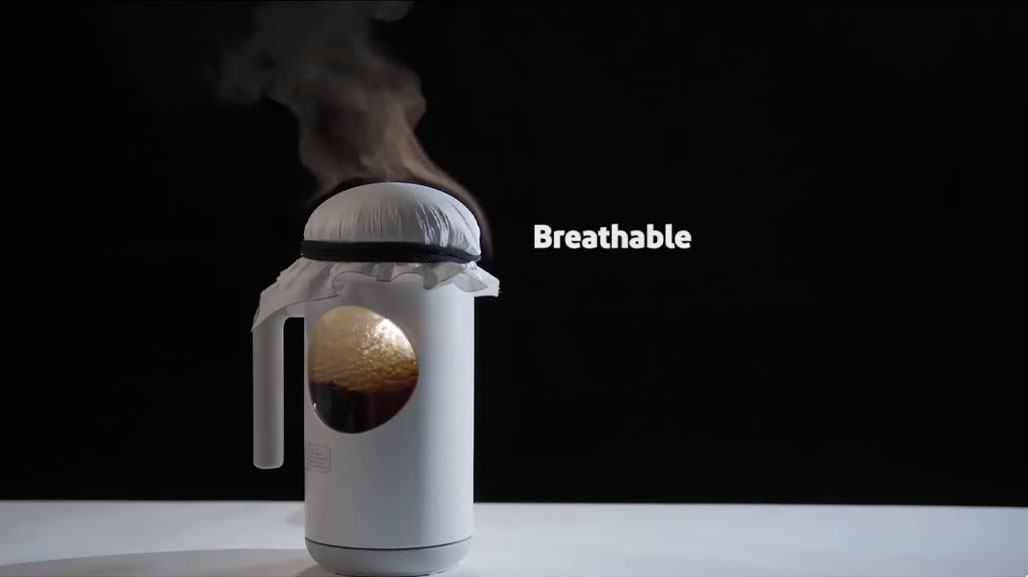
Tyvek® is also breathable, thanks again to the fabric. “The entanglement of fibers in our proprietary material construction creates a barrier, but it also leaves the ability for air to pass through,” she says.
Conversely, microporous film is going to trap air inside the garment and not let it escape. “It’s like wearing a plastic bag—all the breathability is gone,” she adds. This is especially problematic for workers in warmer climates or in areas with little circulation, where the film layer could contribute to heat stress.
WATCH: See what happens when a bubbler kit puts microporous film and Tyvek® through the same breathability test environment:
Making the Right Choice in Protective Garments and PPE Suits
Ultimately, the best garment for a particular task is the one that will protect workers from hazards, withstand the rigors of the job and be comfortable to wear.
And many times, the optimal solution is not achieved by looking at price alone.
“Microporous film may be less expensive per garment, but if two are being worn instead of one during a shift because it’s not holding up or it’s not comfortable, those types of things are not often considered by someone who’s looking at just the cost of the garment,” Mipro says.
“You don’t want a garment that’s overkill, and you don’t want to be underprotected, either,” she adds. “The only way to make sure that you’re picking the right garment for whatever hazards you’re facing is to do a job hazard assessment. And that is something that our DuPont team can help with.”