Video Transcript
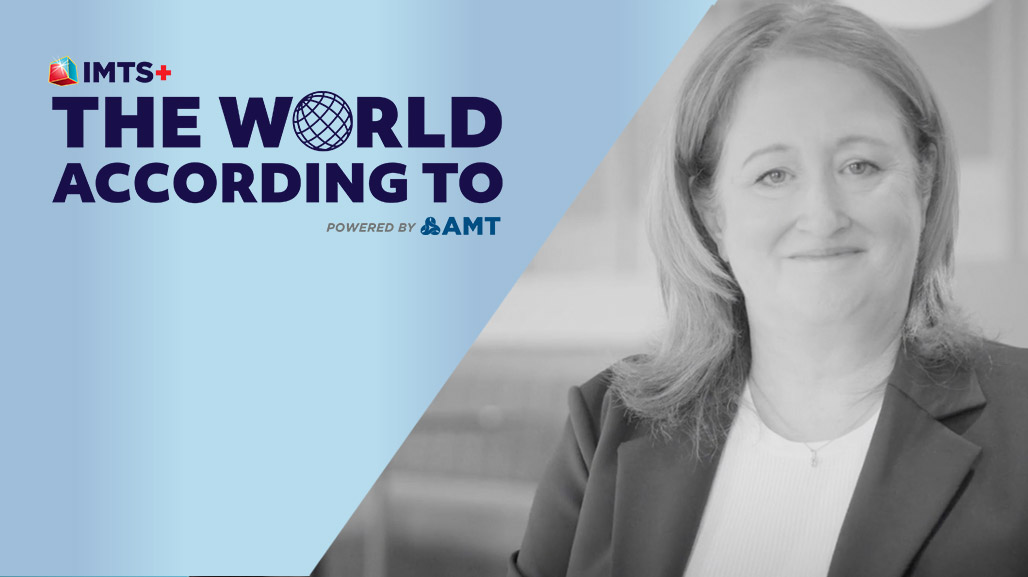
Interviewer: Welcome to “The World According To” on IMTS Plus. Today we're joined by Martina McIsaac, president and CEO of MSC Industrial Supply, to explore how their organization is redefining responsiveness, expanding US capabilities, and investing in the future of manufacturing through training and innovation.
Martina, thank you for taking the time to join us.
Martina McIsaac: Thank you for having me.
Interviewer: So, take us back. How did your journey begin and what led to your role as president and CEO of MSC Industrial Supply?
Martina: I started working for Avery Dennison on their heavy manufacturing side and I've always loved manufacturing. I like working with real people who do real work and that was a great experience. It took me all over the world.
At one moment I was leading some R&D. I led operations. I ran plants. I did sales, business development, M&A. So, really nice, well-rounded experience. And then I took 5 years off when my children were small. And then the second part of my career, I joined an organization called Hilty, which is a family-owned private company that sells professional construction tools, software, services.
So made the move from industrial to construction. But the interesting thing is those two experiences essentially taught me to understand what manufacturing needs as a customer of MSC and then taught me to understand what a supplier would need from MSC. You know, understanding the innovation cycle and the need to monetize R&D and how manufacturers think about distribution.
So those two pieces together and just my love of transformation. I was a Six Sigma Black Belt back in the day.
Interviewer: What experiences along the way most shaped your perspective on manufacturing?
Martina: One of the challenges that I had in my time at Avery Dennison, we had a business that was very successful and had a set of aging patents and we had to change our cost structure to be able to survive after the patents expired. We took everyone in the company offsite to kind of come up with a plan and some of the best ideas came from people right on the plant floor.
They know the needs and they have the answers.
Interviewer: As you've watched the industry evolve, what changes stand out and what continues to fuel your passion today?
Martina: A distributor exists to connect disconnected suppliers from disconnected customers. We are the bridge to bring those two together. But MSC has always been different. We provide a technical translation function if you like. So this is a technical product line and we need to deliver productivity to the customers and help them apply the available technology. What's thrilling now is just the menu of what that technology looks like is getting bigger and bigger, right?
You've got AI, you've got connected CAM workflows. You have digital twins and simulations. Now you're not saving a couple of minutes on a process. Now you're saving days on a process because of what the technology can let you do.
Interviewer: How are you keeping pace with it in terms of training your workforce?
Martina: I think that's a challenge for all of us right now. I mean for everyone. I think we are, our own operations right now are sort of also being transformed and where we apply automation and AI.
And I think what we are doing is making sure that we preserve and respect and value the decades of experience that our team has in conventional support and then we're supplementing them with specialists and new skills as we go along.
Interviewer: How would you describe the culture at MSC and what do you think makes it unique?
Martina: Our culture is deeply rooted in the values of the family and the legacy of the company. So the Gershwind-Jacobson family, one of the things that our current chairman Mitchell Jacobson, so the son of our founder, said to me when I met him and when I was interviewing and it was one of the most compelling reasons to come to MSC, he said, "You have four stakeholders. You have your customers, your suppliers, your investors, and your associates." And he said I believe that any business that doesn't make that ecosystem work for all the beings in it doesn't deserve to exist as a business and so that's what we live.
Interviewer: You spoke earlier about being that translator, having a consultative approach. As your organization grows to now I believe more than 7,000 people, how do you instill that consultative mindset across such a wide organization?
Martina: We have spent a lot of time and in fact just recently last December completed some restructuring of our field-facing resources in order to deploy the right skills to the right place. So we have a salesforce that is designed to cover the right customers with the right skills. We also have specialist teams that support that consultative selling and then we have back office teams that are tapping into decades of institutional know-how that can support. So, it's a multi-layered approach, but it's one that MSC's built over decades and we just continue to refine.
Interviewer: What do you think differentiates MSC Industrial in the market?
Martina: It's the technical know-how. It's that translation of what technology means to the customer's actual productivity.
Interviewer: Where are you seeing the greatest growth opportunities for MSC Industrial right now and what's driving that momentum?
Martina: Everybody needs metalworking in some form, but there are some markets that stand out. Aerospace has been strong the past few years. We're seeing a resurgence now in sort of the automotive and heavy truck. We're very excited about the possibility of expanding production in the US. There's obviously reshoring, but there's also reactivating capacity in existing facilities and we are feeling that tailwind now.
Interviewer: Which technologies do you think will most shape your customers’ future and what challenges do you think will still remain?
Martina: Our biggest challenge is the trained workforce and the aging workforce in metalworking and we know that we're going to have to be relying on fewer humans or maybe lesser-trained humans, right? And so MSC sort of takes that challenge on to say how can we supplement when you used to have a machinist with decades of experience. How can we take a lesser-trained person but make your productivity outcome, Mr. Customer, look the same? And so I think there's automation opportunities, the opportunity for simulation and for connected workflows on the plant floor that can help take some decision-making away from that operator and maybe move it upstream in a different way so that you can still get the same productivity out of a different profile on the plant floor.
Interviewer: Are there some things you think are unsolvable?
Martina: You know, I think we have not solved the labor problem. We don't have a resurgence of people wanting to go into the trade. So, we're going to have to match that up with technology in a different way. And I think that's something the whole industry is coming together to do. The interesting angle to that is to the extent that we digitize, for example, tool path design or tool path optimization or we digitize some of the programming and we connect the plant floor and we create a different kind of a job. That's maybe the exciting future.
Interviewer: Looking ahead to IMTS 2026 at which MSC Industrial Supply is an exhibitor. IMTS is a major opportunity to showcase what MSC is focused on. What are the key themes that you'll be bringing to the show and why do they matter?
Martina: IMTS is the forward look at the industry, right? It's a thrilling environment. So the opportunity for MSC at IMTS has always been to be at the center of the conversation. My very first 15 minutes at IMTS, a customer came into see us at our booth, asked a question. We connected it to a metalworking specialist. They together walked over to a supplier and solved a problem, like literally in my first 15 minutes, that's what IMTS is for me. It’s just how can MSC position themselves as that connector?
Interviewer: When attendees come to your booth at IMTS, what would you like them to walk away with after experiencing MSC Industrial?
Martina: I would like them to leave knowing that in MSC they have a technical partner with deep expertise who is well connected to all the potential that exists in the industry to drive their productivity.
Interviewer: So, to sum it all up, The World According To Martina McIsaac is…..
Martina: The World According To Martina McIsaac is connected, predictive and data driven.
Interviewer: Martina, thank you for the conversation and for your vision of where MSC Industrial Supply and the future of manufacturing is headed. And that concludes this episode of World According To. Join us next time for another conversation shaping the future of manufacturing right here on IMTS Plus.