Manufacturers today have to do more with what they have. That includes absorbing rising carbide costs, squeezing higher output from existing machines and coping with a shrinking labor pool—all while margins stay tight.
Robert Navarrete, national product manager for turning and threading for Iscar USA, says that’s why it’s more important than ever to make smarter tooling decisions by focusing less on the cost of a tool and more on the cost per part.
“Maybe an insert costs $5 or $10 more than what you’re currently using, but you’ll be able to stop that machine 50 percent less,” Navarrete says. “Your shop rate costs a lot more than that piece of carbide.”
“Maybe an insert costs $5 or $10 more than what you’re currently using, but you’ll be able to stop that machine 50 percent less.”
Robert Navarrete,National Product Manager of Turning and Threading,Iscar USA
Below, Navarrete shares his practical, shop-floor-focused advice on how to rethink tooling decisions so you can cut your cost per part and increase productivity.
Why Purchase Price Is the Wrong Metric for Cutting Tools
The true cost of a cutting tool is determined by how many parts it makes before it needs to be changed, Navarrete says. In addition to shop rate, other key variables in the cost-per-part equation include the number of cutting tool edges, tool life, machine downtime for changeovers and batch size.
Iscar uses both preliminary and post-test reports to make the cost-per-part case with customers. On the front end, Navarrete and his team will give a shop a pre-sale test report that outlines what they’re proposing and the assumptions behind it—insert cost, an estimated shop rate (or a default number if the customer won’t share theirs), and target cutting parameters.
“We’ll plug in rough parameters, and say, ‘You’ll get 50 parts with your existing insert, and 50 parts with the new insert, but parameter-wise, this is how much more efficient you’re going to be.’”
Once a shop agrees to do a test, Iscar is able to replace that estimate with comprehensive real-life production data.
“When we do the actual testing, it goes from a one-page preliminary test report to a seven-page document where we tell them: Here’s how much the insert costs, here’s how much longer the insert lasted, here’s how many you would have to buy for a batch of 1,000 parts, here’s how much setup time you need, etc.. It’s a pretty thorough report,” he adds.
When Bigger Isn’t Better: How Right-Sizing Carbide Pays Off
With tungsten carbide prices at historic highs, manufacturers should focus on making sure they’re not using more carbide than what’s needed for the job, Navarrete says.
He says shops often default to large, general-purpose carbide inserts even when their machines and depths of cut don’t require that much carbide.
“The CNMG 432 is the most widely used insert in the world,” he says. “Although this is the most popular turning insert on the market, it doesn’t necessarily mean it is the right tool for the job. Shops can use smaller carbide pieces, which cost less, and still take 0.200” depths of cut.”
Navarrete says this is another case where bigger isn’t necessarily better. “Actually smaller, stubbier inserts are sturdier and robust and they’re more impact-resistant so they have less harmonics.”
When you control harmonics in a compact setting, he says, “you’re getting more productivity because you’re able to go faster with a stable setup.”
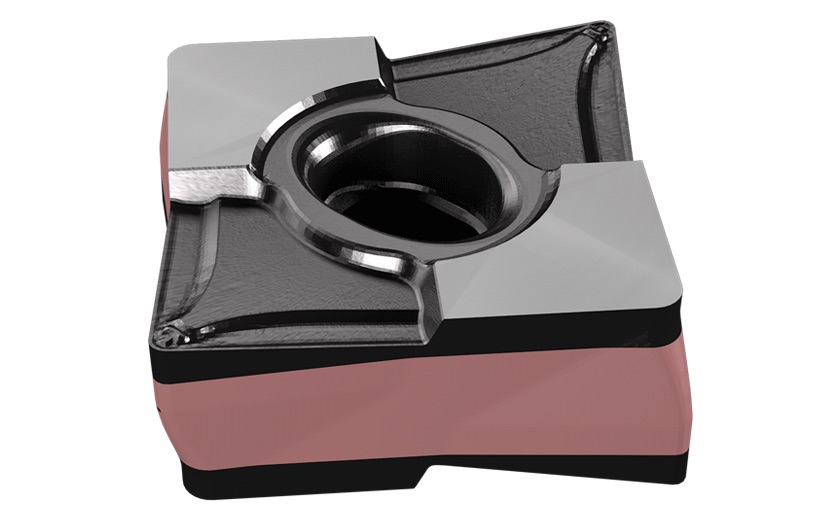
Iscar’s CXMG carbide turning insert is a smaller, stubbier alternative to the CNMG 432.
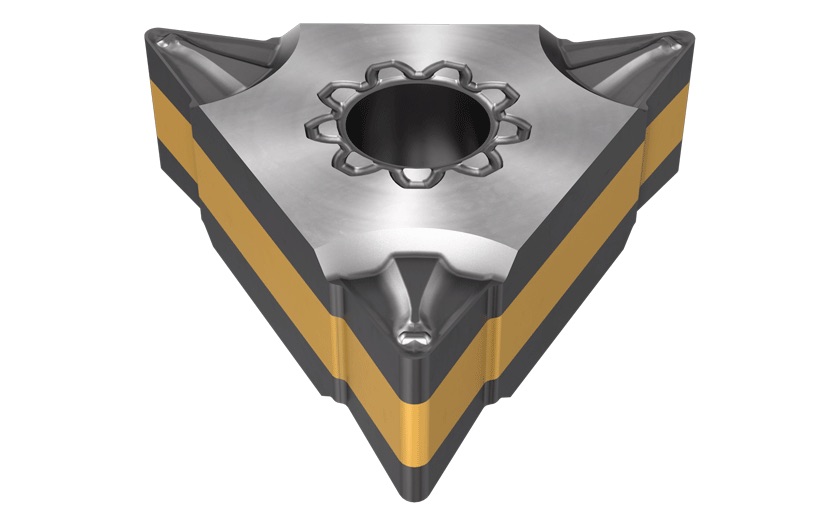
The advantages of Iscar’s D6NMG carbide insert include a smaller IC and four additional cutting edges compared with a traditional 2-sided DCMT.
For Larger Productivity Gains, Go Application-Specific
Another common mistake that shops make is trying to use a general-purpose insert for different materials and applications.
“I know that customers are trying to cut costs and so they want one answer that’s going to cut everything,” Navarrete says. “We can do that, but it’s not going to cut everything efficiently.”
For example, when machining the high-temp alloys and hardened steel that are often used in aerospace and automotive applications, carbide isn’t the best choice.
“In these cases, we recommend CBN, ceramics and potentially some PCD,” he says. “These are expensive inserts, but they’re also more efficient, more predictable and you’ll get a lot higher cutting parameters. That’s where that cost versus productivity comes into play.”
In the case of CBN, Navarrete notes that facilities don’t necessarily have to pay for an insert made entirely from CBN to get the benefits.
“With CBN, the whole piece of the insert’s not CBN, it’s just the tip of it,” he explains. “If I’m only taking an 0.008” depth of cut, I only need to sell you this much CBN, so your CBN is going to cost that much less.”
For applications that require heavier depths of cut, he says, Iscar can increase the CBN portion of the insert, giving shops flexibility to “play with the amount of CBN” and balance performance against price.
Dialing in on exactly what you’re doing is how you can maximize productivity and cost savings.
“What type of machinery are you running? What type of coolant are you running? How’s it being held?” he says. “Let us look at the total package, and we can narrow down the choice. You’re going to get the most profitability when we’re gearing our recommendations to exactly what you’re doing.”
Predictability Is the Hidden ROI of Premium Tooling
With labor shortages forcing shops to run leaner, predictability has become as valuable as raw performance, Navarrete says, especially in Swiss shops that run lights-out machining.
“A lot of shops these days, especially now that they are having trouble finding workers, want somebody to be able to push a button and walk away,” he says.
“If we can give you a high-performance tool that can enable you to set a timer for 50 parts or 100 parts, and know that you’re going to come back to that machine and it stopped at 50 or 100 and the tool’s still there, you’re paying for that reliability and peace of mind.”
Donna Behen is a writer and editor with experience in healthcare, finance, and business.
ISCAR supports world class manufacturing through continual advances in cutting tools technology. ISCAR's comprehensive line includes indexable inserts, end mills, toolholders, solid carbide drills and more. With innovative machining technology, ISCAR's tooling solutions will reduce cycle times, increase machine tool capacity and improve the profitability of your machine shop.
To request a quote, please login to your existing account or register a new one. This helps us provide you with a personalized experience and keep track of your requests.