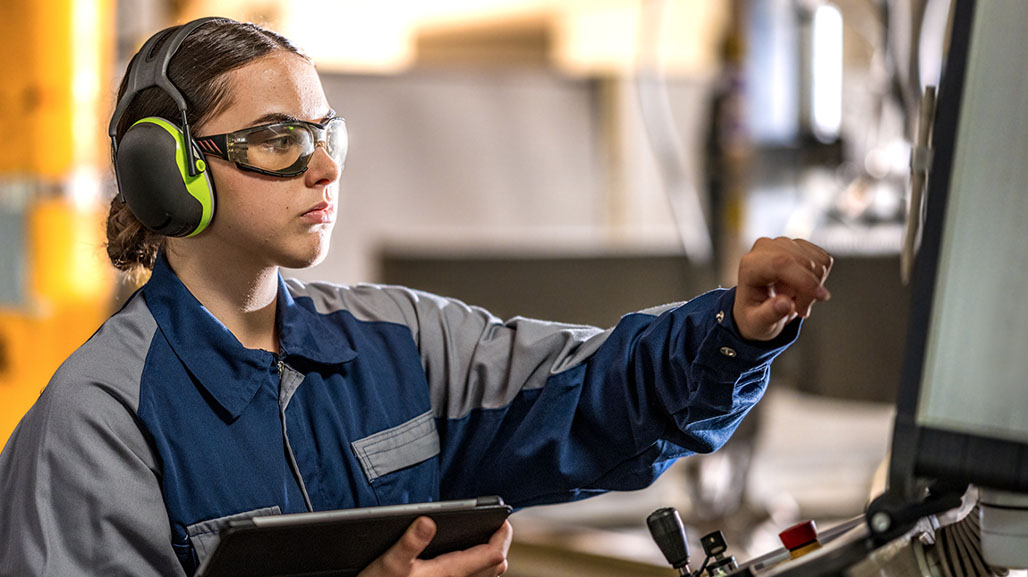
There’s no denying that the need for filling manufacturing jobs is a near-term reality. But that doesn’t mean millennials and members of Generation Z are not working as machinists and programmers today. We shine a light on next-generation machinists who have found their calling in metalworking.
Machinists of a certain “baby boomer” age are either retiring or will be in the coming years—and that has many companies in automotive, aerospace and other sectors concerned about finding workers to fill new and replacement positions. Experts estimate that roughly 2 million jobs will go unfilled in manufacturing in the next 10 years if things are not corrected.
Yet, despite the steady retirement of boomers and the career ascension of Generation X machinists into supervisory and management positions, there are millennials and Generation Y adults who are training or working on the shop floor as machine operators, setup personnel and CAD/CAM programmers today.
Some are taking advantage of apprenticeship programs and scholarships funded by machine makers—or government-backed programs. A 2017 presidential executive order doubled the amount of taxpayer money for existing job training and apprenticeship programs to nearly $200 million—which is an effort to help reduce the coming worker-demand gap.
“Manufacturing in this country has not disappeared. I would not characterize it as fading away, dying,” said Mark Dodge, a professor and program coordinator at Nashua Community College, in an interview with StateImpact New Hampshire. “It has certainly changed, and it has become, still, a valuable part of what we do in the country. And it is a strategic part, not just in the military sense, but in the medical profession. We have the ability to respond quickly, for example, with heart stents, bone screws, artificial hips, knees, and things like that—all came out of a machine shop.”
Listening to the Generation That Is Helping to Resolve the Skills Shortage
So who are the next generation of machinists and manufacturing experts? Believe it or not, they appear to be pretty similar to past generations—with some depicting themselves as self-proclaimed “gear heads” and those who have discovered they like working with their hands and head together. Others have been exposed to manufacturing through their families—or simply are looking for greater wage-earning potential than a retail store clerk or low-level office job can offer.
“I like working on cars, but you can’t make much in automotive these days, because too much competition,” said Ben Dubray, who was a 21-year-old machining student when he was interviewed by StateImpact New Hampshire. “But my grandfather’s a machinist, and his friends are machinists, and a few of them own their own shops. And I remember them talking about the fact that there’s no new machinists. So that kind of gave me the hint to look into this. Because if nobody’s going into it, there’s going to be jobs, won’t there?”
Do you have a negative perception of millennial and Gen Y workers? Read why your perceptions are probably off in “How Empowering Millennials Can Help Bridge the Manufacturing Skills Gap.”
Orlando Morales worked at a supermarket for 10 years before finding he had a penchant for machining. Morales, who is now 33, discovered the role of a machinist when he toured a rice company and learned how the combine machines were fixed by making custom parts. He told StateImpact: “I witnessed firsthand how the machinist cut up some metal and made a new part for the machine and got it back up and running in no time. And that was really amazing.”
For others, attending college and obtaining a four-year degree and a mountain of debt to crawl out of is not necessarily a path they wanted to take—or they discovered college was not exactly for them. When Greg Serio was 19 years old he had been expelled from the University of South Florida after receiving a scholarship. He was a young dad working as a part-time bouncer and did not envision a career in manufacturing—but it happened.
“After my 24th birthday and three hard-earned promotions later, I became a metalworking specialist,” Serio wrote in a blog post for Fullerton Tool Company. “I thought I could kill it on the job, but I was quickly humbled and finding myself way over my head … After about a month in, I was on a giant lathe talking to a machinist about turning 440 cast stainless (the nasty scale stuff). He was telling me words like ‘thou’ and ‘tenths’ and I can imagine the look on my face, he recognized my ignorance immediately when I asked, ‘How many decimal points are that?’”
Serio describes how he was humbled, but that he now takes great lengths to show gratitude toward those who saw his potential. Now 30, Serio is a manufacturing consultant for TPOMFG, with 10 years of experience.
“I witnessed firsthand how the machinist cut up some metal and made a new part for the machine and got it back up and running in no time. And that was really amazing.”
Orlando Morales,
Millennial Machinist
Max Inks, now 27, dropped out of his electrical engineering program at Penn State University after three years. He ended up continuing his education at a local community college, where he took electronics and robotics courses. After a tour of the ExOne Company, a 3D printing facility, for one of his classes, Inks landed a job there four months after graduation.
“I think this was a God-given gift for me to find this, and it’s literally in my backyard,” Inks said in an interview with PublicSource. “No one outside of the industry truly knows that we exist in Pennsylvania, let alone the fact that we can print in stainless steel.”
Want to learn more about 3D additive manufacturing? Read “The Case for 3D Printing in Manufacturing.” Want to get more technical? Check out “The Unique Challenges and Solutions in Metal 3D Printing.”
Brian McDowell was working at Walmart before becoming a machinist at L&S Machine Company in Latrobe, Pennsylvania. He wanted to make more money than his assistant manager job paid. Many machine shops like L&S offer on-the-job training and a career path through earning credentials. McDowell, who is now 34, had worked for L&S for 11 years at the time he was interviewed by PublicSource.
McDowell believes it’s a great career opportunity for millennials and other generations. He told PublicSource: “It really is worth it. Where else are you going to go at 20 years old, 21 years old and go be a machinist where they start you out at a decent pay?”
“The more you know, the more you learn, the more you’re going to make,” he added.