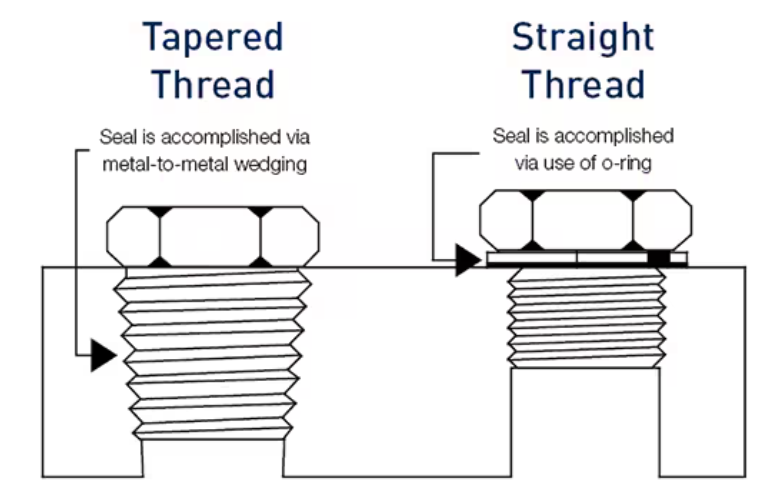
Having served the transportation industry for over 100 years, Parker understands the requirements for trucks and air brake system components. Traditionally, DOT-rated compression and push-to-connect fittings use American National Standard Taper Pipe Threads, referred to as NPTF pipe threads. NPTF or pipe fittings feature tapered threads providing the mechanical strength needed to hold the joint together, plus the metal-to-metal sealing formed when the tapered threads are tightened against tapered port threads. This thread type requires the use of a thread sealant to seal any spiral leak paths or voids that may remain between the tapered threads on the fitting and threads on the port.
The far more common industry standard for the connection ports installed on air brake system components such as air tanks and brake valves, the choice of pipe thread fittings often arises as a matter of necessity, with the fitting thread dictated by the corresponding ports on components. As another benefit, pipe threads don’t require an additional sealing mechanism, besides thread sealant, and they tend to be the lower cost of the two major types.
Disadvantages of pipe threads
The main disadvantage with pipe threads, however, is that voids in the connection still can remain. Pipe threads are prone to leakage, especially since there is no other sealing mechanism besides the tapered threads themselves. In air brake systems, pipe thread leakage has been noted at one area in particular — port connections on air tanks, a known source of warranty claims. Studies of these leaks have shown it may be the way these ports are manufactured that leads to a poor seal.
The process requires female threads to be machined into steel spuds that are welded into the air tank. The ensuing welding process can cause the spuds to warp, which results in a poor fit. In addition, certain NPTF threads can be difficult to position. For instance, an elbow pipe thread fitting may need to be loosened to orient, creating a potential leak path.
Leakage issues like this are less of a concern with the other main fitting thread type, the straight-thread O-ring (STO). Fittings of this design have straight threads providing only the mechanical connection, but not the airtight seal. Meanwhile, the seal is handled by an elastomer O-ring seal or gasket that mates up against a defined portion of the equipment. In this way, the O-ring compensates for any variation in the surface of the port.
A far more reliable option
A less common option for ports installed on air brake components, STO fittings may not be specified in systems with the frequency of pipe threads. However, they have proven to offer more reliable connections where they’re used. For example, warped air tank spuds have less impact when STO fittings are used. One OEM found that most of their warranty claims for air leakage disappeared when they switched from air tanks with pipe thread ports to tanks with STO ports.
However, the added reliability of STO fittings also comes at an increased cost to truck OEMs. In many cases switching to STO fittings may require some customization of the fittings or their respective components. These are costs and benefits for OEMs to weigh as part of their overall business plans.
This article was previously featured on Parker's blog.