Understanding the Cost of Workplace Injuries and How to Prevent Them
With employers spending more than $1 billion each week on serious, nonfatal workplace injuries, the financial impact of poor worker safety is truly astonishing. Here’s how to keep workers safe—and mitigate those preventable expenditures.
Companies looking to better manage costs and improve safety conditions for their workers would do well to focus their efforts on minimizing the most expensive workplace incidents.
Overexertion—defined as working beyond one’s physical capabilities—is the most costly cause of workplace injuries nationwide, according to the 2020 Liberty Mutual Workplace Safety Index, which tallies the leading causes of the most serious workplace accidents that mean an employee misses more than five days from work.
The estimated cost to employees from overexertion is $13.98 billion each year, according to the report, which is more than double the third-highest injury cause on the list: being struck by an object or equipment, which costs businesses $6.12 billion a year. The category includes injuries related to lifting, pushing, pulling, holding, carrying or throwing objects.
“Improving safety is critical to better protecting workers and companies’ bottom-lines.”
James Merendino,Liberty Mutual
Overall, disabling workplace injuries cost U.S. businesses more than $59 billion annually, Liberty Mutual found in its research, yet the leading causes of these injury costs can be mitigated with fairly straightforward safety measures or increased employee training.
To do so effectively, employers must “focus on the causes of the most serious injuries,” he adds.
10 Most Costly Causes of Workplace Injuries and Ailments
Indeed, minimizing the risk of accidents begins with your company’s commitment to safety and understanding how the most common injuries happen. Employers can then start to reorient their operations to better manage and mitigate safety risk.
According to the 2020 index, the 10 most costly causes of disabling workplace injuries and illnesses are:
3. Struck by object or equipment (being hit by objects)
4. Falls to lower level
5. Other exertions or bodily reactions
6. Roadway incidents involving motorized land vehicle (vehicle crashes)
7. Slip or trip without fall
8. Repetitive motions involving microtasks
9. Struck against object or equipment (colliding with objects)
10. Caught in or compressed by equipment or objects (running equipment or machines)
The 2020 index shows that these 10 injuries by themselves amounted to $52.9 billion in direct U.S. workers’ compensation costs, translating into more than $1 billion per week that businesses spend on just the top 10 most costly injuries, the report said.
The company researched the top 10 causes and ranked them by their direct cost to employers, based on medical and lost-wage expenses. The data were compiled using information from Liberty Mutual, the U.S. Bureau of Labor Statistics and the National Academy of Social Insurance.
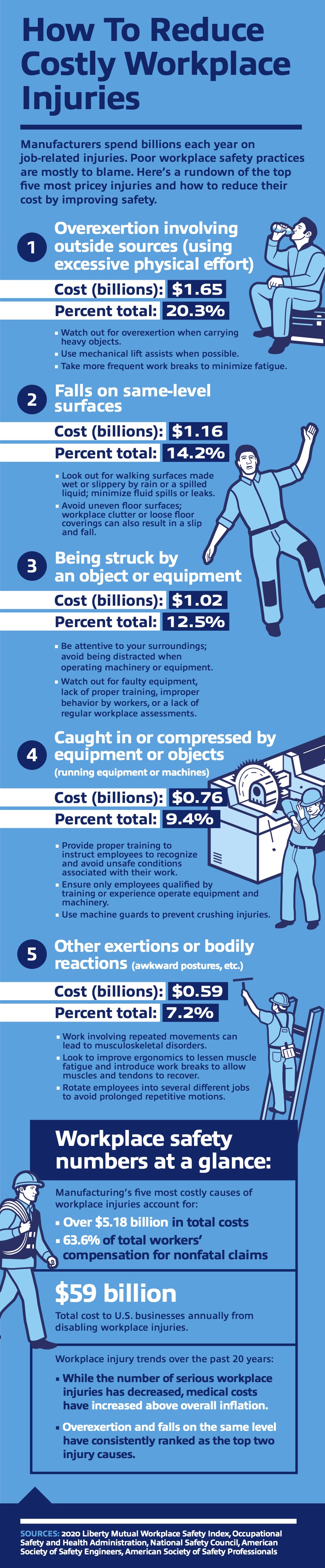
This year, Liberty Mutual included injury cost findings segmented by specific industries. To help you improve safety and reduce costs in your facility, here is the list of the top five costly injuries in the manufacturing sector and tips on how to avoid them:
Click to enlarge
Manufacturing injury cost infographic
Making the Case for More Safety Training
These injury statistics are a good place to start when identifying areas where more safety training is needed.
With the COVID-19 pandemic placing a greater strain on company finances, companies are no doubt looking for ways to save on costs. And safety managers seeking investments in safety require a strong business case.
Using safety calculators to better understand and estimate costs of injuries to support your investment decisions is a good approach. You can create a snapshot of safety performance in your company with your TCR and DART rate scores, and track how they compare to other companies in your industry using NAICS codes.
These scores help you to benchmark your business against industry averages. Scores higher than average are a lead indicator that safety practices should be updated, and they can result in lost business or higher insurance premiums. They can also help you make a strong business case for increasing your training budget.
The good news is that with more safety training now done virtually due to the pandemic, your workers can stay up to date on the latest safety practices despite dwindling travel budgets and the need for widespread physical distancing.
Roland Jones is a veteran editor and researcher with two decades of experience covering business, technology and finance. He holds an MBA from NYU Stern and is a Columbia Knight-Bagehot fellow.
To request a quote, please login to your existing account or register a new one. This helps us provide you with a personalized experience and keep track of your requests.