Industrial 3D Printing: Choosing the Right Process, Material and Service
From prototyping and design iteration to bridging product release and full-scale production, 3D printing offers a range of fast, cost-effective solutions.
Such scenarios are where 3D printing service bureaus earn their keep. At 3D Parts Unlimited, the additive manufacturing (AM) branch of MSC, a team of experienced support personnel works with product designers, manufacturing engineers, and research and development (R&D) professionals who grapple with these and similar bottlenecks every day.
“It’s never as simple as ‘just 3D print it,’” says Jordan Nowak, program manager for 3D Parts Unlimited.
“A complex part that would require multiple machining setups and many days on the shop floor can often be printed overnight.”
Jordan Nowak,Program Manager,3D Parts Unlimited
He goes on to explain that, even though AM is the fastest, most flexible path from CAD file to completed part, anyone wishing to take advantage of its many benefits should first have a basic understanding of 3D printing technology, its limitations and when to use it over—or more likely, in conjunction with—traditional manufacturing processes.
Polymer 3D Printing Technologies: MJF, FDM, SLS, SLA and DLP
Unlike machining and plastic injection molding, industrial 3D printing isn’t a single technology. Rather, it’s a family of processes, each distinctly different and each presenting a range of material choices, postprocessing considerations and design for additive manufacturing (DfAM) principles that can make a print job predictable and profitable or, if applied improperly, downright impossible.
Multi-Jet Fusion (MJF)
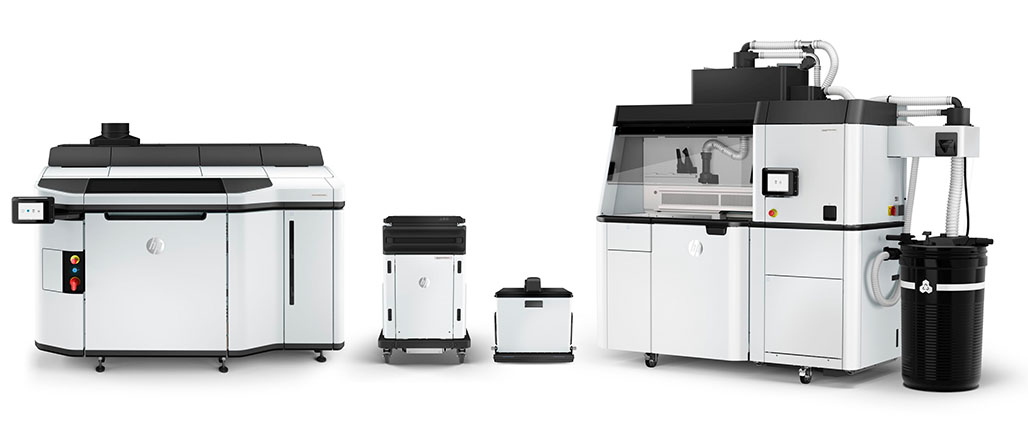
Developed by Hewlett-Packard (HP), MJF is known for its ability to print polymer parts at production levels. It deposits a liquid fusing agent onto a bed of nylon powder, then applies infrared energy to selectively sinter it. The result? Isotropic mechanical properties—meaning part strength is consistent regardless of build orientation—and a surface finish that doesn’t exhibit the “stair stepping” common with 3D printing.
Says Nowak, “For customers needing end-use parts in PA12 or PA11 nylon in quantities ranging from dozens to tens of thousands, MJF is often the right answer.”
HP’s Multi-Jet Fusion (MJF) 3D printer can print polymer parts at production levels.
Fused Deposition Modeling (FDM)
FDM builds parts by using a heated nozzle to extrude thermoplastic filament layer by layer. It is well-suited to prototyping and production of workholding fixtures and tooling inserts, particularly when engineering-grade materials like carbon-fiber-reinforced nylon are specified. “Surface finish is the trade-off,” Nowak says. “Layer lines are clearly visible, and part accuracy is slightly less than with powder-based processes.”
Selective Laser Sintering (SLS)
As its name suggests, the CO₂ laser in an SLS printer selectively sinters bits of nylon-like powder to build parts. Unlike most AM processes, however, it does so without the need for support structures. “This means we can pack the entire build chamber with parts,” he says, which significantly improves economics for even moderate quantities, while also enabling complex geometries that would be problematic with other AM processes.
Stereolithography (SLA) and Digital Light Processing (DLP)
Like a crayon in a coloring book, the ultraviolet (UV) laser in an SLA printer traces and fills in successive slices of the workpiece, curing the photopolymer resin below as the beam passes, while DLP projects each slice as a complete image, curing it all at once.
Both technologies deliver excellent surface finish and fine feature detail, yet DLP systems like the 3D Systems Figure 4 platform are much faster than SLA. They also support high-temperature resins and rubber-like elastomers, making them a strong choice for gaskets and sealing surfaces, Nowak points out.
Metal 3D Printing: When to Choose Direct Metal Laser Sintering (DMLS)
More accurately known by its generic label, laser powder bed fusion (L-PBF), DMLS is a trademark of machine builder EOS. It uses a fiber laser to melt successive layers of aluminum, titanium, cobalt chrome and other metal powders into fully dense parts that are often impractical or downright impossible to make via conventional processes: internal cooling channels, complex lattice structures, and perhaps most intriguing to product designers, consolidated assemblies.
The downside, however, is extensive and sometimes costly postprocessing. “This includes support removal, bead blasting, heat treatment and CNC machining of critical features, and some or all of these are always needed for metal AM parts,” Nowak says. “Fortunately, designers have many 3D printed polymers available that can often replace metal—engineering-grade plastics that offer high strength and durability at lower per-piece costs.”
3D Printing vs. Traditional Manufacturing: A Speed and Cost Comparison
Nowak says one of the most common questions newcomers to 3D printing ask is whether it’s less expensive than machining or molding. After all, AM processes are largely unattended, so one might assume that labor costs are minimal and that tooling expenses are likewise minimal. It’s an easy choice, right?
The answer is rarely this simple. Part geometry, job quantity, tolerances and material—these are just a few of the variables that determine part price and delivery speed, but most importantly, whether 3D printing is the best choice for the application (although it frequently is).
As noted, tooling costs, if any, are minimal with 3D printing. There’s also no waiting for fixture design and manufacture, or time spent writing and proving out CNC programs. Because of this, minimum order quantity (MOQ) and setup time are hardly the cost drivers seen with conventional manufacturing processes.
“A complex part that would require multiple machining setups and many days on the shop floor can often be printed overnight,” Nowak says. Conversely, a blocky, prismatic part with a few drilled holes will almost always be cheaper and faster to machine.
Material Selection Guide: Matching 3D Printing Polymers to Application Requirements
For general industrial applications, PA12 (Nylon 12) processed via MJF or SLS is a first choice. It offers good mechanical properties, chemical resistance and predictable accuracy. PA11 (Nylon 11) delivers greater flexibility and impact resistance, making it preferable for living hinges and snap-fit features.
For applications requiring stiffness beyond what unfilled nylon provides, carbon-fiber-reinforced nylon via FDM—with optional Kevlar or continuous carbon fiber inlay—can produce parts that exceed aluminum in strength and loading potential.
For high-temperature environments or where chemicals are present, PEEK and Ultem (PEI) are the materials of choice. Both are available via FDM and offer exceptional thermal stability and chemical resistance. In many applications, elastomeric DLP resins deliver dimensional accuracy on par with or exceeding that of a common alternative, urethane casting.
3D Printing for Production Parts: Quality, Tolerances and Surface Finish
According to Nowak, the perception that 3D printing is a only a rapid prototyping technology has become obsolete. He says service bureaus like 3D Parts Unlimited routinely run production jobs—holsters for electric drills on commercial vehicles, for instance, and robotic grippers for assembly lines—at quantities in the tens of thousands and beyond.
Further, many parts today are unrecognizable as 3D printed. Properly applied, MJF and SLS produce no visible layer lines and surfaces that accept dyes and coatings uniformly, with dimensional accuracy that rivals plastic injection molding.
When ordering parts, be sure to specify tolerances in line with the printing process. Depending on the part size and material, ±0.010 inches and a 125 Ra microfinish are a good place to start. Also, ask about postprocessing options—tumbling, vapor smoothing, dyeing and various coatings can help with wear resistance, UV stability and cosmetics alike.
Nowak suggests that, rather than thinking of 3D printing as a replacement for traditional manufacturing, engineers and product designers should see it as one more tool in today’s comprehensive, very capable toolbox.
For prototyping and design iteration; as a bridge between product release and high-volume production; for digital inventory of fixtures, grippers and other workholding devices that a service bureau can deliver quickly and cost-effectively—these are just a few of 3D printing’s uses and capabilities, especially when delivered by a trusted partner.
Kip Hanson is a freelance writer and manufacturing consultant. Hanson, who is the proprietor of KAHMCO LLC, has more than 40 years experience in manufacturing, machine tools, fabrication and ERP systems. In addition, Hanson is a contributing editor at Manufacturing Engineering, Shop Metalworking Technology and others. He has been writing about manufacturing technology since 1998.
To request a quote, please login to your existing account or register a new one. This helps us provide you with a personalized experience and keep track of your requests.