Video Transcript
JACOB SANCHEZ: Every shop wants that mirror finish. You want that polished look, and it doesn't matter if you're on a lathe, mill or a grinding machine. But our parts are complex, with sophisticated geometries and tight tolerances, and that can make finishing a daunting task. And when you add automation to that, it ups the challenge. So we're here today with the Norton team.
They're going to help us uncover more of the finishing process. We're going to dive into more of the automation process and learning how, if you do it correctly, it'll help you get that job done. So that's it. You and I, we're going to be hanging out today learning how to finish the job with automation.
This is Norton. We're heading on over to the Abrasive Process Solutions Lab, where they have a team of automation experts to help manufacturers like you with your own real parts, real production challenges, and test, verify, and perfect the finishing process before it ever gets back to your shop floor.
I promised you an automation expert, and I have one of the best, my friend Nathan Jackson.
NATHAN JACKSON: All right, Jacob, good to see you again, man. I like that we keep coming back.
JACOB SANCHEZ: So today I really want to dive into finishing. It's a challenge in any metalworking industry. And when you start trying to add some variables to that, like automation, it can look even more challenging, a little bit daunting.
What are you hearing from customers in your networks that come here to help you figure out their finishing issues?
NATHAN JACKSON: Consistency is the biggest thing we hear from customers. A lot of consistency issues with finishing. You know, you can imagine if you have a shop full of operators, every operator is going to grind slightly differently. They're going to use different force, different contact time. There's going to be fatigue. It depends on whether they've had lunch or not that day, that sort of thing.
But with automation, we can control these variables so that we're always grinding with the same force and with the same process, every single part.
JACOB SANCHEZ: So it sounds like you're trying to find an actual proven process and create a proven process, correct?
NATHAN JACKSON: Exactly. So automation is going to allow you to have consistent pressure, repeatable motion, and predictable outcomes even on your most complex parts.
JACOB SANCHEZ: And those results don't happen by accident. It comes from that process getting proven, tested, and verified throughout the manufacturing facility. I'd love to jump into the robotics cell and get after it.
NATHAN JACKSON: Absolutely. Let's go take a look.
JACOB SANCHEZ: So it's time to get some work done. We're here with our robotic cell. We're here in the APS lab. Nathan, what are we going to be going over? So what are we going to do?
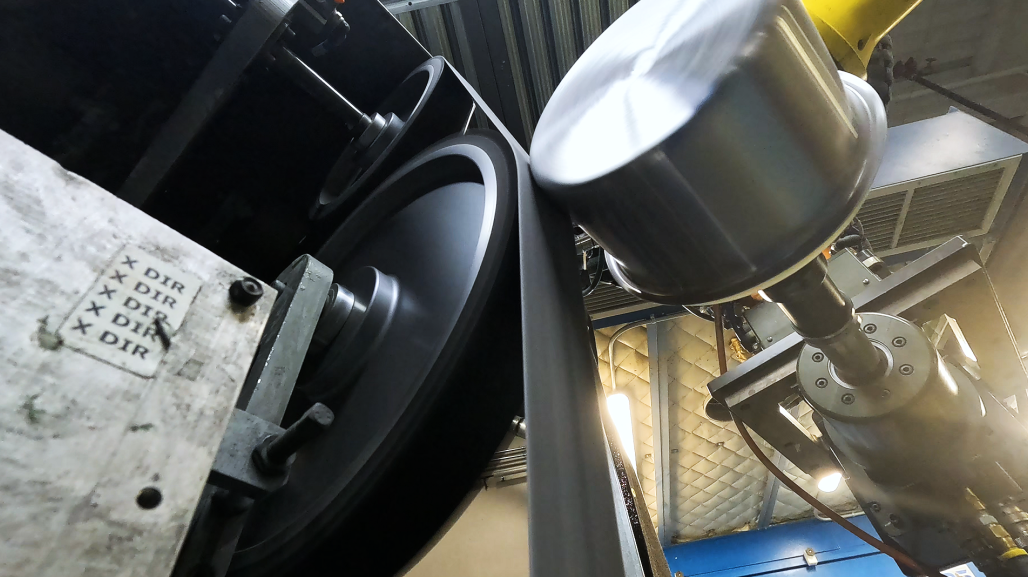
NATHAN JACKSON: Today is kind of simulating a finishing process using our six-axis industrial robot that we have here. On the end of the robot, we have a spindle that's going to rotate our part as we polish it. So first thing we're going to do when we're polishing is take it to these belts. We can try a bunch of different belt, grit sequences to kind of dial in which products are needed.
One other thing. That's nice. You know, we've been talking about this constant pressure. This head has compliance built in, which means throughout the entire cycle, it's going to be constant force.
JACOB SANCHEZ: And that's going to help the robot shine. You have consistency here. Consistency there. That's what you need with automation.
NATHAN JACKSON: Exactly. And then once we've done that, we're going to bring it to the buff and do a little bit of buffing just to kind of get that final shiny mirror finish that people expect from their finishing process. And with the robot, every time we run this, it's going to have a consistent, repeatable result because every parameter is going to be the same.
JACOB SANCHEZ: Before any part can make it into the robot itself, there's a lot of work that goes down here at the APS Lab. You have to break down an application and establish a process, and I have some experts to help me do that. Mike Chappelle.
MIKE SHAPPELL: Good to see you.
JACOB SANCHEZ: How's it going? So good to see you again. Andrew Biro, good to see you, man. Mike, what are some things that you're seeing from your customers out in the field?
MIKE SHAPPELL: Well, when a part first comes to us from the customer, they're asking us to help them with the challenge. And they present us what the final part needs to look like. And then we use that information to design what we have to do inside the robot lab to create that process and give them that net result in the end.
JACOB SANCHEZ: Nice, and sounds like you're starting from scratch. They have a process. You're just trying to help them optimize it.
MIKE SHAPPELL: That's right. And the use of automation, we're able to take what they're coming to us with and then enhance it. And let the automation really work in their favor.
JACOB SANCHEZ: Nice. So, Andrew, when it comes to taking some of these variables and putting them into a process, how do you go about it?
ANDREW BIRO: A lot of what we have to do, to Mike's point earlier, is sort of work backwards from the end goal. And a lot of what we do is do we want to use about do we want to use a wheel that's dependent upon how we can approach the part, and what limitations there are with the geometry of the part, the material on the part, and the finish that we want to hit.
The other thing we have to look at is what sort of pressures and forces do we need to apply, right? How do we optimize all of that to work with the abrasive in order to give us the right result? The focus of the lab is really about tweaking all of those small changes so that they work in harmony with the abrasives that we select to give us the final solution and a final recipe for the customer.
The really nice thing about the upsell is that we can do a lot of that development work here in the lab, so that we're not taking up precious time at the customer site.
JACOB SANCHEZ: Nice. I think I'm actually going to go head over with a finished good, the finished part with Nathan in the metrology area. And we're actually going to check out some surface finish.
How you get a finish on a part is very important. But what that finish actually is is even more crucial. Nathan, let's dive into the first one.
NATHAN JACKSON: So the first thing we're going to do to ensure we've kind of met the customer's requirements, most people have a surface finish requirement, so we would use a profilometer here to get a surface finish reading and confirm that we have met our customer's requirements. So this is our raw part we're looking at here after roughing.
JACOB SANCHEZ: Rough part 119. We're gonna switch these out. Pop that one there. This is the finished one we did earlier. Correct. And that is a three.
NATHAN JACKSON: So, for you, that would typically mean if you want a mirrored finish, a lot of times what that means is like sub 5 or 6 micro inches. So by hitting a 2 to 3 range in this part, we've shown that we've gotten that mirror finish that the customer would be looking for.
JACOB SANCHEZ: Now, what's another process that they would be looking for out of the lab here?
NATHAN JACKSON: So another thing we can do is use a microscopic camera to take very close-up images of the surface, just to kind of see how that scratch pattern on your finished part looks.
JACOB SANCHEZ: And so you would pop in the rough one, you'd obviously dial this in. You can see that there it pop this off, pop the finished one back on. And then you'd be able to see that.
NATHAN JACKSON: Exactly. Yes. And like I said, because this is a camera, we can take images as well and use that for documentation. If we're trying to compare different grit sequences or different finishing products, as we talked about before.
JACOB SANCHEZ: That's cool. And I think the biggest thing here is the fact that you're not just machining the part and then saying to the customer, all right, here you go. You machine the part, you verify the part, and you're giving the customer that confidence to continue to move forward.
NATHAN JACKSON: Exactly.
JACOB SANCHEZ: So we've seen how the automation process needs to get proven here in the lab. And now I'm with Brad Heraghty. How's it going, sir?
BRAD HERAGHTY: Good to see you again.
JACOB SANCHEZ: National account manager for Norton here to represent the customer. What do you think the customer really gets out of coming to a place like this? They have their finishing challenges. They're stepping into the scary world of automation. What do you see from them?
BRAD HERAGHTY: It takes the guesswork out of it. They get to come in and see their parts being worked on and see what the possibilities could be right? And that's great because that builds confidence when thinking about going to automation, especially in a critical final step.
JACOB SANCHEZ: But it's also a little bit of trust, right? Because you may not know my process. I know my parts really well. And now here you go. Take them from me.
BRAD HERAGHTY: Absolutely. So, you know, you mentioned trust, and I mentioned it's, you know, proof of concept. So what that really does is it says, hey, we take on that risk of that initial investment, which allows the customer to see an overall performance in the process, and how it could work without having to make any capital investment and their own shop floor. So talk about trust. We're hoping that helps build them by showing them the process of what it could be.
JACOB SANCHEZ: So confidence. Trust that going both ways and helping out with some of that capital investment. That's what I'm learning today. Now yeah, I appreciate everything you do for the customer.
BRAD HERAGHTY: Likewise.
JACOB SANCHEZ: Thanks for having me today.
BRAD HERAGHTY: Thank you.
JACOB SANCHEZ: Finishing may be one of the last steps in the manufacturing process. But as we've seen today, it plays a critical role in your part quality and your process performance. And you need that process. You need an application, and you need to figure out a way to validate results if you want to optimize manufacturing. That's what we learned here today at the APS lab with the Norton team.
And now you and I, we know … HOW TO finish the job with automation.
Narrator: For more metalworking tips and industry best practices, stay tuned for the next How To episode and subscribe to the MSC Industrial Supply YouTube channel, a source of original manufacturing content Built To Make You Better.