Video Transcript
JACOB SANCHEZ: Everybody assumes that measurement, it's straightforward. You grab your part, you go to your tool, and you trust whatever that reading is on that screen. But in reality, there are tons of variables that can change your results. Temperature, pressure, even your technique, how you're holding your tool, all of that can add up to some expensive problems in your shop.
That's why I'm here today, yet again, with the Mitutoyo team. We're going to be diving into a few things. One. How do measurements change? Number two. How do you properly check a tool? And then number three. How do you use all that information to figure out ways to consistently get accurate measurements every time? And with that, it's time for us to get started in learning how to improve measurement accuracy.
I know you all rely on the How To team for your knowledge, for your education, but even the best of teachers knows when it's time to pass it along to the experts. This right here is Mitutoyo America's Education team, Jeff and Josh. How's it going, fellas?
JEFF MEYERHOLZ: Doing great, thank you.
JACOB SANCHEZ: So to kick things off because we have a lot to go over today, right? I wanted to get your perspective. We'll start with Jeff, if that's all right. What comes into a good training session?
JEFF MEYERHOLZ: So we believe in avoiding lectures. That's something that really scares a lot of people. So we believe in hands-on experiential learning. So as soon as they come in, we get the tools in front of them, start playing with it. People learn on the job in a lot of organizations out there. Unfortunately, those skills that they're taught aren't always correct, and they don't realize that some of the skills they’re learning can really have big impacts on the quality of measurements they're making.
So our job is to correct some of those errors, some of those bad habits that they've learned over time. So they leave here and have a huge amount of confidence when they return to their organization.
JACOB SANCHEZ: Nice. And even if they don't know their bad habits because you're learning them on the job, maybe from some tribal knowledge from somebody else, you know, it may not be the company's way of doing it. It also sounds like it's not just death by PowerPoint, which I think we all get, right? Josh, what's your take on that?
JOSH WORTHLEY: Yeah, we like to keep our trainings very, very interactive, having hands-on demonstrations that the students will go through to understand. Oh, if I place my fingers incorrectly, I'm going to get bad data. Or if I have temperature influences or other technique influences, I'm going to get bad data. So it's much easier to teach and to learn those things with hands-on, with a tool in your hands, doing those things, it really helps make it click.
At the end of the day, we want students to have confidence in what they're doing, so on the shop floor they can get good data and make good decisions.
JACOB SANCHEZ: Yeah, well, I'm your guys’ student today. I feel like I want to get hands on with some equipment. I want to check some things out. You mind if we go get started?
JEFF MEYERHOLZ: Let's go. Let's do it.
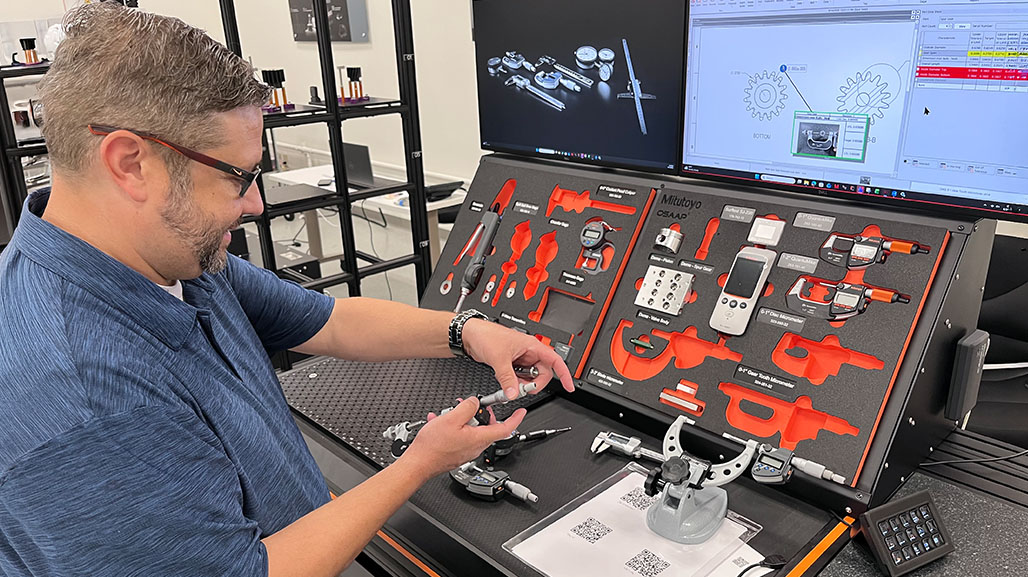
JACOB SANCHEZ: When was the last time you saw me get this hands-on. This is what I'm talking about when we look at getting into products and figuring things out. We're in the training lab with Josh. We're going to be going over temperature, the calibration, pressure, techniques, all of it with measurement equipment. Josh, what have you got to start with me?
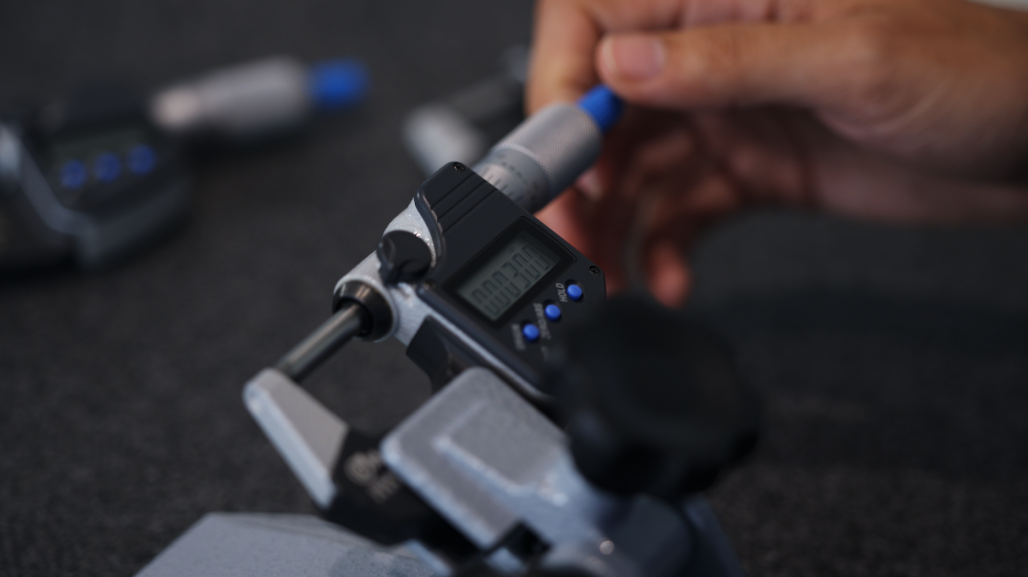
JOSH WORTHLEY: So we've talked a lot about temperature. So I've taken this micrometer, and I set the origin on it this morning. And I've just been hanging on to it, warming it up, trying to mimic what it would be like if somebody were using it all day.
So if we go back and check the zero now on the origin, we can tell it is not reading zero anymore.
JACOB SANCHEZ: What do we got there? That's two thou.
JOSH WORTHLEY: That's 2/10.
JACOB SANCHEZ: Oh yeah. That's an extra zero for sure.
JOSH WORTHLEY: Yeah. So having these things warming up over time, using them in your hands, that's a bad deal. You need to be going back and checking that zero very frequently if you're handling them. Or, one thing you can do to help with this is just put the micrometer in a stand. This gets your body heat and your temperature out of affecting the tool.
JACOB SANCHEZ: And what does this look like? So that's a temperature when it comes to me handling something. But is there a difference between, like, a temperature out in a shop?
JOSH WORTHLEY: Yeah. So it's really important if you can, to let the tools acclimate to soaking in the same environment with the parts that you're inspecting. It gets even worse if you're moving the tools or the parts from different environments that have different temperature changes, and they're actively changing when you're trying to measure them, that's a bad deal.
You need to let the equipment, let the parts soak in their environments.
JACOB SANCHEZ: It doesn't matter what type of millions, tenths, thousandths that you're inspecting to, that soaking is good for every shop to stay consistent. We're talking about temperature of the human using the tool. We're talking about the temperature environment when it starts expecting calibration of the equipment. What else goes into this?
JOSH WORTHLEY: Yeah. So, from a calibration perspective, I can't use this tool at all unless it's been calibrated. And the environment that is really important is 68°F. We calibrate all of our equipment at 68 degrees. It has to be that way. That number is a very important temperature. If you're measuring differently than that, you might need to do some math to calculate to compensate for your temperature differences.
JACOB SANCHEZ: Nice. And now what do you have when it comes to actually using the equipment? What are some tips?
JOSH WORTHLEY: So, the calipers are the really classic ones that we like to look at. A common question that we'd like to ask in our classes is where the heck do you put your thumb? Do I put it here? Do I put it here? Does it matter? Maybe it doesn't matter at all. When I'm measuring a part, should I be measuring at the top of the jaws? Should I be measuring at the bottom of the jaws? Does it matter? Short answer is yes. Yes, it does. All of these things matter. So if I'm measuring at the top of the jaws, I can start putting too much pressure on my thumb and not really affect that measurement too much. But if I go down to the bottom of the jaws and I start squeezing, I can affect that number very, very quickly.
So the technique in your finger placement, the consistency in that is critically important. If your thumbs are dancing around or you're handling this thing in all sorts of weird, different ways, your ability to feel that pressure is going to not be good. It's not going to work very well if you're using inconsistent technique.
JACOB SANCHEZ: This just goes to show, even if you have a high-end piece of equipment, if you're not using it consistently, it's not going to be reliable. Let's go check in with Jeff to learn a little more.
Good to see you again, Jeff.
JEFF MEYERHOLZ: Good to see you as well.
JACOB SANCHEZ: So we learned a lot about variables that can affect a measurement. And it seems now that we understand those, I feel like some people still may think that I can just take a pair of calipers. I can measure it, I guess a standard. And now this caliper is calibrated.
What do you have to say about that?
JEFF MEYERHOLZ: A lot of times, they refer to that as like a verification check real quick. And those can be very handy. But I like to live in analogies a lot. And so what I think of is when I get up in the morning, I do a quick little stretch. All right. Body's functioning well. All right. I'm good to go.
That's not the same as a full doctor's annual physical, is it? Well, that's the same thing for a calibration of, say, a caliper is a quick verification check. Is stretching, exercising that caliper seems like it's functioning okay, but it's not to the same depth and procedural analysis that you're going to get out of a full calibration. Another part of that is am I checking all the major surfaces across the entire operational range.
That's part of a full calibration. I am searching for those errors. I want to prove that this thing is functioning at its maximum capacity before I hand it off to the technician out there. So what you're going to search for are some of those masters. One of the most common ones is a gauge block. You want to make sure that these gauge blocks have been calibrated themselves so that I know this can be trusted.
So I'm going to send that off to be calibrated typically at a CAL lab. It's just like Mitutoyo offers here in Aurora, Illinois. So I'm going to have these traceable standards. I know these are good. I can use these in that calibration procedure. So that traceability, that reliability, and that trustworthiness is passed along to the caliper, which is then used out on the shop floor for those parts that are being manufactured.
JACOB SANCHEZ: So even though I have a high-value piece of equipment and I can maybe get a measurement out of it, I'm doing this calibration process so I can make sure I'm creating a repeatable, accurate environment to get my measurements. Is that kind of the deal?
JEFF MEYERHOLZ: Absolutely. The key is trust. We've talked about that many times already. You have to trust your measurements in order to trust the data, which ultimately gets passed along, so that the people who are receiving your parts that you just manufactured have trust in them as well.
JACOB SANCHEZ: Yeah. I appreciate what you've taught me today. And Josh, fantastic job as well.
Today, we took calibration beyond the basics and saw firsthand how temperature, pressure, and technique play into measurement accuracy in the real world. With this knowledge, you're going to be seeing new confidence in your machinist and your inspectors to deliver accurate measurements on every job. I want to give a special thank you to Josh, Jeff, and the entire Mitutoyo team for helping us learn how to improve measurement accuracy.
Narrator: For more metalworking tips and industry best practices, stay tuned for the next How To episode and subscribe to the MSC Industrial Supply YouTube channel, a source of original manufacturing content Built To Make You Better.