Every area of a facility floor carries its own risks, but few places bring as many together at once as the loading dock, where forklifts, pedestrians and trailers all operate to move freight across the same tight space.
“Loading docks are a meeting point of people, material and, in a lot of cases, heavy equipment,” says Tanner Rienbolt, account specialist at Justrite. “You get all those things in one area, and you have a recipe for disaster if there’s not a good safety program in place.”
And the hazards are always changing. Even a secure dock can turn dangerous in an instant—a trailer shifts or a worker steps into a crosswalk at the wrong time. The stakes rise further when hazardous chemicals, flammables or gas cylinders are part of the load, Rienbolt says.
Common Loading Dock Hazards
Loading dock risks tend to fall into a few main categories, each shaped by how people, equipment and trailers interact.
Unsecured Trucks and Trailer Creep
Unsecured trailers may be the most underestimated dock hazard, Rienbolt says. Facilities often invest heavily in visible safety measures—floor tape, crossing signs, forklift beepers—while the trailer itself is overlooked.
“People tend to see ‘secured trailer’ as a checkbox and go on with their day rather than making it a safety measure to keep an eye on and monitor,” he says. “If it hasn’t been properly chocked, you can create a really serious gap, and that’s when slips and falls happen.”
Forklift and Pedestrian Traffic
“You see people walking through forklift traffic lanes, and forklifts driving through pedestrian lanes, trying to cut off 10 seconds,” Rienbolt says. “You might save the seconds, but the risk is just not worth it. It increases your liability for accidents, and we see it a lot.”
Read more: Moving Violations: Protecting Workers from Falling Objects and Other Struck-By Hazards
Edge and Fall Risks
An unprotected dock edge becomes a drop-off hazard the moment a trailer pulls away, particularly for forklift and pallet jack operators working near the opening.
Read more: 5 Quick Tips for Passive Fall Protection
5 Loading Dock Safety Tips
The following practices go a long way toward reducing the risk of dock incidents.
Separate Pedestrian and Vehicle Traffic
Watch how people actually move through the facility, and map your foot and forklift traffic patterns to that, rather than sticking to a predetermined plan, Rienbolt says. Phil Zee, merchandising director for compliance and training at AccuformNMC, adds that although facilities typically mark lanes with floor tape, overhead line projectors can offer additional visibility at night or in spots where tape doesn’t hold up.
Chock Trailer Wheels Before Loading or Unloading
Whether it’s a wheel chock or a dock restraint system, make securing the trailer a non-negotiable, repeatable process that’s completed before anyone goes near the truck, Rienbolt advises. “There needs to be clear communication when it’s done every single time, so there’s no confusion,” he says.
Inspect Dock Levelers and Dockboards Before Every Shift
Constant use from forklifts and pallet jacks wears down hinge points, lip plates and leveler mechanisms that can lead to a failure under load, effectively shutting down the dock, not to mention creating a hazard. For that reason, “dock levelers and boards should be part of your safety program, and they should be inspected as such,” Rienbolt says. “Operators should be encouraged and taught to see the problems with equipment before they become real issues.”
Establish a Signal System for Truck Arrivals and Departures
Zee points to stop-and-go signals—typically red and green lights positioned both outside the dock for the driver and inside for workers—as a shared status check that keeps everyone working off the same information; he also explains that safety signs and safety lines reinforce safe behavior. Without clear signals, a driver can pull away thinking a load is complete while someone is still inside the trailer.
Assess Dock Lighting Regularly
A trailer’s interior has no light source of its own. Zee recommends dock lights, often mounted on an adjustable arm, positioned to illuminate the inside as workers load or unload by hand or pallet jack.
OSHA Loading Dock Requirements
The Occupational Safety and Health Administration (OSHA) has a few key standards that apply to loading docks.
29 CFR 1910.178 requires that trucks and trailers be secured—typically with a wheel chock or an equivalent mechanical restraint—before loading or unloading with forklifts and other powered industrial trucks.
29 CFR 1910.28 requires guardrails, safety nets or personal fall protection for unprotected dock edges 4 feet or higher. There’s a narrow exception under which an employer can demonstrate that fall protection is not feasible.
29 CFR 1910.26 requires that dockboards be able to carry the maximum load and be secured against unsafe movement, and that wheel chocks be used to secure vehicles on the boards.
Types of Loading Dock Safety Equipment
The right equipment helps companies turn loading dock safety tips into daily practice, making safe behavior the default rather than an extra step.
Loading Dock Safety Barriers
Fixed or removable barriers mark the dock edge and block access when no trailer is present, reducing fall risk for pedestrians and powered equipment.
Read more: Fall Protection Spotlight: Safety Railings and OSHA Guardrail Requirements
Safety Gates
Rising or swinging gates close off an open doorway automatically when a trailer isn’t docked, closing a gap that’s easy to overlook between trucks.
Dock Levelers and Dockboards
These extend from the building to meet the trailer bed, closing the height gap so forklifts and pallet jacks can cross without a step or lip to catch a wheel.
Wheel Chocks and Trailer Restraints
A wheel chock wedges against a trailer’s tires, and a dock restraint locks onto the trailer. Both can keep a trailer from moving away from the dock face during loading or unloading.
Make Training a Recurring Exercise
The biggest failure points at the loading dock center around incorrect or missing equipment and the poor habits of employees, Rienbolt says. Safe habits are formed through training, and many facilities aren’t doing enough.
“You’ll have annual check-ins with your team—Jan. 1 every year, you go through a big training and everyone’s on board, but then come February, either everyone’s forgotten about it, or they just decided it’s not important, and the dangerous habits come back,” he explains.
“You want to make it a consistent conversation so everyone from the top down knows what they’re doing. Safety has to become a part of the way a facility operates, not just a checklist or something that you do once a year.”
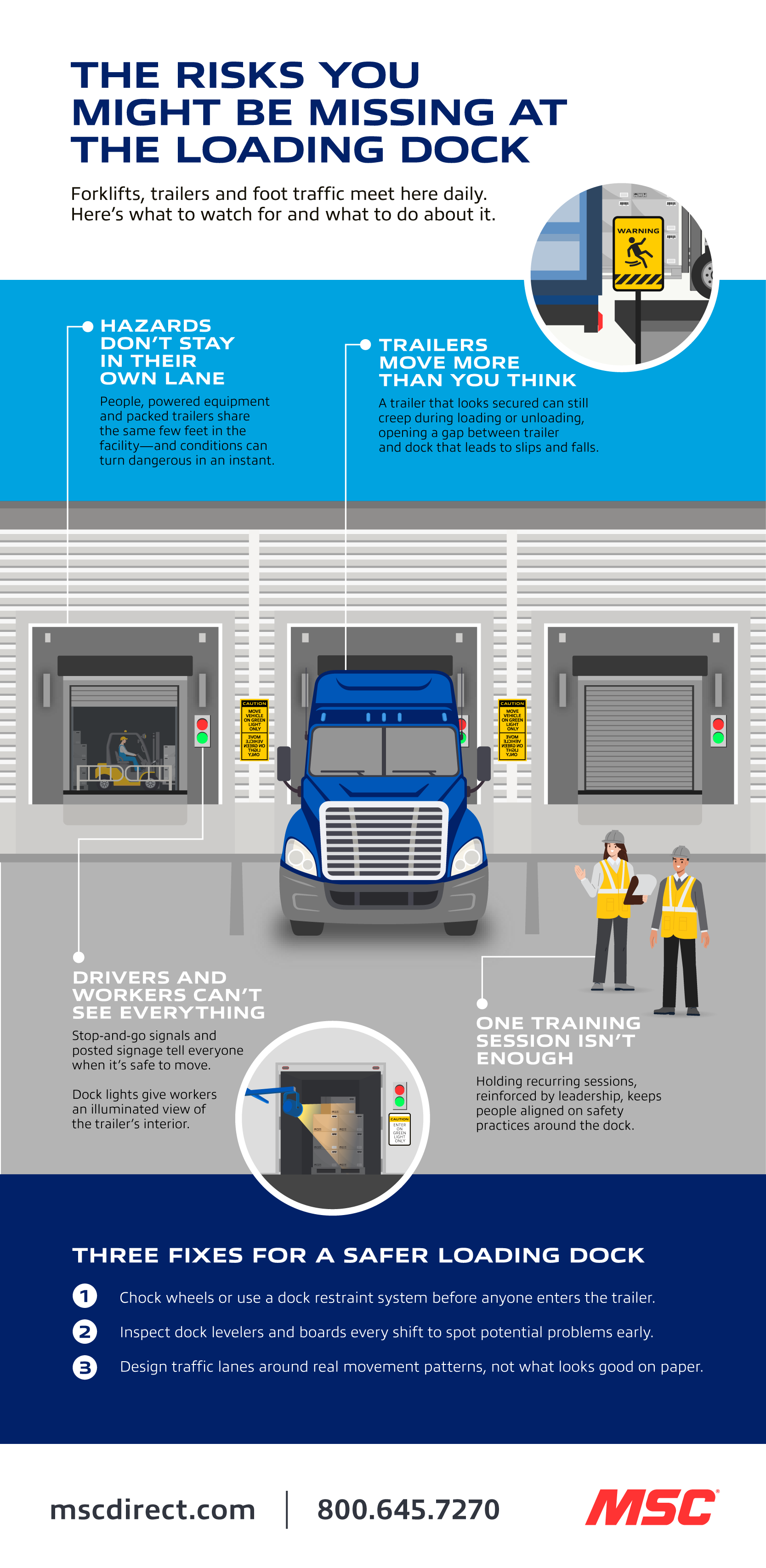
For a visual breakdown of loading dock risks and fixes, see the infographic below.