Video Transcript
Narrator: This video is brought to you by Justrite Safety Group, helping protect people, property, and the planet. If you're looking for real-world insights, tips from leading industry experts, the latest trends in products and technology, you've come to the right place. From MSC Industrial Supply, this is Tooling Up.
TONI NEARY: Hi everyone and welcome to Tooling Up. I'm your host, Toni Neary, and I'm so glad that you've joined us today. Before we get started, take a minute and go ahead and click those Like and Subscribe buttons so you don't miss a single episode from MSC and our industry partners. Today on Tooling Up, we're discussing why more manufacturers are taking a proactive approach to facility safety, and how the right hazardous material storage solutions help protect their people, facilities, and operations.
Joining me from Justrite Safety Group are Dan Hacker, Director of Channel Development, and Chris Wagner, Inside Channel Account Manager for Justrite and Eagle Safety Cabinets. Dan and Chris, thanks for joining me and welcome to Tooling Up.
CHRIS WAGNER: Yeah, thanks for having us.
DAN HACKER: Appreciate you having us. Thank you.
TONI NEARY: Dan, I'd love to start with you. For viewers who may not be familiar with Justrite Safety Group, tell us a little bit about the company and your role there.
DAN HACKER: Yeah, absolutely. Justrite’s really focused on one thing: people, property, and the planet. And ultimately, what we try to do is take a consultative approach when we come in and talk to people. We really want to understand the situation they’re in. We don't just want to sell them something. We want to work with them. We want to identify their risks.
We want to work through their hazards and come up with a solution that works best for them. In my role, I work closely with industrial distribution people just like MSC, and I try to partner their people with their customers and pull back through that consultative approach of selling, as we discussed.
TONI NEARY: And it really sounds like the conversation around facility safety has changed quite a bit over the years. Manufacturers today aren't just dealing with flammable liquids anymore. What are some of the biggest changes that you've seen, and why is it more important than ever for companies to really take a proactive approach to hazardous materials storage?
DAN HACKER: Yeah, absolutely. Toni, the workplace is changing all the time. Things are very fluid. And here recently, we're trying to manage more materials, more regulations, and more risks than ever before. You know, codes continue to evolve; regulations continue to evolve. There's larger storage of chemicals for bulk purchases that make more sense. Now we've got lithium-ion batteries that are coming into play.
And I'm certain you've heard about some of those fires in the news where lithium-ion, whether it's your cell phone or your scooter or your e-bike, they're just significant and disastrous. And where we're really seeing the best support is with insurance companies coming alongside to make sure that their people, their clients that they're protecting, are doing everything they can to mitigate that risk.
We want to make sure that those customers are adopting best business practices when it comes to safety, and ultimately the goal is to prevent something from occurring as opposed to dealing with the ramifications of what happened after the fact.
TONI NEARY: All right. So, Chris, once manufacturers recognize those changing risks, how do they begin evaluating whether their current hazardous material storage solutions still actually even meet their needs?
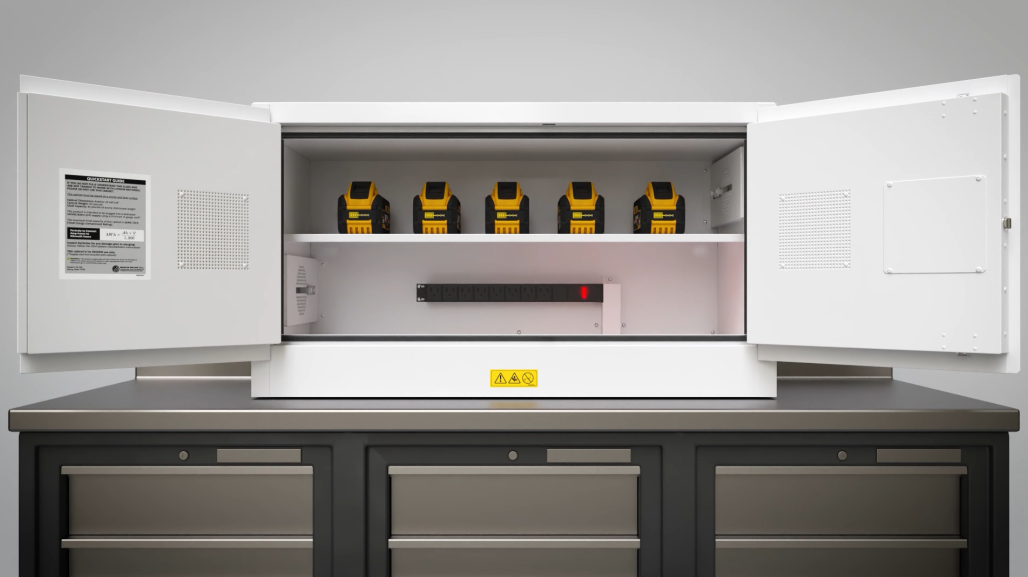
CHRIS WAGNER: Yeah, that evaluation process is really important. I mean, that's what determines what sort of cabinet you need. So traditionally you just buy a yellow cabinet and throw flammables you have inside of that. It's not the case anymore. And we have expanded our cabinet line to reflect that. So whether it's, as Dan mentioned, our lithium ion cabinet for storing charged lithium ion batteries, or our utility guard cabinet with expanded storage.
If you want to do a green cabinet for, say, pesticides, blue for acid corrosive. We can do custom cabinets as well too. So it's not really a one-size-fits-all. We have a lot of different options and opportunities to help improve safety, compliance and efficiency in the workplace.
TONI NEARY: Awesome. Well, let's start with one of the most common hazards manufacturers face and that’s storing flammable liquids. So when evaluating their facility, what questions should they ask to make sure they're choosing the right safety cabinet for their application?
CHRIS WAGNER: Yeah. So there's a couple of different things that we want to look at. We want to look at volume. So how much of the material do you have on site, as well as what is that? So by law, you have to have SDS sheets for the material, the liquid chemicals you have on site. Those SDS documents are what's going to tell us how much we're able to have on site, as well as, you know, where it can be.
And those are things that help kind of lead the decision to choosing that right safety cabinet for the level of protection that's needed.
TONI NEARY: So, Chris, I think people may assume a safety cabinet is just a safety cabinet, but there are some really important differences, especially between manual-close and self-closing models. Can you walk us through this?
CHRIS WAGNER: Yeah, absolutely. So we do offer both models of cabinet: manual and self-closing. Self-closing cabinets are going to be required in the majority of U.S. states. But the important thing to remember is that they both provide the same level of protection, flammable protection, as long as they're closed. So that's the problem, that’s what we're trying to engineer out with our self-closing cabinet is having to rely on that human piece to go there and manually close the door every time it's used.
So our self-closing cabinets utilize what we call a fusible link. It melts whenever the cabinet’s in a fire situation; if it hits 165 degrees, this metal will actually melt, allow the door to self-close, so that way you don't have to worry about did I close that the last time I went in and took something out of it? But it makes sure that the cabinet is fully closed in a fire situation. But it's important to note that these cabinet regulations change all the time. More and more states are mandating self-close cabinets. You're able to be grandfathered under some circumstances, but at the end of the day, like I said, we're trying to engineer out that risk of the individual human just forgetting to close the cabinet as you go about your day.
TONI NEARY: So we've talked about traditional flammable liquid storage, but manufacturers today are managing a much, much wider variety of materials and workplace hazards than we were even just a few years ago. Chris, what are some of these newer challenges that you're seeing, and how has Justrite responded with these new and innovative storage solutions?
CHRIS WAGNER: Yeah, I think we've taken the proactive step of looking at the market and seeing what sort of dangerous material is out there. Lithium-ion batteries. I know we talked about it briefly already, but they're more pervasive than you've ever seen. These tools are incredibly helpful. They're very, very popular. But at the end of the day, charging this battery is dangerous.
A lot of places will just stick them, you know, on a dock in the back, several of them in series. And while they're charging, they could be they could be induced into what's called a thermal runaway event. It's a chemical fire. Very, very difficult to put out. They can reignite after they've been put out. So we saw a need in the market for something that the regulations hadn't quite caught up with yet.
Those are being written. But right now, like you're right, it's really the financial side. The insurance executives, the insurance companies, are coming in and saying, hey, look, we can see the financial burden of 5000 lithium ion battery fires in the U.S. a year. What are we going to do about this? And so that's where we came in and developed our cabinet to allow these batteries to safely charge in a way where, if there is a thermal runaway event, it's contained inside that cabinet overnight and doesn't spread to the rest of the facility.
TONI NEARY: And then another solution you offer is your outdoor safety cabinet. So what situations call for storing hazardous materials outside of the facility instead of indoors?
CHRIS WAGNER: A lot of times it depends on the facility itself. It can be either an abundance of material. If they have over the maximum allowable quantity inside of a control room, maybe they just need excess storage. Maybe it's particularly nasty stuff that they don't want around their people or their property. So it really comes down to the application and what's going to be most appropriate.
We saw that a lot of our customers were purchasing our indoor cabinets and just putting them outside, which is great, but our standard cabinets aren't built for that. They'll rust and corrode pretty quickly. So we created a cabinet that uses galvanized steel, 16 times more corrosion-resistant than regular steel, and it's got a couple of different product attributes like a slanted roof, forklift pockets for easy maneuverability.
But most importantly, it's got the exact same 10-year limited lifetime warranty as our indoor cabinets. So we took our bread-and-butter indoor standard safety cabinet and reproduced one that's just as robust and will hold up outside under those conditions.
TONI NEARY: And finally, not every safety improvement is about adding another cabinet. Sometimes it's about making better use of the storage space that you already have. So tell us about Utili-Guard and how it helps customers improve organization and efficiency.
CHRIS WAGNER: Our Utili-Guard cabinet features integrated storage inside of the doors. Dan pointed out to me a couple of weeks ago, it's very similar to the storage inside your refrigerator. I mean, if you're going to buy a new fridge, you're not going to buy one without a space for your eggs and butter and ketchup and mustard, right? That's everything that we use initially, quickly, every day it’s right there.
Very similar line of thought with the Utili-Guard cabinet. So by utilizing that space on the inside of the doors, we can get about 28% more storage, which if you were in a place where space is at a premium, that's huge. So not only does it help you store more on site, but it allows you to help with visual ID, visual inventory and have things just readily available at reach.
And in all, you know, laid out nicely for you.
TONI NEARY: All right, Dan, one thing I've really taken away from today's conversation is many companies just don't even realize what their biggest safety risks are. Can you tell us a little bit about the STUD-E program that you've created and how that really does help manufacturers?
DAN HACKER: Yeah. So the STUD-E program is simple. We come in, and we consult your safety program. We look at that scary closet in the corner, and we open it up, and we start identifying, hey, you're doing good here. But we need to focus on a few more things here. And it's our ability to come in, take a look at the situation, take some pictures, line up the regulations you're doing well. And then we point out where you need to focus on. And we list the specific regulation you're not hitting. And then we take the extra step of here's the product that is going to take care of the situation. And we provide a full PDF report. So it's our way of helping increase your safety culture, increase your safety program.
And it's a proactive approach as opposed to, unfortunately, a reactive approach which many people take.
TONI NEARY: Fantastic. I can't thank you enough for both being here and sharing your expertise with us today.
CHRIS WAGNER: Thanks for having us. It was a great time,
DAN HACKER: We appreciate the time, Toni. Thank you so much.
TONI NEARY: It was so great having Dan and Chris visit with us today. To learn more about Justrite Safety Group’s hazardous materials storage solutions, visit: www.mscdirect.com/products/justrite-cabinets or contact your local MSC safety consultant. Don't forget to subscribe to our channel so you never miss an episode. Thanks for watching and we'll see you next time on Tooling Up.
Narrator: Want more insights and ideas to improve the efficiency and productivity of your operations? Check out the Tooling Up video playlist to hear tips that can take your company to the next level, and subscribe to our channel so you won't miss out.