



Indicates an immediate hazard with a high probability of severe injury or death.
Basics of Safety Signs and Identification
Comply with the law
ANSI Z535 and OSHA 1910.145 — Safety signs are required to indicate and define specific hazards that, without identification, may lead to injury or death. Select your sign with the header that indicates the degree of potential hazards in your application. Complying with OSHA 29 CFR 1910.145, the federal specification for accident prevention signs and tags, is the baseline requirement behind every safety sign selection on this page.
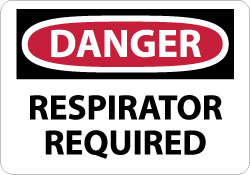
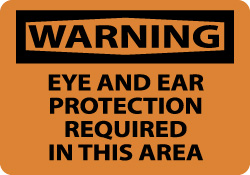
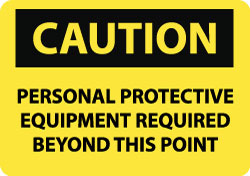
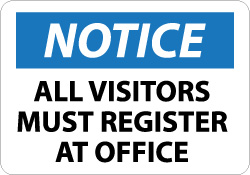
Different Safety Signs and When to Use Them
OSHA Guidelines for Safety Signs and Identification
OSHA 29 CFR 1910.145(c)(1) and NFPA 101 Life Safety Code require that the locations of fire extinguishers, sprinklers, hoses, and alarms be clearly marked.
OSHA 29 CFR 1910.37 and the NFPA 101 Life Safety Code require all exits to be clearly marked.
OSHA 29 CFR 1910.37(q)(1), (3), (4), (6), (8) requires directional exit signs wherever the path to the nearest exit is not obvious. Additionally, any doors, passages, or stairways that are not exits—and could be mistaken for one—must be marked either as “Not an Exit” or labeled with their actual use (e.g., “Closet,” “Property Room”).
OSHA 29 CFR and ADA Section 4.1.2(7) require accessible toilet and bathing facilities to be identified with the International Symbol of Accessibility.
OSHA 29 CFR 1910.1200 requires all hazardous chemical containers to be labeled with the chemical name and appropriate hazard warnings to inform employees of potential exposure.
OSHA 29 CFR 1910.305(b)(3) requires box covers to be permanently marked with “HIGH VOLTAGE” on the outside.
NEC 430.102 – A disconnecting means it is required for motors, motor circuits, and controllers. Provisions for locking or adding a lock must be permanently installed on or at the switch or circuit breaker used as the disconnecting means.
OSHA 29 CFR 1910.145 – Signs must be posted where hazardous situations could result in death or serious injury, indicating immediate danger and required precautions. In areas with potential for serious injury, signs must caution against unsafe practices.
OSHA 29 CFR 1910.145(c)(2) – Caution signs must be used to warn against potential hazards.
OSHA 29 CFR 1910.147 – All energy sources must be turned off and locked out during machine servicing or maintenance. If a source cannot be locked out, a tagout system must be used instead.
OSHA 29 CFR 1910.1450(h)(1) and 1910.1200(g)(10) – Material Safety Data Sheets (MSDS) must be readily accessible to all employees under the Right-to-Know provisions.
OSHA 29 CFR 1910.145 – Location signs for eyewash stations and safety showers are recommended to ensure quick and easy identification in emergencies.
OSHA 29 CFR 1910.146(c)(2) – Signs must be posted near permit-required confined spaces to warn employees of potential hazards, using messages such as “PERMIT REQUIRED CONFINED SPACE.”
NFPA Life Safety Code 5-2.2.5.4 – Stairs serving five or more stories must have signage at each floor landing inside the stair enclosure. Signs must indicate the floor level, the top and bottom termini of the stairs, stair identification, and the floor and direction of exit discharge.
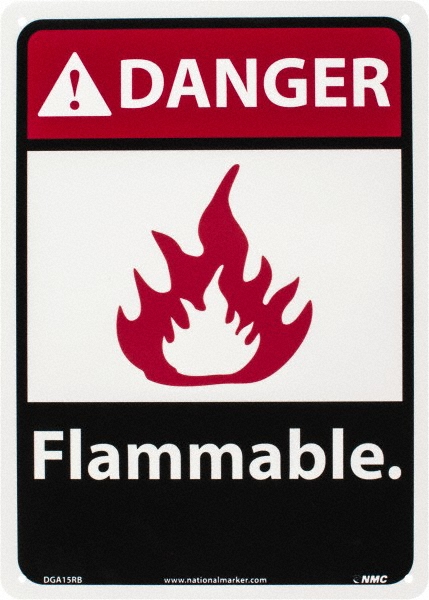
Fire Signs
• OSHA 1910.106(d)(3)(ii) – Storage cabinets for flammable liquids must be clearly labeled with “Flammable – Keep Fire Away” in a conspicuous location.
• OSHA 1910.158(c)(1) – Fire hose reels or cabinets must be clearly identified and used exclusively for fire equipment.
• OSHA 1910.157(c)(1) – Portable fire extinguishers must be clearly identified, properly mounted, and easily accessible at all times.
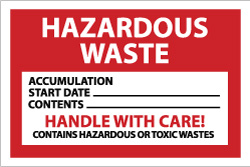
Hazardous Waste Labels
Labeling Requirements for Hazardous Waste (per DOT 49 CFR Part 172 & EPA 40 CFR Part 262) – Hazardous waste containers must be labeled in English, using durable labels with contrasting colors. Labels must be clearly visible and not obscured by other markings, attachments, or labels.

Safety Marking Tapes
Tape Color Safety Codes (per OSHA 29 CFR 1910.144(a)) - Recommended color designations for safety tape as outlined by OSHA:
• Red – Indicates danger, fire protection equipment, and flammable liquid containers.
• Orange – Indicates hazardous parts of machinery or energized equipment.
• Yellow – Signals caution and marks physical hazards; may be used with black/yellow stripes interchangeably.
• Blue – Warning against starting equipment under repair.
• Green – Indicates safety and first aid equipment locations.
• Black & Yellow – Indicates caution and marks physical hazards.
• Magenta & Yellow – Indicates radiation hazards.
• Red & White – Signifies danger and marks fire protection equipment.
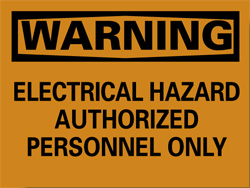
Electrical Hazards
ANSI Color Code (ANSI Z535.1) – Orange is the designated color for identifying hazardous machine parts or energized equipment that may cause shock or injury.
To request a quote, please login to your existing account or register a new one. This helps us provide you with a personalized experience and keep track of your requests.