



Approved safety cans are required wherever flammable or combustible liquids are used or stored in commercial and industrial settings.
Store Hazardous Liquids the Safe Way
From OSHA compliance to types, colors, and construction, learn everything you need to know about safety cans and how they protect your workplace.
Why Use a Safety Can?
The handling of hazardous liquids is regulated by strict safety and health requirements. Employees working with flammable, combustible, and explosive liquids must be protected with approved safety cans. These containers are considered the first line of defense, helping prevent fires by:
Safely containing hazardous liquids and liquid-soaked materials
Controlling vapor release
Meeting federal, state, and local fire codes
Complying with OSHA regulations
What designates a container as a safety can suitable for storing flammable liquids comes down to a few specific characteristics: it must be metal, have a maximum 5-gallon capacity, and include a spring-closing lid, a spout cover, and a flame arrester that safely relieves internal pressure if exposed to fire. Liquids that are flammable or combustible must be stored in safety cans, or other approved containers, to avoid the risk of fire. A safety can is also sometimes called a gas can, fuel can, or safety canister, though not every gas can sold meets the OSHA and FM/UL requirements described on this page.
Compliance and Regulatory Requirements
NFPA 30 and OSHA 29 CFR 1910.106(a)(29) define a safety can as an approved container (≤ 5 gallons) with a spring-closing lid and spout cover that safely relieves internal pressure when exposed to fire.
Types of Safety Cans
The two main types covered by NFPA 30 are Type I, with a single spout for both filling and dispensing, and Type II, with a separate flexible spout for more controlled, safer dispensing.

Type I Safety Cans
- Single spout for filling and dispensing
- Include leak-tight, spring-closing lids with gaskets designed to relieve internal pressure
- Fixed or free-swinging handles
- Warning labels in three languages and flame arresters in the spout opening
- Available in lab cans, disposal cans, and faucet can styles

Type II Safety Cans
- Two spouts: one for filling and one with a flexible metal spout for safer controlled dispensing
- Actuated pour valve for reduced spill risk
- Include leak-tight, spring-closing lids with gaskets designed to relieve internal pressure
- Fixed or free-swinging handles
- Warning labels in three languages and flame arresters in all spout openings
Specialized Styles

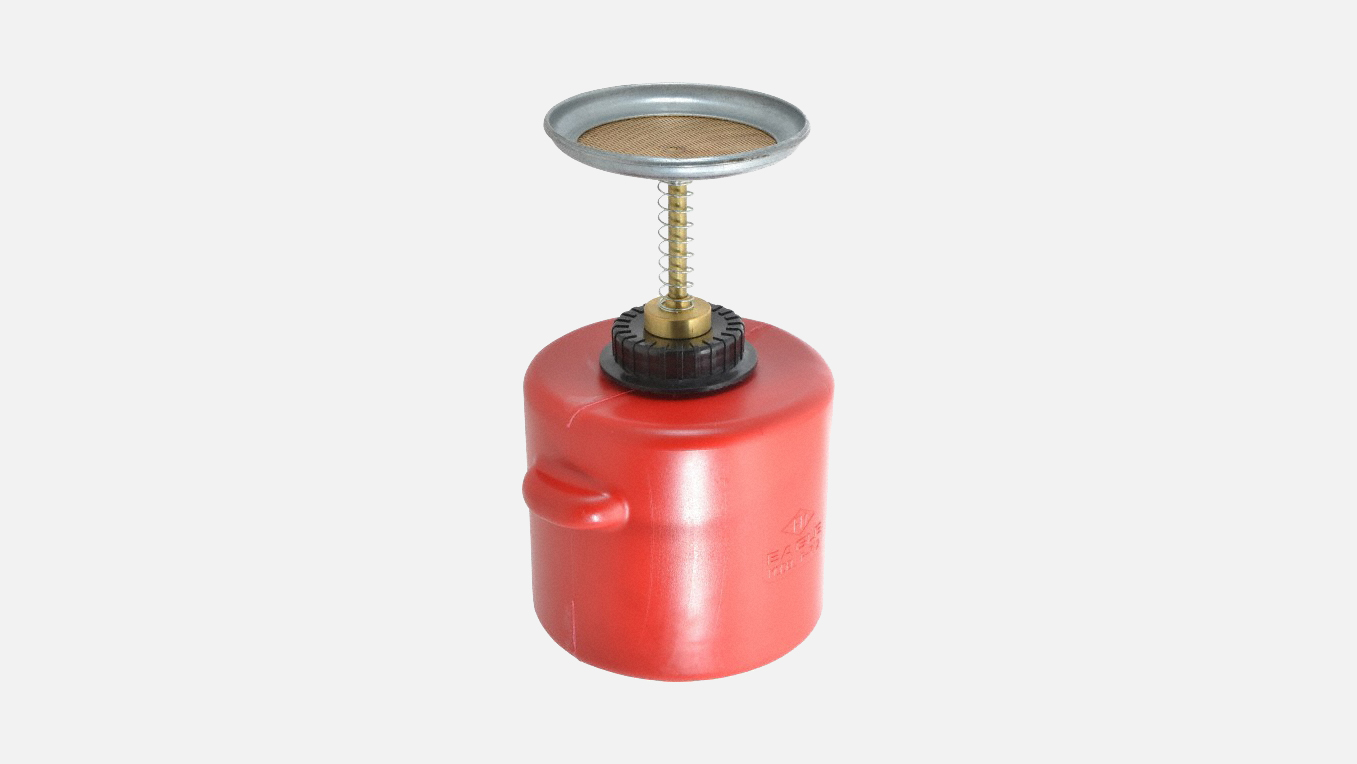
Oily Waste Cans
For solvent-soaked rags; self-closing lid prevents spontaneous combustion. Oily waste cans are typically constructed of metal with a self-closing lid, which directly answers whether containers for oily shop rags need to be metal with a lid that stays closed: yes to both, since metal construction and a self-closing lid are what prevent the heat from spontaneous combustion in solvent-soaked rags from escaping and igniting.

Safety Can Colors & Identification
Colors help separate, organize, and identify chemicals, and assist first responders in emergencies.
OSHA 29 CFR 1910.144 states, “Safety cans or other portable containers of flammable liquids having a flash point at or below 80° F, shall be painted red with some additional clearly visible identification either in the form of a yellow band around the can or the name of the contents conspicuously marked on the can in yellow.
In other words, gasoline and other flammable liquids should be stored in an approved container that's red with yellow lettering or a yellow band, not a plain red or plain yellow container alone.
Industry-accepted safety can colors are as follows:
Red: Gasoline or other flammable liquids
Yellow: Diesel fuel
Blue: Kerosene
Safety Can Construction Materials

Laboratory Safety Cans
Laboratory safety cans reduce the risk of explosions from vapor ignition in industrial, hospital, and scientific labs. They are designed to:
• Meet OSHA requirements
• Provide pressure relief
• Contain vapors safely in high-risk environments
Frequently Asked Questions
A safety can is an approved metal or approved-material container, no larger than 5 gallons, used to store or dispense flammable or combustible liquids. It includes a spring-closing lid, spout cover, and flame arrester designed to relieve internal pressure and contain vapors if exposed to fire.
A container qualifies as a safety can when it's an approved container of 5 gallons or less, with a spring-closing (or self-closing) lid, a spout cover, and a flame arrester or spark arrester, built and listed to standards such as UL 30, FM 6051/6052, or NFPA 30.
An approved safety can. Under OSHA and NFPA 30, 5 gallons is the maximum capacity a container can have and still qualify as a safety can.
Under OSHA 29 CFR 1910.144, containers for flammable liquids with a flash point at or below 80°F, which includes gasoline, must be painted red with additional yellow identification, either a yellow band or the contents marked in yellow lettering. Industry practice also uses yellow for diesel and blue for kerosene.
Yes. Oily waste cans for solvent-soaked rags are typically metal with a self-closing lid; the metal construction and lid work together to prevent the heat from spontaneous combustion from escaping and igniting nearby materials.
Workplace storage and handling of flammable liquids in safety cans falls under OSHA (29 CFR 1910.106 and 1926.152) and NFPA 30. Transporting flammable liquids on public roads is a separate matter governed by U.S. Department of Transportation (DOT) hazmat packaging regulations.
A Type I safety can has a single spout used for both filling and dispensing. A Type II safety can has two spouts: one for filling and a separate flexible metal spout with an actuated pour valve for safer, more controlled dispensing.
Glossary
Safety Can: An approved container of 5 gallons or less with a spring-closing lid, spout cover, and flame arrester, used to store or dispense flammable or combustible liquids.
Type I Safety Can: A safety can with a single spout used for both filling and dispensing.
Type II Safety Can: A safety can with two spouts: one for filling, and a separate flexible spout with an actuated pour valve for controlled dispensing.
Flame Arrester: A mesh screen or similar device fitted in a safety can's spout or vent opening that prevents flame from entering or exiting the container.
Spring-Closing Lid: A lid mechanism that automatically closes and seals a safety can when not actively being filled or poured from.
UL 30: Underwriters Laboratories' safety standard for metal safety cans, covering construction and performance requirements.
FM 6051/6052: Factory Mutual's approval standards for safety cans, evaluated as an alternative to UL listing.
Terne: A steel sheet coated with a lead-tin alloy, sometimes used as a safety can material for corrosion resistance.
To request a quote, please login to your existing account or register a new one. This helps us provide you with a personalized experience and keep track of your requests.