If you are new to electrical work, field service, or even serious DIY projects, your test tools are crucial. To begin, a digital multimeter (DMM) and a clamp meter combination are essential if you plan to work on any electrical system.
This pairing provides the foundation for your test tool kit, enabling you to test safely, diagnose confidently, and work efficiently from the start. However, selecting the right pair is challenging.
Fluke offers a variety of DMM and clamp meter combinations to suit diverse testing needs. This guide explains the function of each tool and presents optimal options for your specific applications and objectives.
Why You Need Both a Multimeter and Clamp Meter
A digital multimeter (DMM) measures various electrical values such as voltage (AC/DC), low-range current, resistance, continuity, frequency, and sometimes temperature or capacitance. It uses test leads that connect to exposed wiring or terminals. You will use it to verify control board outputs, check sensor signals, or measure resistance across a fuse, among other specific tasks.
A clamp meter measures current without breaking the circuit. Its jaws clamp around a live conductor to measure the current flowing through it. Most clamp meter models also measure voltage, resistance, and continuity using test leads.
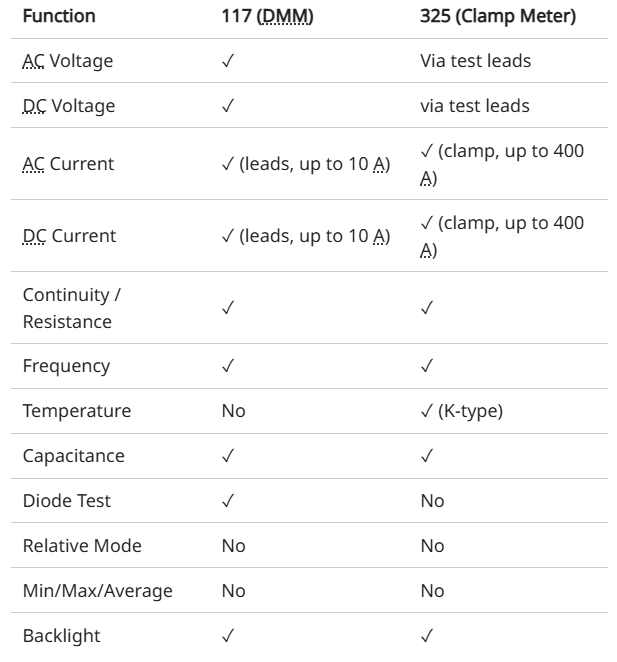
Here is a comparison:
The DMM provides more detailed insights and can perform a wider range of measurements. However, you may not be able to use it safely in all situations where live current is present.
A clamp meter enables safe, fast current measurements, particularly in tight panels or with multiple conductors. However, it offers fewer measurement capabilities than a DMM, so it cannot provide a comprehensive assessment of asset condition.
Together, these tools offer a broader range of measurement capabilities and flexibility for both field and lab measurements. Different situations require specific tools, and having both a DMM and a clamp meter ensures you are prepared for any task.
Watch this short video to learn when to choose a digital multimeter vs. a clamp meter.
Selecting the Right Multimeter and Clamp Meter Pair
Fluke manufactures a wide variety of digital multimeters (DMMs) and clamp meters for diverse environments and applications. Your specific application will determine the features and specifications required to complete tasks effectively and achieve optimal value.
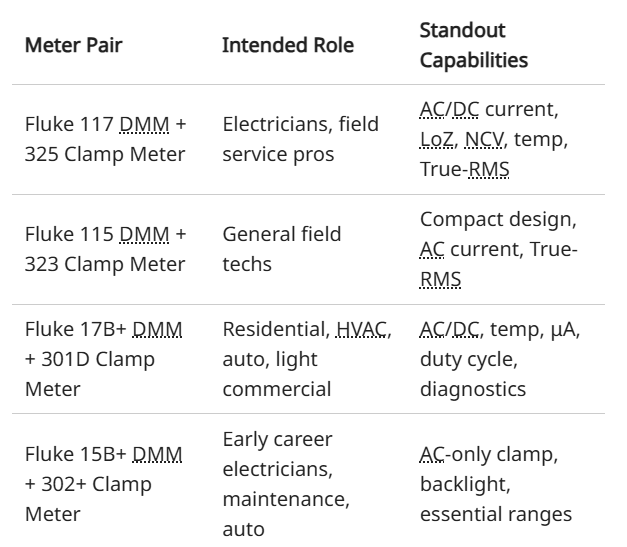
Fluke has selected four reliable and beginner-friendly meter combinations to assist you in assembling your test tool kit, whether you are an apprentice electrician, a technician in training, or a dedicated home project enthusiast.
Fluke 117 DMM and 325 Clamp Meter: The Electrician's Combination
Electricians require tools that adapt to various job conditions. You may be troubleshooting live panels on some days, while on other days you will be working in low-light conditions or dealing with noisy signals. The Fluke 117 DMM and 325 clamp meter pairing combines two of Fluke's reliable tools for daily electrical work across residential, commercial, and industrial environments.
The Fluke 117 is designed for field use with non-contact voltage detection, low-input impedance to prevent false voltage readings (ghost voltages), and True-RMS accuracy for stable measurements even in complex systems. The Fluke 325 adds a compact clamp with both AC and DC current measurement, temperature capability, and a rugged form factor built for tight panels.
To learn more, explore the Fluke 117 Electrician's Multimeter, and then examine the Fluke 325 True-RMS Clamp Meter to understand how this combination can support your work.
This combination provides the following to meet your needs:
True-RMS readings for accurate troubleshooting
Non-contact voltage detection for added safety
AC/DC measurement up to 400 A via clamp
Temperature readings with a K-type thermocouple
Bright backlit displays and compact designs for ease of use
Fluke 115 DMM and 323 Clamp Meter: The General Maintenance Combination
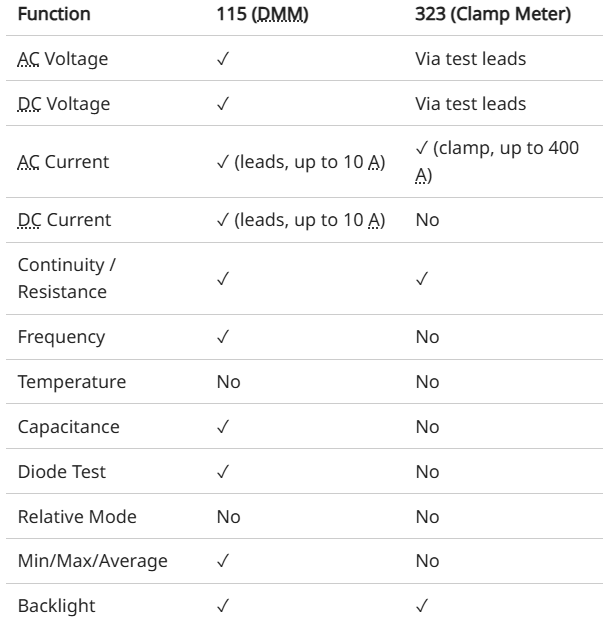
For service technicians and facility maintenance teams, speed and simplicity are important. The Fluke 115 DMM and 323 clamp meter combination delivers straightforward performance in a rugged, compact form. The Fluke 115 supports True-RMS, frequency, and capacitance readings. It also offers Min/Max/Average recording, which is not available on all multimeter models. The compact design of the 115 is suitable for one-handed operation, which is advantageous when troubleshooting in panels, equipment rooms, or tight compartments. The 323 clamp meter adds AC measurement up to 400 A, making it a reliable choice for routine load checks and breaker diagnostics.
To review all specifications for the Fluke 115 Field Technician's Digital Multimeter, and to discover more about the Fluke 323 True-RMS Clamp Meter, please refer to the respective product documentation.
This combination provides the following to meet your needs:
One-handed operation and easy portability
True-RMS accuracy for dependable troubleshooting
Min/Max recording to track fluctuations over time
Slim clamp jaws for tight electrical panels
CAT III 600 V / CAT IV 300 V safety ratings
Click here to continue reading this article in its entirety and learn about more combinations to equip you with the necessary tools to manage your learning and your work environment effectively.
This article was previously featured on Fluke's blog.