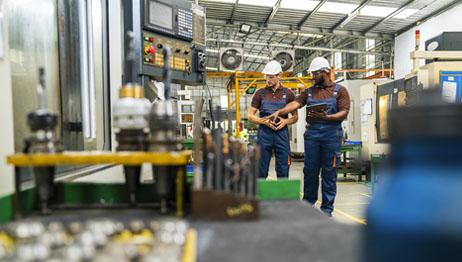
As the United States celebrates 250 years of growth and innovation, the history of American manufacturing tells a parallel story. From interchangeable parts to artificial intelligence, the manufacturing industry has continually evolved to meet new challenges.
Along the way, breakthrough technologies, advancements in production methods and workforce innovations have transformed how products are made and helped establish the U.S. as a global manufacturing leader.
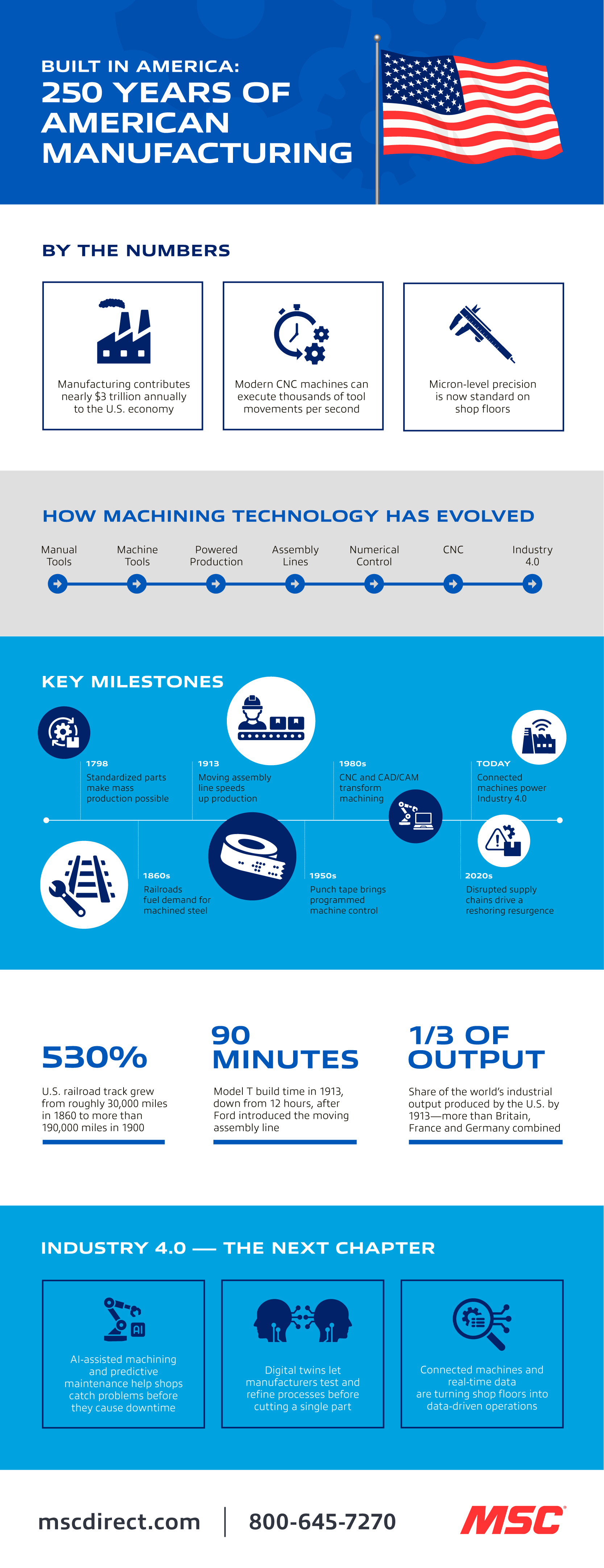
The milestones below highlight some of the key developments that have shaped American manufacturing and continue to influence the industry today.
The Industrial Revolution Comes to America
In 1798, when the U.S. government sought a more efficient way to produce military firearms, manufacturers began experimenting with interchangeable parts. Instead of hand-fitting components for each weapon, parts could be produced to consistent dimensions and assembled with minimal adjustment.
The approach, later known as the American System of Manufacturing, helped drive the development of precision machine tools, gauges and measurement systems that remain essential to manufacturing today.
Steel, Railroads and the Rise of Mass Production
The introduction of the Bessemer process made steel much faster and less expensive to produce, which fueled rapid industrial growth across the country beginning in the 1860s. Andrew Carnegie became the process’s most influential American champion, building the Carnegie Steel Company into the nation’s dominant steel producer.
At the same time, railroads expanded nationwide, creating enormous demand for steel rails, bridges, locomotives and manufacturing equipment. U.S. railroad track grew from roughly 30,000 miles in 1860 to more than 190,000 miles by 1900.
As steel production increased, manufacturers invested in larger factories and more sophisticated machine tools, laying the groundwork for mass production. By 1913, the U.S. produced one-third of the world’s industrial output—more than Britain, France and Germany combined.
That same year, Henry Ford’s moving assembly line dramatically reduced the time required to build a Model T automobile. Production time was cut from more than 12 hours to roughly 90 minutes. The assembly line soon became a model for manufacturers across numerous industries.
World War Manufacturing and the Arsenal of Democracy
World War II triggered one of the most dramatic manufacturing transformations in U.S. history. Factories that once produced consumer goods shifted rapidly to aircraft, tanks, military vehicles and weapons.
The war accelerated advances in machining, quality control and production planning while demonstrating the enormous capacity of American industry. Many manufacturing practices that were developed during this period continued to influence factories long after the war ended.
Global Competition Reshapes American Manufacturing
In the decades after World War II, American manufacturing experienced unprecedented growth and global dominance. By the 1970s, however, manufacturers faced increasing competition from Japanese and German producers, particularly in automobiles and electronics.
Traditional industrial centers throughout the Midwest experienced factory closures and job losses, while production expanded in other regions of the country and around the world.
The challenges pushed many manufacturers to adopt lean manufacturing practices, automation and continuous improvement initiatives to remain competitive.
Advances in Manufacturing Technology: Automation, CNC and Industry 4.0
As manufacturers sought new ways to improve productivity and remain competitive, automation began transforming the factory floor. In the 1950s, researchers at the Massachusetts Institute of Technology developed one of the first numerical control (NC) systems, allowing machine tools to follow programmed instructions instead of relying entirely on manual operation. For manufacturers, NC technology represented a major step toward automation and greater production consistency.
Computers became more powerful and affordable in the 1970s and 1980s, and computer numerical control (CNC) technology began replacing earlier NC systems. Manufacturers were now able to machine complex parts with greater precision, repeatability and efficiency. CNC machining quickly became a cornerstone of modern metalworking and remains one of the industry’s most important technologies.
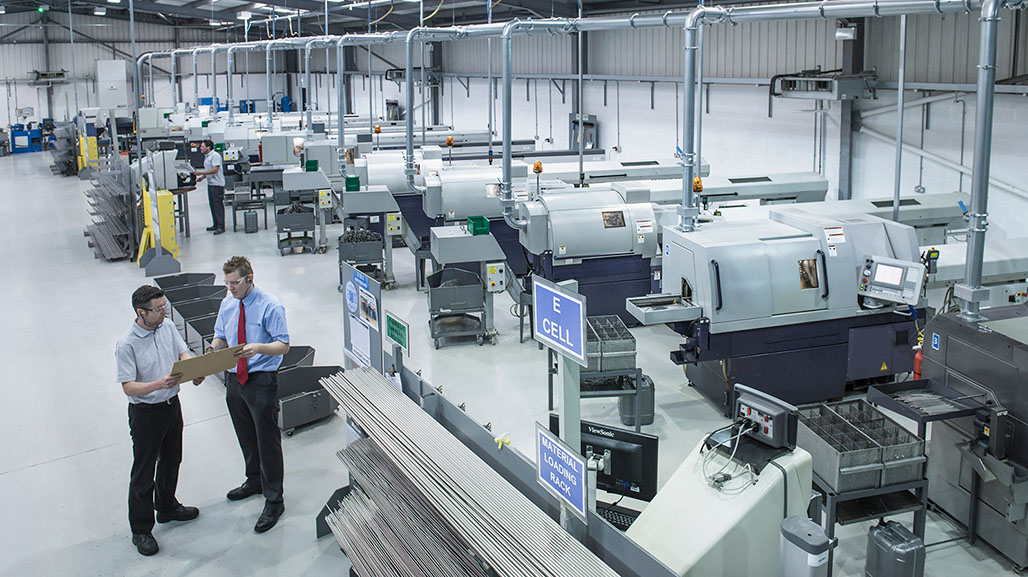
Today’s manufacturing facilities increasingly rely on connected equipment, robotics, automation and real-time data. Sensors can monitor machine performance, predict maintenance needs and help manufacturers improve both productivity and quality. Many shops are also combining additive manufacturing technologies with traditional machining processes, creating new opportunities for flexibility and innovation.
These advances have not only improved productivity and quality but also helped make domestic manufacturing more competitive. As automation and digital technologies matured, they became important factors in a renewed interest in U.S.-based production.
The Reshoring Movement: Why U.S. Manufacturing Jobs Are Coming Back
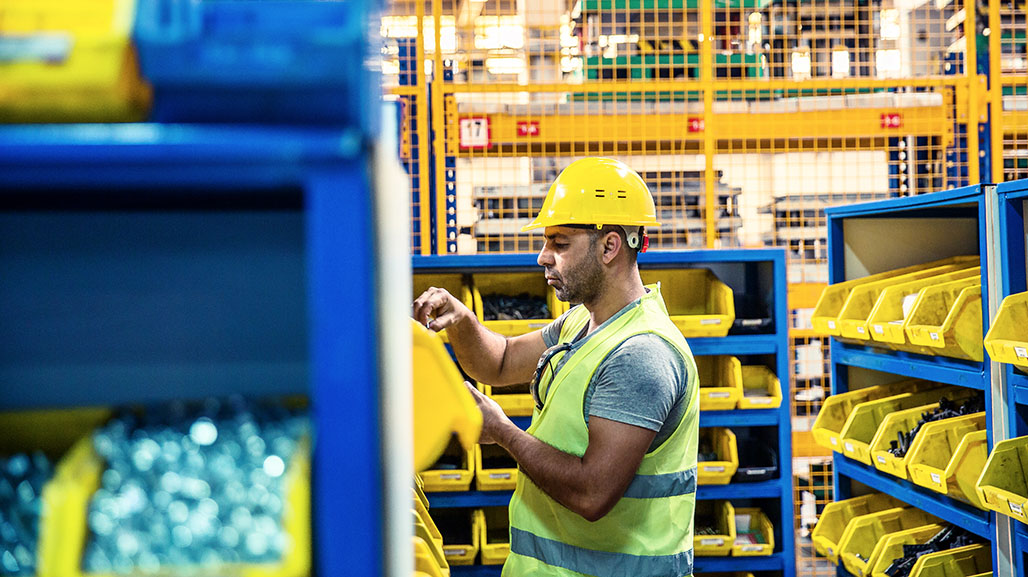
In 2020, the COVID-19 pandemic exposed deep vulnerabilities in global supply chains. These disruptions—along with geopolitical uncertainty and rising tariffs and transportation costs—prompted many companies to accelerate existing reshoring efforts and increased domestic investment.
The trend renewed attention on workforce development, supply chain resilience and the importance of maintaining U.S. manufacturing capabilities.
The Future of American Manufacturing: Workforce, Technology and Supply Chain Resilience
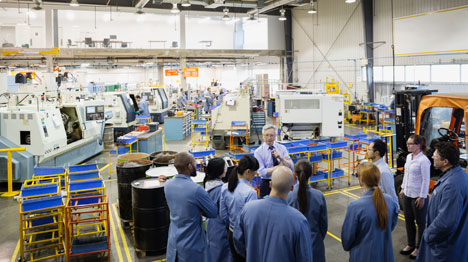
The U.S. manufacturing industry continues to evolve as artificial intelligence, advanced automation and Industrial Internet of Things (IIoT) technologies become more common. At the same time, manufacturers are investing in training, upskilling and recruitment initiatives to address skilled labor shortages and prepare employees for increasingly technology-driven roles.
While the tools used in manufacturing have changed dramatically over the past two centuries, the industry’s focus on innovation, productivity and problem-solving remains as strong as ever.
Read more: 14 Workplace Safety Milestones You Need to Know