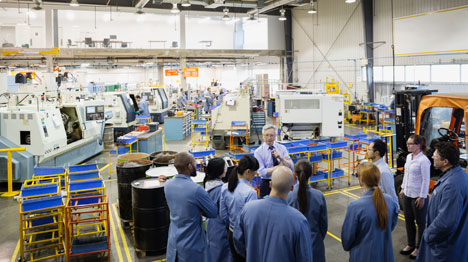
Smart factories use real-time data from internet-connected equipment to improve manufacturing processes. MSC’s Dr. Tony Schmitz describes the terms, technologies and challenges of smart manufacturing.
Smart manufacturing uses real-time data from internet-connected equipment to monitor and improve manufacturing processes.
Common challenges for smart manufacturing implementation are cost, equipment/device compatibility, cybersecurity and lack of workforce training.
Industry 4.0 integrates digital technologies into manufacturing and enables smart manufacturing.
Industry 5.0 extends Industry 4.0 through a focus on collaboration between humans and machines.
Smart manufacturing uses real-time data from internet-connected sensors and machines across the supply chain to monitor, automatically adapt and improve manufacturing processes in smart factories for increased productivity, decreased cost, increased flexibility, greater operational efficiency and reduced energy use. It also provides more flexible technical workforce training to improve product design, supply chain, maintenance, distribution and sales.
Industry 4.0: integrates digital technologies into manufacturing.
Industrial Internet of Things (IIoT): a collection of sensors, actuators, software and other devices used to improve manufacturing and industrial processes.
Digital twin: a collection of data that serves as the digital counterpart of a physical system for simulation, integration, testing, monitoring, maintenance and recycling.
Machine learning: algorithms and software that enable the prediction of process outcomes without explicitly being programmed.
Overall equipment effectiveness: a metric that identifies the percentage of productive manufacturing time.
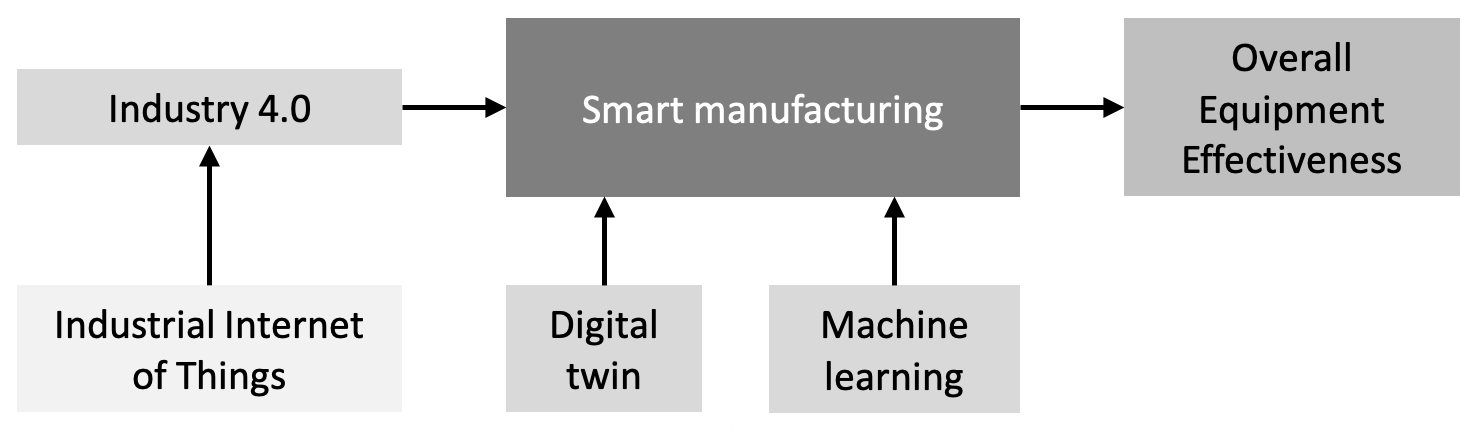
The concepts are related as shown in Fig. 1. We see that the IIoT supports Industry 4.0 which, in turn, helps to enable smart manufacturing. Similarly, the digital twin and machine learning support smart manufacturing. Finally, the capabilities offered by smart manufacturing serve to increase overall equipment effectiveness (OEE) in the modern factory.
Figure 1: Key concepts and relationships in smart manufacturing.
Data-dependent modeling and analytics, including artificial intelligence (AI) and machine learning, are used to improve processes and may be performed in the cloud or at the edge (these terms are defined later). Common challenges for smart manufacturing implementation are cost, equipment/device compatibility, cybersecurity and lack of workforce training.
The National Institute of Standards and Technology (NIST) defines smart manufacturing systems as “fully-integrated, collaborative manufacturing systems that respond in real time to meet changing demands and conditions in the factory, in the supply network, and in customer needs” [1]. In a 2020 study on the subject, researchers succinctly state that “smart manufacturing provides the right information at the right time to the user in an understandable manner” [2].
Key Digital Technologies Underpinning Smart Manufacturing
Let’s define some terms that are used in smart manufacturing.
Edge computing: distributed data storage that is physically near the location where it is needed.
Cloud computing: centralized data storage where information technology services and resources are uploaded to and retrieved from the internet as opposed to a direct connection to a local server.
Information technology (IT): computer systems, software, programming languages, and the processing, storage and distribution of data and information; IT professionals are responsible for the installation, maintenance and troubleshooting of these systems, software and networks and ensuring that they align with an organization’s business needs.
Technologies of Smart Manufacturing
There are several key technologies within smart manufacturing.
CNC machining: material removal by milling, turning, drilling and other operations from computer-aided design (CAD) digital part descriptions and toolpaths from computer-aided manufacturing (CAM) software; CNC machines include sensors, preferably wireless, as part of the IIoT.
Automation/robotics: enable repeatable performance and data gathering for tasks that have been previously completed manually, releasing humans to perform thinking tasks.
Additive manufacturing (AM)/hybrid manufacturing: AM can supplement or replace traditional manufacturing; hybrid manufacturing combines metal AM with machining (and other processes) to reduce material waste and produce designs that may not be possible by either AM or machining alone.
Digital twins: digital model of an intended or physical product, system or process.
Design for manufacturing (DFM)/design for manufacturing and assembly (DFMA): a design methodology that enables and optimizes prefabrication through a set of design choices and principles; products and components are designed specifically to make manufacturing processes easier and more cost-effective.
Big data analysis: analysis of large data sets using cloud storage and processing; can assist with process improvement, logistics, risk assessment, cost structures, growth strategies, quality control, build-to-order and other sales patterns, and after-sales services.
AI/machine learning: using AI, intelligent machines are created that work and react like humans; machine learning is a subset of AI, allowing software to predict outcomes without explicitly being programmed.
Augmented reality/virtual reality (AR/VR): assists with training by enabling an employee to receive instructions from a remote expert who sees an activity through the employee’s eyes.
Challenges of Smart Manufacturing
Smart manufacturing is implemented in smart factories, where (ideally) activities are tracked in real time, machines talk to one another, machines are repaired before they malfunction, production lines can be rapidly altered and customized, and energy consumption is optimized [3]. However, there are implementation challenges for smart factories that must be addressed, such as:
We must not only collect the data, but also use the data to learn about processes and enable improved decision-making.
We must install the appropriate sensors at preferred spatial locations on equipment, which requires domain expertise.
The cost of sensors, storage, computing, network and analysis may take time to provide a return on investment.
The data collection infrastructure must be compatible with existing and new equipment to provide machine-to-machine (M2M) communication.
Cybersecure and reliable network connectivity is required.
Smart Manufacturing vs. Industry 4.0
Smart manufacturing and Industry 4.0 are sometimes used interchangeably. Industry 4.0 captures the rapid technological advancements of the 21st century and enables smart manufacturing. Its key elements are:
Machines with sensors that upload continuous data streams to the cloud for analysis (i.e., the IIoT).
Robotics and automation.
Advanced human-machine interfaces.
Cyber-physical systems.
AI, machine learning and data analytics.
Within the smart factory, Industry 4.0 is relevant to:
Design: innovative new products and technologies.
Prototyping: AM, CNC machining and other processes.
Production: automating production lines.
Delivery and tracking: on-time delivery with shipment tracking.
Assistance: customer support during distribution and after purchase.
What Is Industry 5.0?
Industry 5.0 is a newer concept that extends Industry 4.0 through a focus on collaboration between humans and machines. Its goal is to empower people to fully use their skills and make work safer, more efficient and more meaningful. It aims beyond efficiency and productivity to consider the role and the contribution of industry to society while emphasizing worker well-being. It applies new technologies to provide prosperity beyond jobs and growth and respects the production limits of the planet.
This article first appeared in Modern Machine Shop, February 2026, mmsonline.com.
Terry, S., Lu, H., Fidan, I., Zhang, Y., Tantawi, K., Guo, T. and Asiabanpour, B., 2020. The influence of smart manufacturing towards energy conservation: A review. Technologies, 8(2), p.31.
Dr. Tony Schmitz is a distinguished technical fellow at MSC who offers a rare blend of deep academic rigor and real-world manufacturing insight. He has a Ph.D. in mechanical engineering and more than 25 years of experience in machining dynamics, vibration, metrology and advanced manufacturing. He has authored more than 200 peer-reviewed papers as well as three engineering textbooks, and he holds 12 U.S. patents.
To request a quote, please login to your existing account or register a new one. This helps us provide you with a personalized experience and keep track of your requests.