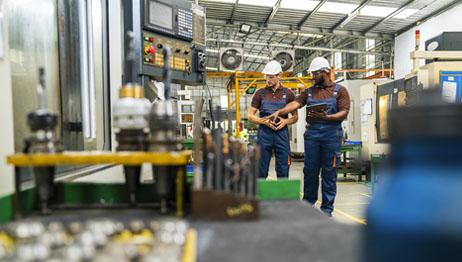
Unplanned downtime due to overlooked or delayed maintenance tends to snowball. What was seemingly a minor vibration becomes a pile of defective parts. Difficulty holding a tight tolerance results in a missed delivery. The machine that “was running fine yesterday” sits idle while the supervisor waits for the service technician to arrive, all the while watching as her carefully planned production schedule comes apart.
The unfortunate reality for many small- to mid-sized machine shops and sheet metal fabricators is that most equipment problems are not catastrophic failures. They present themselves gradually, with clues that seem unrelated—part dimensions suddenly begin to drift, tool life grows inconsistent and that annoying chatter becomes more frequent.
“Equipment level is hugely overlooked, especially on CNC machinery.”
Richard Hochecker,
Metalworking Specialist,
MSC Industrial Supply Co.
The good news is that many of these problems are both preventable and easily diagnosed. All it takes is a structured troubleshooting approach and, more importantly, a willingness to pause production briefly to protect long-term uptime and profitability.
Mechanical Issues: Identifying and Fixing Common Equipment Malfunctions
It’s this last issue—an unwillingness to stop production for a little preventive maintenance (PM)—that MSC Industrial Supply metalworking specialist Richard Hochecker sees most often. “It’s understandable that shops want to maximize their machine uptime, especially when they’re under pressure to deliver parts,” he says. “But ignoring the filters, fans, lubricants and cutting fluids eventually catches up with you.”
Even when shops are diligent about checking the boxes for these routine maintenance tasks, many forget that foundations settle, as do the precision machine tools sitting on top of them. The result? Accuracy changes gradually enough that operators adapt without realizing it, until dimensional requirements are no longer achievable.
“Equipment level is hugely overlooked, especially on CNC machinery,” Hochecker says. “For the latter, it’s something shops should be checking at least every six months. The good news is that you don’t need anything fancy—a high-quality machinist’s level is usually enough to verify whether anything has shifted.”
He notes that the same applies to turret alignment on turning centers and multitasking machines. Suppose the operator accidentally bumps a toolholder during touch-off, or a small programming error slips past during prove-out. It’s entirely likely (and understandable) that no one will want to talk about it.
Even on the most rigid of lathes, however, it doesn’t take much force to knock the tool’s centerline out of whack, an event that can have a dramatic impact on tool life and part quality alike. When in doubt, mount a round toolholder to the turret, bring it to X0 and sweep the bore with a dial indicator. For very small parts—say anything under 1" in diameter—and difficult materials like Inconel, titanium and 300-series stainless, even a few tenths of runout is enough to affect tool life.
Hochecker points to another mechanical check—spindle drawbar force on CNC machining centers—that’s frequently overlooked, at least until part dimensions start slipping or chatter appears. The springs or Belleville washers inside the clamping mechanism will eventually become fatigued, which will not only lead to bad parts but can also damage toolholders and even the spindle. “That’s why you should inspect CNC machining centers every few weeks or so—it only takes a minute, and the force gauge costs about as much as a high-end toolholder.”
Electrical Problems: When to Call a Technician vs. Fix It Yourself
Electrical issues present a different challenge. While many symptoms appear to be mechanical in nature—spindle alarms or axis faults, for example—the underlying cause might be power- or control-related. But as Hochecker rightly points out, this is also where internal maintenance discipline matters most. Strict lockout/tagout procedures are not optional, and troubleshooting should never involve bypassing safety systems.
For most shops, the line is clear: Basic fault inspections and documented observations are helpful, but deeper electrical diagnoses belong to qualified repair technicians. “What gets expensive is when shops wait too long and then can’t resolve the issue on their own,” he adds. “Now it’s not just unplanned downtime. It’s service calls and days waiting for someone to get on the schedule.”
A structured approach helps avoid these expenses. Document the fault and, if possible, clear it. Use a multimeter to verify that the incoming voltage and amperage are correct. Check for obvious cable or connector damage. Confirm that fans, filters and enclosures are clean and unobstructed. Get much beyond that, and it’s probably time to call the service company. “If you sacrifice an hour or two every month for preventive maintenance, you avoid losing days later,” he says. “That’s the trade-off shops have to accept if they want to maximize machine productivity and part quality.”
Preventive Maintenance: Stopping Problems Before They Cause Downtime
Despite this sound advice, many shops still operate in reactive mode. MSC Industrial Supply regional metalworking manager Geoffrey Wolfe observes that most fall into one of two camps—those with a planned preventive maintenance (PM) program and whose machine tools are always in great shape, versus those that are always in firefighter mode and have less-than-predictable uptime.
“Some shops are just more inclined to make the time needed for routine machine service,” Wolfe says. “Others keep running until there’s a major failure and then scramble to fix it.”
Beyond lubrication and cleaning, preventive maintenance also means verifying machine accuracy against clearly defined standards, not opinions or hunches. “Always go back to the manufacturer’s accuracy specs,” Hochecker says. “That’s what makes the machine run like new, not whatever someone thinks is ‘good enough.’”
Building Your Troubleshooting Toolkit: Essential Diagnostic Equipment
Effective troubleshooting depends on having the right diagnostic tools, and knowing when to use them. As mentioned earlier, a quality machinist’s level belongs in every shop. So does a multimeter, a good set of hand tools, and the correct lockout/tagout signage. For advanced diagnostics, especially on CNC and 5-axis machines, more expensive tools provide the clarity that guesswork never will. “On 5-axis machining centers and multitasking machines especially, laser and ballbar testing are critical,” Hochecker says. “That’s how you verify accuracy and pivot points.”
Wolfe suggests that troubleshooting should not stop at the machine itself, noting that many so-called “machine problems” are actually tied to improper cutting tool selection and application parameters. “A lot of times we’ll see people aren’t running the right carbide grade, or their feeds and speeds are way off,” Wolfe says. “They’ll just use whatever insert or drill is available and then blame the machine when tool life is poor.”
Here again, robust process documentation and consultation with the tooling supplier help alleviate some of this angst. This is especially true given the ongoing skilled labor shortage. As Wolfe and other industry experts point out, young operators often lack the experience needed to add value in today’s increasingly demanding manufacturing environment—a situation that will ultimately be solved only one way: sustained investment in training and education.
“There’s definitely a training gap,” Wolfe says. “Many of the fresh hires these days don’t fully understand turning and milling applications, or know what modern cutting tools are capable of. This is why I encourage continuous learning through our educational partner Tooling U-SME, not to mention leveraging our extensive library of online resources.”
Finally, bear in mind that MSC Industrial supports manufacturers through its team of metalworking specialists—Wolfe and Hochecker included—as well as its machinery and tech teams.
“All of us are here to help customers find the best tooling for whatever application they’re working on,” Hochecker says. “We can also advise them on machine maintenance procedures and suggest diagnostic approaches when problems arise. We’re just a phone call or email away.”
Video: How To Minimize Downtime in Your Shop