Safety managers have a lot going on day to day, and basing PPE purchases simply on cost could be seen as a time-saver for them and a cost-saver for the company. Win-win, right? Not necessarily.
Total cost of ownership, or TCO, can tell a very different story. Take hand protection, for example. When companies choose “bargain” gloves, they might find that frequent replacement, reduced worker compliance and injury-related downtime often make them the more expensive option in the long run.
“We’ll ask, ‘Why are you guys wearing this particular glove?’ Nine times out of 10 they say, ‘It’s what we’ve always used.’ A big piece of it is just lack of understanding.”
Ben Schneider,
Senior Business Development Manager,
MCR Safety
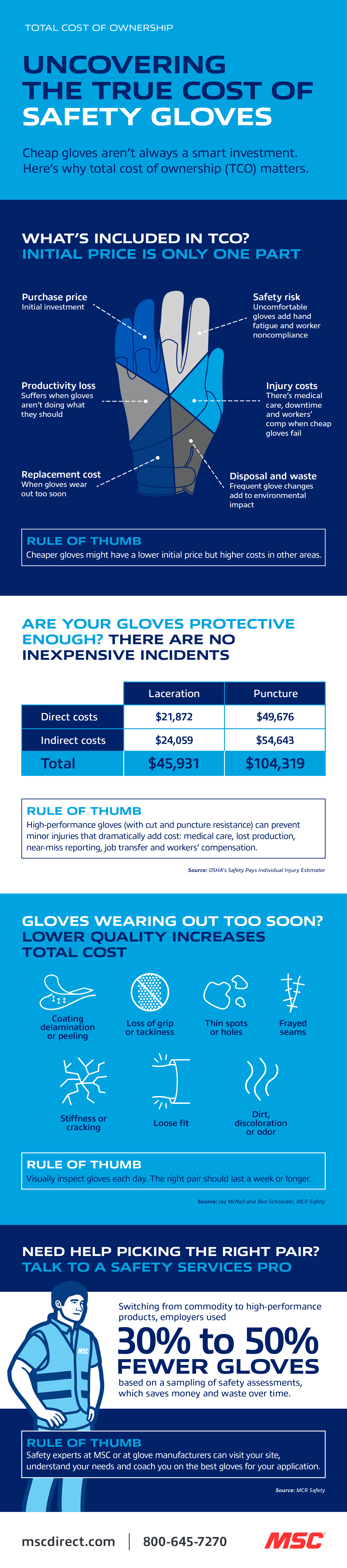
The initial investment is only one element of a glove’s total cost of ownership. Other factors include:
Productivity loss. When gloves aren’t protecting hands like they should, workers can’t do their jobs.
Injury costs. When cheap gloves fail, it exposes workers to real safety risks, and employers to resulting medical expenses and workers’ compensation claims.
Safety risk. When bargain gloves prove uncomfortable, it can increase hand fatigue during a shift and worker noncompliance.
Replacement cost. When gloves wear out too soon, costs for additional gloves can quickly add up.
Disposal and waste. When subpar gloves are changed out more frequently, it creates more waste, adding to a company’s environmental impact.
Many industry suppliers offer on-site safety assessments or buying guides to help employers find the right personal protective equipment for each application. Education about TCO is a big part.
“We’ll ask, ‘Why are you guys wearing this particular glove?’ Nine times out of 10 they say, ‘It’s what we’ve always used,’” says Ben Schneider, senior business development manager at MCR Safety. “A big piece of it is just lack of understanding.”
Sometimes, glove choice for an application matters as much as build quality—matching a glove to a specific work environment can manage TCO.
“Say you go into a machine shop where they’re handling oily parts,” Schneider says. “They may have a glove with a polyurethane palm. Well, polyurethane and petroleum products don’t mix. It’ll delaminate that glove, and the usage on it will be shortened greatly.”
Besides coating that is peeling, look for other signs that a glove is losing its effectiveness and needs to be replaced: thin spots or holes in the fiber or coating, frayed fabric, loss of grip, stiffness or cracking, or loose fit.
After reviewing his safety assessments, Schneider discovered that when employers switched out their commodity-style gloves with high-performance products—often with abrasion or cut resistance or more premium features—they saw an average usage reduction of 30 percent to 50 percent. In addition to the cost savings from using fewer gloves, there is a sustainability benefit.
Need help determining your safety needs? Speak to an MSC industrial safety consultant. To get started, fill out this form.
For more on glove TCO, check out this graphic:




![Why the Cheapest Safety Gloves Aren’t Always the Smartest [Infographic]](https://images.ctfassets.net/5j4ln2up7bt7/2gVEyRZylkBIlvTDtTRRc7/dde0c00e4846d6a88d56a7a68f09332a/mcr-PD5931_action4571-thumb.jpg)