A production line went dark for several hours recently. The culprit? A missing wrench. It would only take about 5 minutes to fix the downed machine with the right tool in hand, but the entire line sat idle while someone drove to the hardware store to buy the thing that no one could locate on the floor.
Sean Murphy, a brand ambassador for PRO-SAFE, says these kinds of situations happen all the time in manufacturing environments, and they are frequently avoidable.
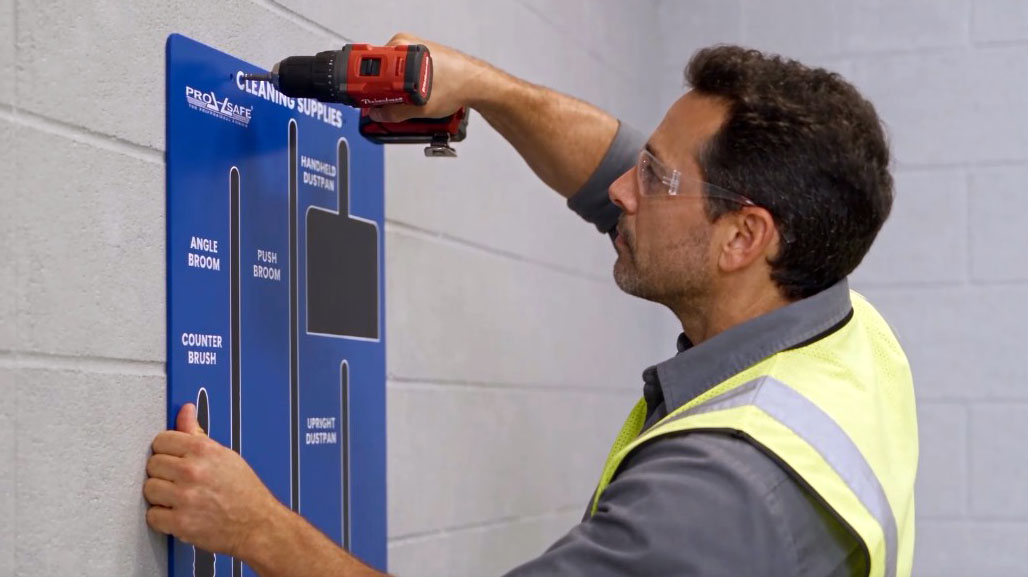
The solution centers around visual management—taking what a facility knows and putting it where everyone can see it, instead of leaving it to memory or a conversation with someone who happens to be standing nearby. A shadow board gives every tool a permanent, visible home, for example. Clear signage makes a hazard or a standard impossible to miss.
Here, Murphy explains why small challenges add up to real cost for manufacturers, and what it takes to address them for good.
Why is it risky for a facility to rely on information that only lives in one person’s head?
Tribal knowledge is a major business risk, and a lot of organizations don’t even realize it. Environments that run on tribal knowledge have steeper learning curves onboarding new employees or cross-training existing ones—it’s not documented anywhere, so you’re wholly reliant on that person to do all of the training, and it takes longer to get those employees up to speed.
It’s also a big risk to a business if that employee leaves. All of that knowledge leaves with them. Now you’re trying to figure out how the process actually works, and that can create a lot of downtime—in some cases it requires bringing in an outside source to troubleshoot the process.
Read more: How to Design Floor Marking Standards That Improve Safety
Is documentation enough on its own, or does it need to be visible out on the floor?
Standard work documentation needs to give clear visual detail on how to perform a process—if it’s just written down somewhere, the operator still doesn’t have it in front of them when they need it.
Often, the cost shows up in the little things: a wrong material or wrong component getting pulled because there was poor signage, or something wasn’t put in the right place, and nobody catches it until it’s three steps later in the process, and now you’ve got to throw away hundreds or even thousands of parts, and you’ve lost tons of employee time and productivity.
How can mistakes be caught before they turn into bigger losses?
The more you can illuminate an issue, the easier it is to prevent. 5S boards, signage, and visual batch and lot management keep a work environment structured enough that problems are preventable, or at least detectable, before they get three steps down the line.
If all of your materials for a job are coded with a blue dot, and you see one with a red dot, you know right away that something’s wrong. Anything you can do to make it easy for the operator to know this isn’t what I’m supposed to be working on—that’s what prevents these big issues.
Where does visual management—like 5S boards—make the biggest difference?
When you’ve got clutter and chaos, that tends to bury hazards, and if you can’t see them, you can’t remediate them appropriately. Getting a facility organized and clean, using 5S boards, really makes a big difference, because it helps you expose those hazards so you can remediate them.
A clean, organized workplace is safer and more efficient. It’s remarkable the amount of time that gets spent searching for lost things that should have been put away properly in the first place—that’s all wasted resources. A shadow board gives each tool or component a permanent home, so the operator knows every time they need to pull something, it’s right there. They can spend less time looking for stuff and more time actually doing their job.
Read more: Why Is Industrial and Commercial Matting So Important?
How does visual management factor into communication on the floor?
Management time is scarce. If an operator relies on verbal instruction and the manager is tied up elsewhere, you get a stoppage or a delay. If the operator can clearly see what they need to do, things keep flowing without waiting on somebody else. Whether it’s standard work documentation, BOMs [bills of materials] and work orders, and scheduling tools, there are all kinds of ways to communicate visually without needing the manager physically present.
This is big for multilingual crews, too. Safety signage is still largely dominated by the legacy OSHA format, but more and more, you’re seeing a shift toward the ANSI format, which leverages iconography. A workforce doesn’t need to speak English to know there’s a hazard present—they can look at a sign and know that if I go over here, I could slip and fall, or if I put my hand in this machine, I might injure my fingers. The same applies to shadow boards. You don’t need to read the word broom to know where the broom goes. Visual communication transcends language.
What does it take to keep a visual management system working long term?
It’s easy to get everybody excited about a change, like putting tools on a shadow board or materials in their marked spot. But it’s human nature to fall back into old habits pretty quickly. The fifth S in 5S methodology is sustain, and that’s usually the most difficult piece to do.
The key to a strong sustainment program is management buy-in and commitment. Especially when you get busy, you tend to think: I’ve got to get this task completed, and then I can go back to doing it the way we said we would. Well, one exception becomes two, then three, then four, because you’ve always got another job following.
A strong manager has to come in and say, “Even though it seems like you don’t have the time, doing it this way is going to give you more time back in the long run and make us more efficient.”
What’s the first step for a shop that wants to improve its visual management?
You need to sit down and make a list of all the critical processes in your business. What are the things that cannot stop? What do employees who’ve been around for a long time know that you can’t afford to lose?
Document those processes and how they’re supposed to flow, but also document all of the tools and equipment needed to run that job. Then, put in shadow boards and signage to make sure everything stays organized and operating at the level it’s supposed to.