Understanding the Risks and Causes of Lithium-Ion Battery Fires and How to Mitigate Them
With the proliferation of lithium-ion batteries in today’s marketplace, it seems wherever you turn there’s a new device using this technology. From automobiles, e-bikes and scooters to cordless power tools, radios, flashlights, and yes, even cell phones, their usage is everywhere. It’s no surprise then that there’s also been a rise in the number of fires caused by lithium-ion batteries. In 2018, the U.S. Consumer Product Safety Commission’s Status Report on High Energy Density Batteries Project reported that there were more than 25,000 overheating or fire incidents involving more than 400 types of lithium battery-powered consumer products over a five-year period. And in 2023, the FDNY reported 150 injuries and 18 deaths from 267 fires started by lithium-ion batteries, as published by UPI News. The FDNY also reported that lithium-ion batteries are now a leading cause of fires in New York City. What’s worse is that these fires start with no warning and can be incredibly damaging. As seen in the news and social media, the lithium-ion fires can be quite intense and even explosive in nature. This exploding phenomenon is known as thermal runaway and can be catastrophic. According to the NFPA, warehouse fires cause $283 million in direct property damage each year. The problem is compounded by the fact that there aren’t currently any regulations or fire codes specifically for lithium-ion batteries (though they are currently under review).
How Lithium-Ion Batteries Work
First, we need to understand what’s going on inside the battery. In normal operation, lithium ions (negatively charged atoms) move across the cathode to anode and vice-versa through a structure called a separator. The cathode (+) and anode (-) are internal structures, typically plates, made of dissimilar metals. A single cathode/anode arrangement is called a “cell.” While cell phones generally have one cell, rechargeable tools may have up to 20. Electric vehicles may have hundreds of cells. Energy is passed through each cell; therefore each individual cell poses a risk. Cells are encased in a battery housing such as a cylindrical case or pouch and immersed in chemicals known as electrolytes. When connected to an electrical load, the movement of the ions releases energy and powers tools, phones, and computers. However, as with all energy storage devices like fuel tanks and propane gas cylinders, there is always the risk of malfunction, and lithium-ion batteries are no exception.
Most off-the-shelf lithium-ion batteries from a reputable manufacturer with strict manufacturing and quality standards are safe when used correctly. However, problems occur where there is misuse or downright abuse to the battery. After all, we, the users of these devices, are human and can make mistakes. After repeated abuse, the battery (more accurately, the separator) can become compromised and is at risk of going into thermal runaway.
What is Thermal Runaway?
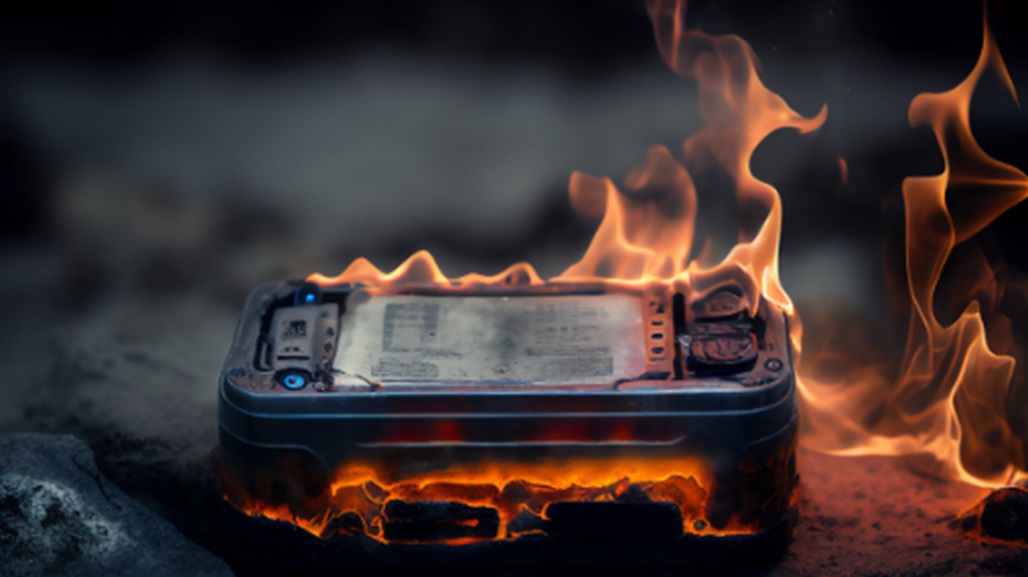
In normal operation of a lithium-ion battery, the transfer of ions between the cathode and anode generates a small amount of heat. This heat is absorbed by the battery case and dissipated into the surrounding air through convection. However, when the heat generated goes beyond the capability of the battery to dissipate, either due to damage or abuse, a chain reaction can occur causing excessive temperatures that lead to combustion, and potentially, explosion. When a lithium-ion battery goes into thermal runaway and explodes, it produces extremely high temperatures and significant flames. Beyond the obvious damages of an explosion, a thermal runaway condition could trigger sprinkler systems to go off and flood a production floor or the flames could ignite flammable materials being used nearby. Thermal runaway events also produce a high volume of toxic gas and smoke.
Common Causes of Thermal Runaway
When it comes to preventable causes of thermal runaway, there are three main issues, including mechanical, thermal, and electrical abuse or misuse. While these issues are caused by user error, there is one other reason lithium-ion batteries could go into thermal runaway and that’s due to quality issues with the battery.
Mechanical Abuse
As the name implies, this is where something physically impacts the battery. Dropping, crushing, and striking the battery are examples of mechanical abuse. In this scenario, the physical damage, if severe enough, may deform or tear the separator. When the separator is compromised, there’s the potential for an internal short (the cathode and anode contacting), causing rapid heating and subsequent thermal runaway.
Thermal Abuse
Another form of abuse is from extreme temperatures. Most if not all batteries should come with a recommended operating and storage temperature range, and it’s critical to stay within these limits. In the case of thermal abuse, the separator can collapse, again paving the way for a potential internal short leading to a thermal runaway condition. This generally isn’t a problem when using the battery, but in more extreme climates it’s very easy to exceed manufacturer specifications. Think of a cordless drill or vape pen sitting in the hot interior of a vehicle in Arizona or Florida in the middle of July and you get the idea.
Electrical Abuse
The third form of abuse can happen when the battery is repeatedly overcharged or used with an incompatible charger. Even with “smart chargers” that shut off when a battery’s State of Charge (SOC) reaches 100%, there is the possibility for damage. In this instance, microscopic structures known as dendrites can form over time. Just like the part of the nerve cells in our brain that share the same name, dendrites are like tendrils that grow, and if the growth is significant enough, can pierce the separator. Again, a compromised separator can result in a short, causing thermal runaway.
Download a PDF of this whitepaper here to continue reading it in its entirety.
This whitepaper previously appeared on Justrite's blog.