Respirator selection comes down to convenience in many metalworking facilities: whatever is already on the shelf, whatever workers are used to wearing or whatever feels easiest for the task at hand. But welding fumes, grinding dust and metal particulates are not the same hazards—and treating them that way can put worker safety at risk.
Different metalworking applications create very different airborne hazards. Welding fumes can include ultrafine particles, gases and ozone, depending on the process and materials involved. Grinding can generate larger particulates and fragments. Machining and cutting can send metal dust into the air.
“In cases where you’ve got higher concentration levels of those hazardous metals, it might drive you from a half-mask up to a powered air-purifying respirator or a supplied-air respirator.”
Erik Johnson,
Industrial Hygienist,
3M
Respiratory Protection Should Match the Exposure
Because exposures vary, respirator selection should involve more than simple filtration ratings or standard-issue masks for every job.
According to Erik Johnson, an industrial hygienist at 3M, personal protective equipment (PPE) buyers must evaluate the specific tasks, airborne contaminants and exposure levels before deciding which product makes the most sense—whether it’s a disposable respirator, reusable half-mask, full facepiece or powered air-purifying respirator (PAPR).
Read more: Head, Face and Eye Protection for Your Workers: What to Use and When
Some metals—such as manganese, which is used in welding and manufacturing—have very low exposure limits, meaning even relatively small concentrations require increased protection.
“In cases where you’ve got higher concentration levels of those hazardous metals, it might drive you from a half-mask up to a PAPR or a supplied-air respirator,” Johnson explains.
Welding applications also may involve low-level gases or vapors in addition to particulates, potentially changing the type of respiratory protection required. “Sometimes you can get a particle filter with a thin layer of carbon, which is enough to knock down the ozone smell,” Johnson says.
Exposure duration matters, too. Longer shifts, heavier dust loads or more demanding environments may call for powered or supplied-air systems with different filter or cartridge options.
Respirator Selection Should Account for Working Conditions
Respirator selection is also shaped by the realities of the work environment, where heat and compatibility with other PPE come into play. “It’s not just the respirator that you’re dealing with,” Johnson says.
“Disposable respirators are nice because they fit really close to the face, so it’s easy to get a grind shield or weld shield down,” he adds. “But if you have a reusable respirator, you can choose a variety of different cartridges or filters. Then, do you want to simply throw away the disposable every day, or do you want to clean and maintain your reusable respirator, which is going to take time and effort? You have some choices.”
Read more: Confined Space Safety: What’s the Correct PPE, Equipment for Working in Hazardous Locations?
A disposable respirator with a valve on the front might be a comfortable and effective solution in one situation, but for another, it’s not enough.
For hot work environments, for example, some supplied-air respirators incorporate cooling airflow or integrated head protection to make all-day wear more practical.
“If you can put them in a supplied-air respirator with a valve that cools the air, then you have personal air conditioning going on,” he says. “That can be a life-changer.”
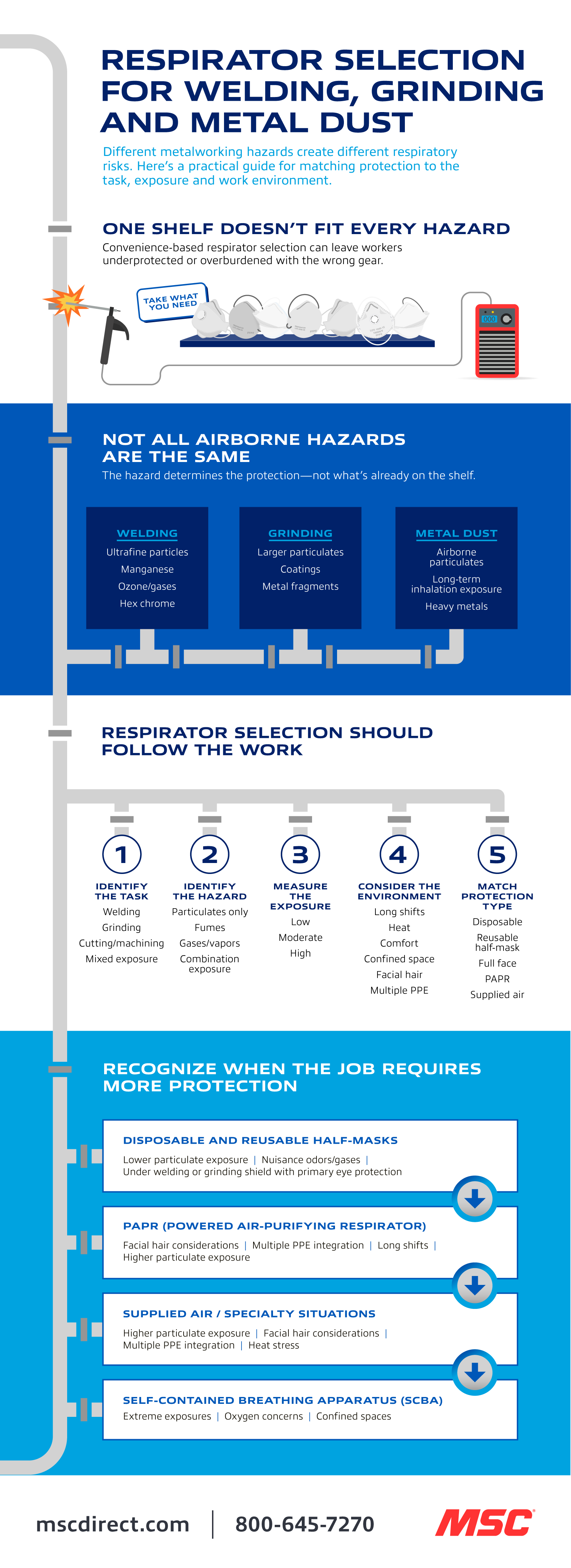
For help selecting respiratory protection across common welding, grinding and metalworking applications, the following infographic offers a practical guide.