Abrasives play a role in nearly every stage of metalworking, from cutting and grinding to surface preparation, finishing and conditioning.
MSC Industrial Supply’s Tru-Maxx abrasive line brings together products for a broad range of these applications. The goal is to give shops access to everyday abrasive solutions that balance performance and price and are backed by support to help customers get the most from their products, says Tru-Maxx national account manager Brad Heraghty.
“Tru-Maxx is really a one-stop shop for everyday needs.”
Brad Heraghty,
National Account Manager,
Tru-Maxx
“When you can eliminate a step or consolidate product lines, those are opportunities to improve overall productivity and throughput,” Heraghty says.
A One-Stop Abrasive Line for Everyday Metalworking
Tru-Maxx is designed to serve as a single resource for many of the abrasive products that shops use regularly.
Heraghty notes that while some grinding operations require highly technical solutions, many abrasive tasks involve routine, hands-on work. Having options for these common jobs gives shops a practical starting point for addressing what they need.
“Tru-Maxx is really a one-stop shop for everyday needs,” Heraghty says. “These are applications that are used almost daily in some capacity. Sometimes it’s production. Sometimes it’s MRO.”
A Closer Look at the Tru-Maxx Product Line
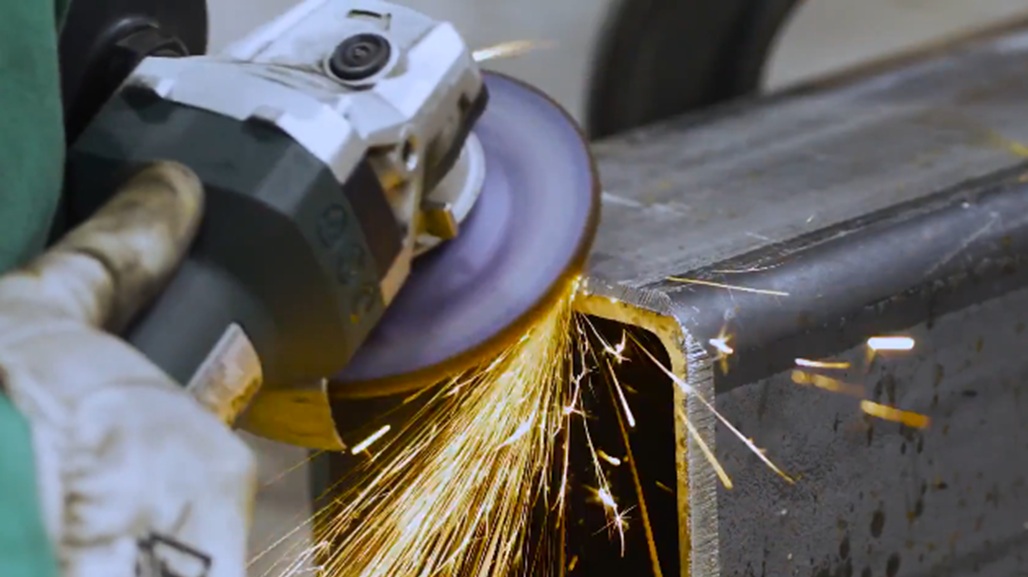
Tru-Maxx zirconia quick-change discs can be used for tasks such as deburring and quick beveling. These applications often involve removing material, cleaning up an edge or preparing a part for the next step. The discs offer an accessible option for jobs that arise regularly in fabrication and maintenance settings.
Zirconia flap discs provide another option for material removal. Heraghty describes them as a middle-tier product that balances abrasive life, cutting rate and material removal. This combination makes them a versatile choice for shops looking for dependable performance across routine grinding and finishing tasks.
For surface preparation, blending and finishing, nonwoven hand pads offer a practical option for routine tasks. They can be used to clean and condition surfaces as well as blend finishes, making them useful for both production and MRO work. Because these tasks can arise throughout a shop, hand pads are a straightforward example of the everyday consumables that make up an operation’s broader abrasive needs.
The line also includes toolroom surface-grinding wheels in aluminum oxide formulations. These products support more technical grinding applications, including work involving hardened steels and other demanding materials.
Altogether, the product categories address a wide range of tasks, from quick material removal and surface preparation to more demanding grinding work. As Heraghty puts it, “We’ve got you covered from quick changes in hand pads to more technical surface grinding.”
Read more: Common Abrasive Mistakes in Fabrication
Simplifying Abrasive Sourcing
For busy shops managing multiple metalworking processes, having a broad range of abrasives available through one source can streamline the purchasing process. Instead of coordinating orders across several suppliers, customers can find products for a variety of everyday applications through the Tru-Maxx line.
“You don’t need to shop around and go to three different distributors and five different suppliers to find good products that will get the job done,” Heraghty says.
Consolidating purchases can also make it easier for a shop to work with a consistent supplier when they need help assessing a product or resolving a performance issue.
Support Beyond the Product
Choosing an abrasive starts with understanding the application, Heraghty says. That means looking at the workpiece material, the tools being used, the desired result and the challenges a shop is trying to address. The questions may be straightforward, but the answers help determine whether a product is suited to the job and where there may be opportunities to improve the process.
For example, a shop may need to remove a certain amount of material while maintaining specific tolerances. Another may be struggling with a slow cutting rate, having trouble dressing a grinding wheel or finding that a wheel is no longer holding its form. Each issue points to a different set of variables to examine.
Heraghty says his team considers factors such as the application, the tools in use, the shop’s goals, its current challenges and the material being worked. It also helps to understand how much product the shop consumes over time. A product used occasionally presents different considerations from one that is consumed in large quantities during a regular production process.
This kind of assessment can also help identify whether the abrasive itself is the issue or if another part of the process needs attention. Heraghty described a customer whose surface-grinding performance was being affected by dirty coolant. In that case, switching abrasives alone would not have addressed the underlying problem.
“Understanding all the variables that go into it is very important,” Heraghty says.
The Tru-Maxx support team can help customers examine these variables, identify potential problems, and determine whether a different product or process adjustment could improve results. That support can be particularly useful when a shop is trying to resolve a recurring issue or determine why an application is not performing as well as expected.
Heraghty encourages customers to consider both the product and the expertise available to help them use it effectively. “There are two ways to define value,” he says. “One is the product itself, and the other is the support team around it.”
Video: TOOLING UP: How Metalworking Abrasives Improve Productivity