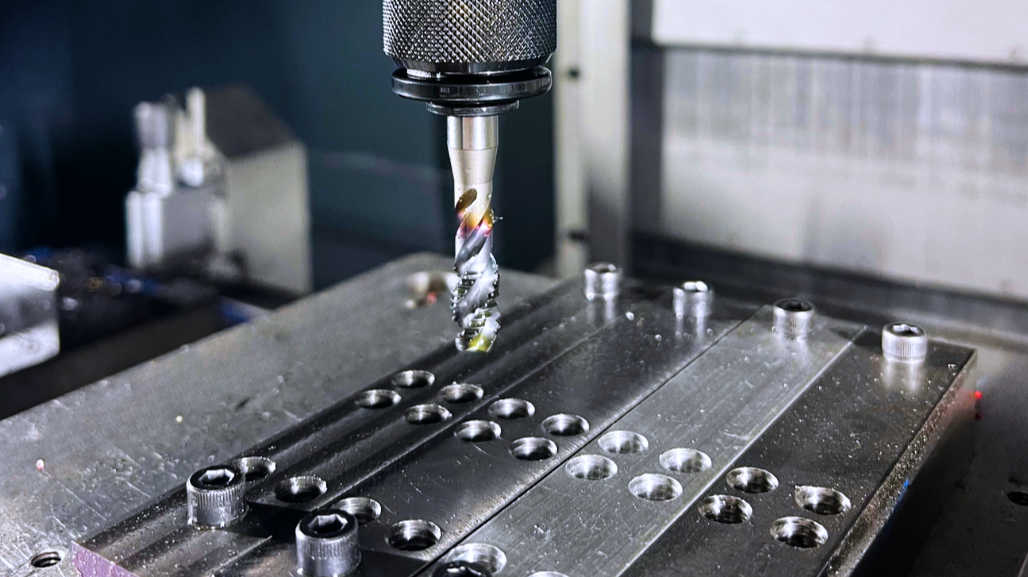
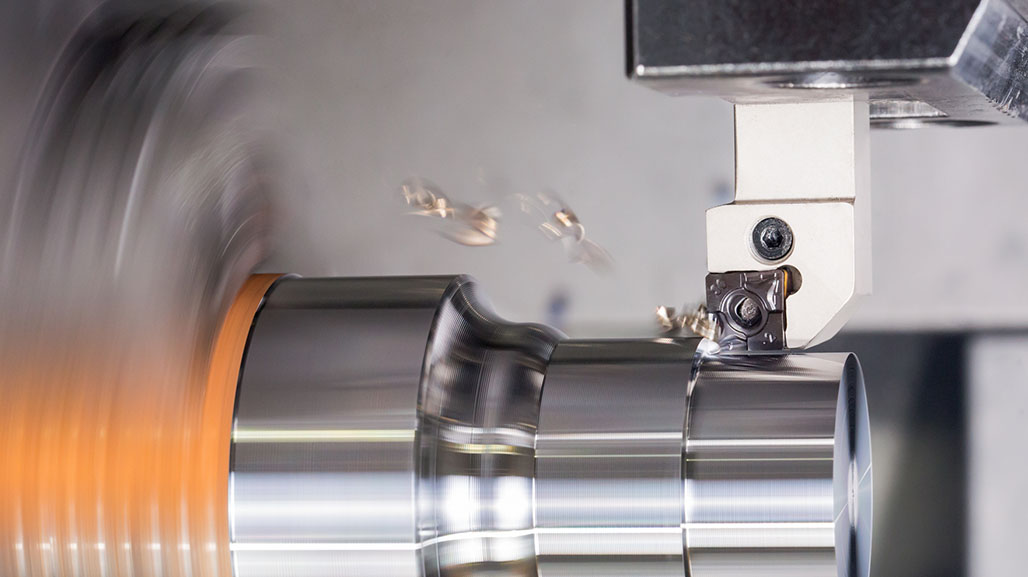
Rising material costs and tighter production timelines are putting pressure on manufacturers to get the most from their cutting tools. Although carbide substrates have steadily improved over the decades, coatings have become one of the biggest drivers of machining performance—helping shops extend tool life, increase throughput and reduce overall tooling costs.
As Marc Steimer, MSC’s director of national tooling, explains, coatings can directly influence productivity and cost efficiency.
“There is a happy balance for how hard you run the tool versus how much life you get out of a tool,” he says. “Correct coatings can allow you to run the tool much faster, which decreases cycle time, and can also allow a tool to run an extended length of time.”
Start with the Material You’re Cutting
When selecting a coating, the first and most important question is simple: What material are you cutting?
“That will have a big factor on what hardness you take for the coating, how much heat resistance you’re looking for, and what the lubricity is on the cutting tool versus the material,” says Steve Turner, MSC’s original metalworking specialist and now peer mentor.
Different coatings are designed to address different machining challenges.
General-purpose work
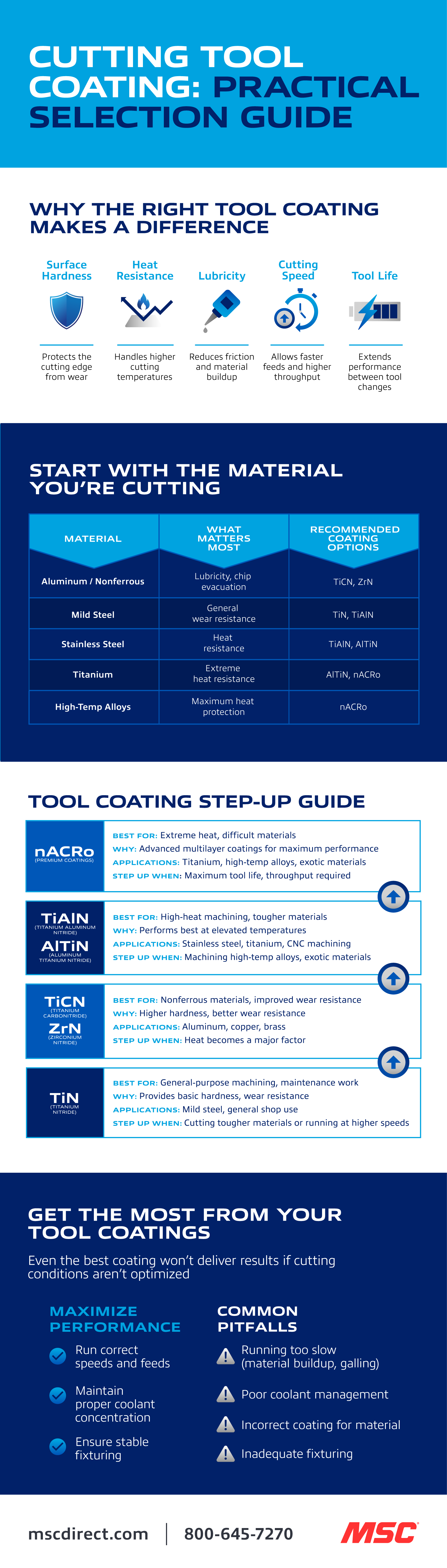
For general-purpose work, titanium nitride (TiN) coatings still serve as a reliable option. “TiN is a good, medium-duty coating for maintenance shops,” Turner says.
Nonferrous metals
As materials become more demanding, stepping up to higher-performance coatings can improve results. For nonferrous materials such as aluminum, titanium carbonitride (TiCN) and zirconium nitride (ZrN) coatings are commonly used to reduce friction and prevent buildup.
“If you don’t get the rpm up, that material will stick to the coating and the end mill. The result: You will gall it, and it will snap,” Turner says. “The object of the game there is to get that heat away as much as you can. With aluminum, not much heat is generated, but you need the lubricity.”
Stainless steel and titanium
For stainless steel, titanium and other higher-heat applications, coatings such as titanium aluminum nitride (TiAlN) and aluminum titanium nitride (AlTiN) often deliver stronger performance. “Both of these coatings love heat,” Turner explains. “They don’t start working until they get to about 1,200 degrees.”
Demanding jobs
For demanding applications involving high-temperature alloys, such as titanium and Hastelloy, premium coatings can help extend tool life further. “When you’re doing high-temp alloys, you’ve got another lily pad to jump to,” he says. “That would be the nACRo [nanocomposite] coating.”
Matching Coatings to Your Machining Parameters
Selecting the right coating is only part of the equation. Machining parameters also play a critical role in performance.
“The ultimate goal is to make sure that you’re getting the life expectancy out of the coating and you’re running the right parameters—speeds and feeds, depth of cut—so you will get exactly what you expect from the coatings,” Turner says.
When properly matched to materials and machining conditions, coatings can help shops strike the right balance between tool life and throughput, which improves productivity and controls costs.
Use this guide to compare tool coatings and match them to your material: