At many manufacturing facilities, abrasive selection is one of those decisions that runs on autopilot. The team reaches for the same discs and wheels they’ve always used, the jobs eventually get done, and the assumption is that there’s not much to optimize.
It’s that kind of mindset that can quietly drain capacity, increase labor costs and create avoidable scrap, says Dana Cass, an abrasive specialist with MSC Industrial Supply.
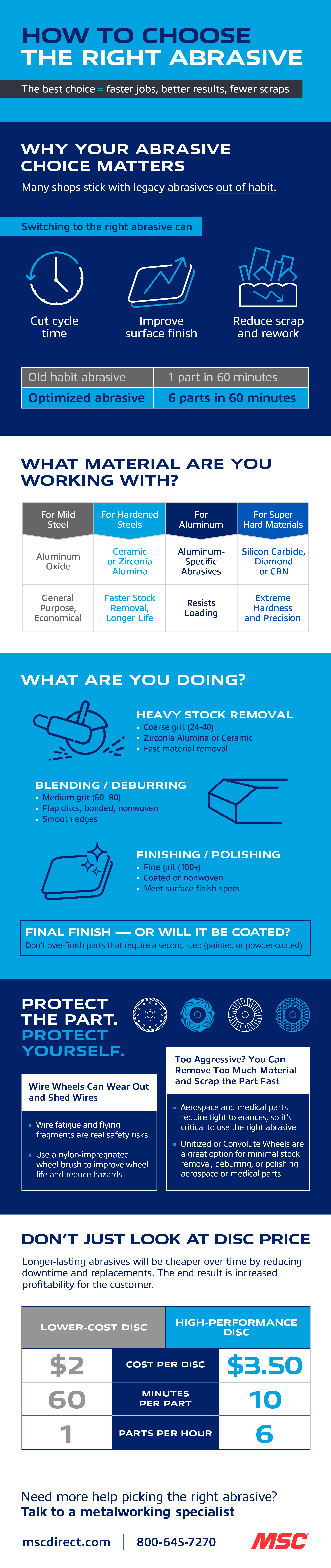
“For example, a lot of shops use aluminum oxide because it’s been around for a very long time and it’s what they’ve always used,” Cass says. “But they may not be aware that by using something like zirconia alumina or ceramic, they’d be able to get a much quicker and better finish than with what they’re currently using—which is more out of habit than anything else.”
“A lot of shops use aluminum oxide because it’s been around for a very long time and it’s what they’ve always used. But they may not be aware that by using something like zirconia alumina or ceramic, they’d be able to get a much quicker and better finish.”
Dana Cass,
Abrasive Specialist,
MSC Industrial Supply Co.
Cass says he’s often called in to troubleshoot when a shop is complaining about how long it takes to complete a grinding or finishing application. “Usually, what we end up finding is that they’re using an inferior product,” Cass says. “It will get the job done, but it will take significantly longer to get it done than if they used the right product to begin with.”
Price is another area where instincts can mislead. Buying the cheapest disc feels like good cost control—until you factor in labor and the number of parts going out the door.
“Let’s say you’ve got an operator working for $25 an hour and it takes him an hour to finish one part with a flap disc that costs $2,” Cass explains. “We can sell you a flap disc for $3.50, but now the worker can get one part done in just 10 minutes, which means you can get six times as many parts out the door for minimal additional cost.”
You also need to think about where finish really matters—and where it doesn’t. For example, over‑finishing parts that will be powder-coated or painted adds unnecessary labor that doesn’t add value. “You may be trying to achieve a really good finish on a product when you really don’t need to,” Cass says.
To learn more about choosing the right abrasive for the job, see the infographic below:
Check out MSC Industrial Supply’s Buying Guides for abrasives:
• Quick Change Discs: Maximize Efficiency with Every Turn
• Deburring and Grinding Wheel Types, Terminologies, and Materials
• Choosing Depressed Center Grinding Wheels
• Grinding and Cutoff Wheels Technical Information: Types and Selection
• Hand Deburring Buying Guide
• Metal Files: Your Complete Selection Guide
• Sandblasting Basics: Media, Equipment & Applications